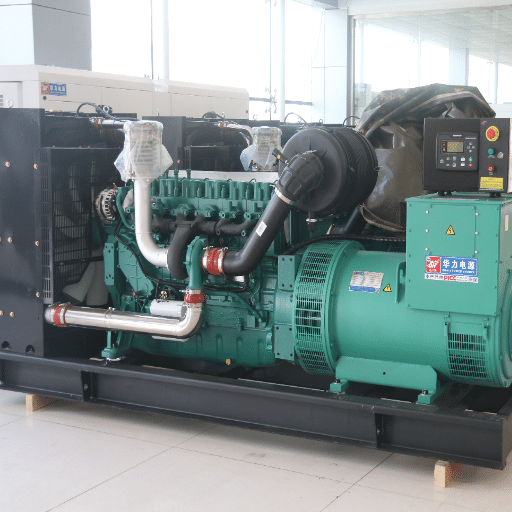


A diesel generator set turns only about a third of its fuel’s energy into electricity. The rest leaves as heat, and generator heat rejection is the calculation that sizes the radiator, the cooling fan, and the generator room. On a typical turbocharged set, the rejected heat is roughly 1.7 to 1.9 times the machine’s rated kW, not the modest figure most buyers assume.
Here’s the short version before the method. A genset rejects heat down three paths: about 20 to 25% of the fuel’s energy goes to the coolant and must be removed by the radiator, roughly 30% leaves up the exhaust, and the remaining small share radiates off the engine and alternator into the room. The figure that sizes your radiator is the coolant share, and on a real set it lands between 60 and 70% of the rated kW.
Our engineering team builds and load-tests sets from 20 kVA past 3,000 kVA at Shandong Huali, with Cummins, Perkins, Weichai, and Yuchai engines. This is the method we use when we size the système de refroidissement du générateur for a site, not a simplified textbook version.
Points clés à retenir
- A generator set rejects roughly 55 to 65% of its fuel’s energy as heat, down three paths: coolant to the radiator, exhaust to the stack, and radiation from the engine and alternator into the room.
- The number that sizes the radiator is the coolant share, usually about 60 to 70% of rated kW. A 200 kW set commonly rejects 120 to 140 kW through its radiator alone.
- The most accurate generator heat rejection calculation reads the figures from the manufacturer’s heat-balance data sheet, which lists heat to coolant, exhaust, and atmosphere separately.
- Without a sheet, estimate from fuel: multiply full-load burn in litres per hour by about 9.96 to get fuel power in kW, then take 20 to 25% of it as coolant heat.
- Room heat is the smallest load, but only when the radiator discharge and exhaust are ducted outside. Recirculated radiator air can more than double the room load.
What Is Generator Heat Rejection?

Generator heat rejection is the portion of fuel energy that a genset cannot convert into electrical power. A diesel engine burns fuel to release heat, converts part of it into shaft work, and must dispose of the rest. The alternator adds its own smaller losses on top.
Heat rejection is not equal to the machine’s kW rating, and it is not a small percentage of it. The common error is confusing “percent of fuel energy” with “percent of rated output.” If 23% of fuel energy goes to the coolant, that sounds small. It isn’t: the fuel itself carries about 2.7 times the rated output. The coolant heat therefore ends up near two-thirds of the rated kW, and a radiator sized for a quarter of the nameplate is undersized by more than half.
Three heat loads matter, and each sizes something different:
| Charge thermique | Où ça va | What it sizes |
|---|---|---|
| Heat to coolant (jacket water, plus oil and charge-air coolers where fitted) | Carried to the radiator | Radiator core and cooling fan |
| Heat to exhaust | Leaves through the pipe and silencer | Exhaust ducting and insulation |
| Heat to room (engine surface plus alternator losses) | Radiates and convects into the room | Room ventilation airflow |
The coolant load is what most people mean by heat rejection, and it’s the one this guide calculates in detail.
How Much Heat Does a Generator Reject? The Energy Balance
Every heat rejection calculation starts from the engine energy balance, the standard split of where a diesel engine’s fuel energy ends up at full load. For a modern turbocharged, charge-air-cooled genset, as a percentage of the fuel’s lower heating value:
| Chemin énergétique | Part de l'énergie combustible |
|---|---|
| Electrical power delivered | Environ 36 à 40 % |
| Gaz d'échappement | Environ 28 à 33 % |
| Coolant and oil cooling, to the radiator | Environ 20 à 25 % |
| Charge-air cooler, separate circuit on larger engines | Environ 7 à 10 % |
| Radiation, convection, friction, alternator losses | Environ 5 à 10 % |
The exact split is engine-specific and lives on the data sheet. Two rules of thumb fall out of this table and stop the worst sizing errors:
- Heat to the radiator is roughly 60 to 70% of the rated kW. On a 200 kW set that is about 120 to 140 kW.
- Total heat rejected is roughly 1.7 to 1.9 times the rated kW. On a 200 kW set, expect 340 to 380 kW to be managed across all three paths.
Two corrections apply. Engines with exhaust gas recirculation push more heat onto the cooling circuit, so high-EGR, high-boost engines sit at the top of these ranges. And the share rejected as heat rises at part load, so cooling must suit the worst real duty, not just full load.
That energy balance is what our engineers match on every build. Each diesel generator we produce ships with a radiator sized to the engine’s measured heat rejection, not a guess from the nameplate.
How to Calculate Generator Heat Rejection in Four Steps

Three methods arrive at the number, and each cross-checks the others.
Step 1: Read the manufacturer’s heat-balance data sheet. This is the accurate method and the right place to start. Genset data sheets publish a heat-rejection section that lists heat to jacket water, charge-air cooler, exhaust, and atmosphere, usually in kW or Btu per minute. Most makers publish these sheets openly, and Onsite Power Advisor maintains a directory of where each OEM releases its generator data. If you are specifying a set, ask the supplier for the sheet before you finalize the room, and read it alongside the spécifications de l'alternateur du générateur for the machine’s temperature rise.
Step 2: Estimate from fuel consumption when you only have the running set. Diesel’s lower heating value is about 9.96 kWh per litre, so multiply the full-load fuel burn in litres per hour by 9.96 to get fuel power in kW, then apply the energy balance:
Fuel power (kW) = fuel burn (L/h) x 9.96
Heat to coolant (kW) = fuel power x 0.20 to 0.25
As a check, a 500 kW set burning about 130 L/h at full load has a fuel power near 1,300 kW, so the coolant share is roughly 300 kW, about 60% of the rating. Use the fuel burn at the load you design for, because it falls as load falls.
Step 3: Estimate the room heat load from the small shares. Room heat comes from engine surface radiation and from alternator losses, typically 3 to 6% of rated output on a modern four-pole machine, rejected in its cooling air. With the radiator and exhaust ducted outside, the combined room load on a clean installation is often 5 to 15% of rated kW. The data sheet’s own “to atmosphere from engine and generator” lines are the reliable source.
Step 4: Convert the heat into airflow. The heat balance formula in the sizing section below turns the kW figure into fan and louvre sizes.
Generator Heat Rejection Calculation Worked Example: A 200 kW Genset

Numbers make the method real. A Caterpillar 250 kVA set, rated 200 ekW, lists its heat rejection at 100% load on its data sheet, published through Gainwell India, comme suit :
| Chemin thermique | Valeur publiée |
|---|---|
| Heat rejected to coolant | 129kW |
| Heat rejected to exhaust | 174kW |
| Heat to atmosphere from the engine | 40kW |
| Heat to atmosphere from the generator | 14.75kW |
| Flux d'air du radiateur | 376 m³/min (about 13,300 CFM) |
The waste paths total about 358 kW, and the fuel input implied by the 200 kW output reconciles to roughly 556 kW, so the figures are within a percent. Now read what each line means:
- Coolant heat of 129 kW is the radiator duty. At about 65% of the rating, it sits in the 60 to 70% band and explains the 376 m³/min radiator airflow.
- Exhaust heat of 174 kW mostly leaves through the stack. What reaches the room is surface radiation from an uninsulated exhaust run, a fraction of this figure.
- Engine and generator atmosphere heat of about 55 kW is the room ventilation load.
Turn that room load into airflow with the heat balance formula. In metric units:
Airflow (m³/s) = heat to room (kW) x 1000 / (air density x specific heat x temperature rise)
Airflow (m³/s) = heat (kW) x 1000 / (1.2 x 1.005 x ΔT)
With 55 kW and a 10 °C allowed rise, the airflow is about 4.5 m³/s, roughly 9,600 CFM. In imperial units the same answer falls out of CFM = Btu/hr / (1.08 x ΔT in °F), where 55 kW is about 188,000 Btu/hr. Add a 10 to 20% fan margin for filters and hot days. The same heat drives the generator room ventilation calculation when you move on to louvers and ducting.
Working from the wrong heat number is the fastest route to an overheated genset. If you are pricing a set for a hot room, send us the model and site conditions, and our engineering team will return the heat rejection and radiator sizing for the engine we match.
Scaling the Example to a 500 kW Genset
Scale the same ratios and the picture for a 500 kW prime set is clear. Expect fuel input near 1,350 to 1,400 kW, coolant heat near 320 to 350 kW, exhaust near 420 to 450 kW, and a room load of 130 to 140 kW with the radiator and exhaust ducted outside. That room load, at a 10 to 12 °C rise, needs about 9 to 11 m³/s of ventilation air, roughly 20,000 to 24,000 CFM.
These are illustrative figures scaled from the published example, not a Huali rating, so confirm them against the heat-balance sheet for your exact set. On a large aftercooled engine the charge-air cooler may sit on a separate low-temperature circuit whose heat must be added to the radiator duty, a configuration our générateur de radiateur à distance guide covers.
From Heat Rejection to Radiator and Ventilation Sizing

Sizing the Radiator
The radiator must reject the coolant heat at full rated load and at the design ambient temperature. Three rules keep the sizing honest:
- Size the whole coolant circuit. Where the oil cooler and a water-cooled aftercooler share the jacket-water loop, their heat adds to the radiator duty. Skipping the aftercooler is a common cause of a hot radiator on turbocharged sets.
- Add a margin. Engine manuals commonly call for roughly 10 to 15% above the maximum full-load heat rejection to allow for overload, coolant-side fouling, and blocked fins.
- Derate for site conditions. Radiator capacity falls as ambient temperature and altitude rise, by a few percent per 300 m of elevation. A temperate pack rated at 40 °C ambient is not the same radiator as a tropical pack rated at 50 °C, and the general derating math is in our spécifications du moteur du générateur guider.
Sizing the Room Ventilation
The room is the second half of the cooling system. Its air does two jobs: it supplies combustion air and it removes the room heat load, the “to atmosphere” figures from the data sheet. Apply the airflow formula above, keep the temperature rise modest (10 to 15 °C), and hold the room below about 40 to 45 °C so the engine breathes air it was rated for.
The number one mistake is not the formula, it’s the ducting. A unit-mounted radiator discharges the coolant heat, typically 60 to 70% of rated kW, as hot air. If that discharge recirculates in the room, the ventilation system must remove the radiator heat and the room heat, more than doubling the load. That’s why we duct the radiator discharge out of the room on every installation.
A hospital engineer in Riyadh learned this the expensive way. Her 200 kW standby set sat in a basement plant room, and the contractor’s radiator duct ended two metres from the intake louvre. On the first 46 °C summer test the room climbed past 50 °C and the set derated below its critical load rating. Re-routing the discharge to the far wall dropped the room to 39 °C and the set held full load. No bigger engine, no bigger radiator, just the heat sent where the calculation assumed it would go.
Common Generator Heat Rejection Mistakes
- Using the nameplate kW as the heat load. A 200 kW set rejects about 358 kW total, mostly through coolant and exhaust, and only a fraction into the room when ducted properly.
- Reading “percent of fuel energy” as “percent of output.” The 20 to 25% coolant share is a share of fuel energy, which is about 2.7 times the output.
- Forgetting the charge-air cooler. On a water-cooled aftercooler engine, its heat belongs in the radiator sizing.
- Ignoring the exhaust run. An uninsulated exhaust run inside the room adds a heat load no data sheet row names directly.
- Unités de mélange. Engine sheets quote heat in Btu per minute, genset sheets in kW, and airflow in CFM, m³/min, or litres per second. Convert everything to one system first.
- Sizing for full load only. A set that idles a lot rejects a higher share of its fuel as heat and needs cooling for its worst real duty.
Questions fréquemment posées
What is heat rejection in a generator?
Heat rejection is the fuel energy a genset cannot convert into electricity, roughly 55 to 65% of the fuel input at full load. It leaves through three paths: coolant to the radiator, exhaust gas, and radiation from the engine and alternator into the room. Each path sizes a different part of the installation.
How do you calculate generator heat rejection?
Read the heat-rejection section of the manufacturer’s data sheet, which lists heat to coolant, exhaust, and atmosphere. Without a sheet, multiply the full-load fuel burn in litres per hour by about 9.96 to get fuel power in kW, then take 20 to 25% as coolant heat and about 30% as exhaust heat.
How much heat does a 200 kW generator reject?
A 200 kW genset typically rejects roughly 340 to 380 kW of heat in total: about 120 to 140 kW to the coolant through the radiator, roughly 170 kW up the exhaust, and about 50 to 60 kW into the room from the engine and alternator when the radiator and exhaust are ducted outside.
Why is heat rejection not the same as generator kW?
A diesel engine is only about 36 to 40% efficient, so the fuel it burns carries about 2.7 times the electrical output. The coolant’s share of that fuel energy is 20 to 25%, and 20 to 25% of 2.7 times the output is about 60 to 70% of the rated kW, not a quarter of it.
Do I need to duct the radiator discharge of my generator?
Yes, on any indoor installation. The radiator discharges the coolant heat as hot air, and if that air recirculates into the room or back into the radiator intake it can more than double the room heat load and derate the set. Duct the discharge outside and keep the intake clear.
How much ventilation air does a generator room need?
Work from the room heat load on the data sheet, usually the “to atmosphere” figures from the engine and generator, and divide by the heat balance formula: airflow in m³/s equals the heat in kW times 1000, divided by 1.2, 1.005, and the allowed rise in °C. A 200 kW set commonly needs about 4 to 5 m³/s with the radiator ducted outside.
Conclusion
Generator heat rejection calculation comes down to one idea: a genset rejects far more heat than its nameplate suggests, and the figure that sizes the radiator is the coolant share, usually 60 to 70% of rated kW. The rest leaves up the exhaust or radiates into the room, and only the room share, a tenth or less when the ducting is right, drives your ventilation fans.
Do the calculation from the data sheet first, cross-check it against fuel consumption, then convert the coolant heat into radiator size and the room heat into airflow. Duct the radiator discharge and the exhaust outside, keep the temperature rise modest, and add a margin for fouling and hot days. Get those steps right and the cooling system becomes the quiet, reliable part of the installation it’s meant to be.
When you specify a genset and want the heat-rejection figures before you size the room, that is exactly the data we include with every quotation. Send us your power requirement, engine preference, and site conditions, and our engineers will return the heat balance and the radiator configuration with the rest of the specification.