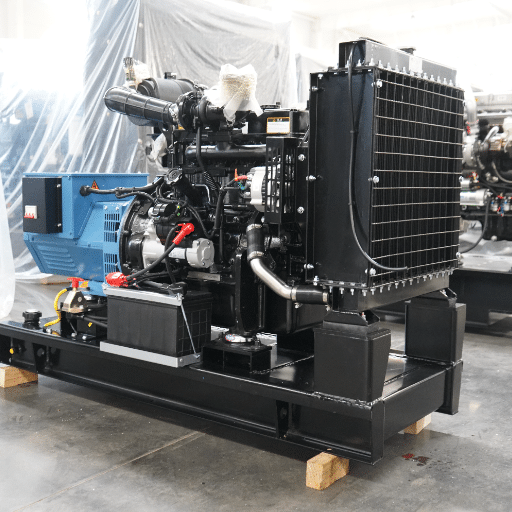



A custom diesel generator is a generator set carefully engineered to fulfill a buyer’s specific load, environmental, and compliance requirements, rather than simply being cherry picked from a standard catalog. An assortment of engine and alternator brands, ratings, design options, and enclosures and skids are all possibilities for custom-built gensets. Typically, a custom build will cost anywhere from 8% to 25% more than the closest standard unit and will add 4 to 8 weeks to the delivery lead time. For sites that cannot fit within catalog kilowatt tiers, ambient ranges, or emissions spots, the premium is the only way to get a unit that will run reliably for 20 years.
This guide walks buyers, engineers, and OEM resellers through what can actually be customized on a generator set, how the manufacturing workflow runs from quote to commissioning, what custom costs, and how to evaluate a customized genset manufacturer. The perspective comes from our engineering team at Shandong Huali Electromechanical, where we build custom and OEM diesel gensets between 30kW and 3,000kW for industrial, telecom, healthcare, and data center buyers worldwide.
Key Takeaways
- A custom diesel generator addresses load, site, certification, or branding requirements that standard catalog units cannot meet within their published tolerances.
- The realistic cost premium for a fully engineered custom build is 8 to 25 percent over the nearest standard unit, with lead times of 8 to 14 weeks for a typical project.
- Customization happens at two levels: accessory-level (enclosure, fuel tank, control upgrades) and engineered-level (voltage, frequency, paralleling, derating for altitude or ambient).
- OEM and ODM are different service models. OEM means private-label of a manufacturer’s design; ODM means the manufacturer engineers the design specifically for the buyer.
- Established Chinese factories typically accept a minimum order quantity of 1 unit for prototype builds, with bulk pricing at 5 to 10 units. Always request Factory Acceptance Test (FAT) data including load bank results.
What Is a Custom Diesel Generator?

A custom diesel generator is any generator set that deviates from a manufacturer’s standard catalog configuration. The deviation can be small, such as a non-standard fuel tank capacity, or extensive, such as a 600V, 60Hz medium-voltage unit with parallel synchronization and an SCR aftertreatment module.
In practice, customization runs along three vectors.
The first vector is component selection. The buyer specifies a particular engine brand and model (Cummins, Perkins, Volvo, Yuchai, Weichai, MTU, or Shangchai), an alternator brand (Stamford, Leroy Somer, Mecc Alte, or Marathon), and a control panel (Deep Sea Electronics, ComAp, Smartgen, or Woodward).
The second vector is configuration. Voltage and frequency change by country (400V/50Hz in most of Europe and Asia, 480V/60Hz in North America, 415V/50Hz in Africa, 380V/60Hz in parts of Central and South America). Paralleling, automatic transfer switching, and bus synchronization add complexity. So does derating for altitude or high ambient temperature.
The third vector is enclosure and chassis. Open frame, sound-attenuated canopy, super-silent enclosure, 20-foot or 40-foot ISO container, trailer-mounted, or weatherproof outdoor cabinet are all common choices. Each has different acoustic, ingress, and serviceability characteristics.
Custom vs. Standard Genset
| Factor | Standard Genset | Custom Diesel Generator |
|---|---|---|
| Lead time | 2 to 4 weeks (in stock or short-cycle) | 8 to 14 weeks (engineered build) |
| Cost premium | Baseline | +8 to 25 percent |
| Engineering review | None (off-the-shelf spec sheet) | Single-line diagram, GA drawing, load study |
| Component choice | Manufacturer default | Buyer-specified within manufacturer authorizations |
| Documentation | Standard manual | Project documentation pack |
| Test scope | Factory production test | Full FAT with named test protocol |
| Best for | Off-the-shelf load match | Edge-case load, site, or compliance profile |
The Two Tiers of Customization
Industry guidance from General Power and MacAllister Power Systems splits customization into two tiers, and the distinction matters for warranty and liability.
Tier 1: Accessory-level customization. Authorized distributors can add or modify accessories without affecting OEM warranty. Examples include sub-base fuel tanks, weatherproof enclosures, remote monitoring modules, and load banks. The original genset retains its design certification.
Tier 2: Engineered-level customization. Only the original manufacturer (or an authorized OEM partner) can change engine displacement, alternator winding, voltage class, or control architecture without voiding warranty and certification. At our Shandong factory, this is the work we do as the manufacturer of record, with engineering review at every change point.
ODM vs. OEM: Which Service Model Fits You
| Service Model | Who Engineers the Unit | Who Owns the Design | Who Brands It | Buyer Type |
|---|---|---|---|---|
| OEM (Private Label) | Manufacturer (standard design) | Manufacturer | Buyer’s brand on nameplate and paint | Distributor or reseller adding to existing portfolio |
| ODM (Original Design Manufacturer) | Manufacturer engineers to buyer specification | Manufacturer (or shared) | Buyer’s brand | Brand or distributor needing a unique configuration |
| End-User Custom | Manufacturer engineers to project specification | Manufacturer | Manufacturer’s brand | Industrial buyer with a specific project |
A distributor in Spain selling under their own brand uses an OEM relationship. A telecom integrator who needs a 50kW unit hardened for 45 degrees Celsius ambient and high-sulfur fuel uses ODM. A hospital procurement team buying one 800kW unit for a single building uses end-user custom.
When Off-the-Shelf Stops Working: Six Triggers for Going Custom

Standard gensets work well when the load, site, and regulatory profile sit inside the manufacturer’s published envelope. Six conditions push a project outside that envelope.
1. Power gap. Standard catalogs jump in steps (50, 75, 100, 125, 150, 200, 250kW). A 175kW continuous load forces buyers to oversize (and risk wet stacking) or undersize (and risk overload). A custom build delivers the exact rating.
2. Site constraints. High altitude, high ambient temperature, dusty air, salt spray, and footprint limits all force changes to radiator sizing, intake filtration, paint, and chassis layout.
3. Regulatory profile. EPA Tier 4 Final, EU Stage V, IMO MARPOL Annex VI marine emissions, and NFPA 110 Level 1 emergency standby compliance each require specific engine, aftertreatment, and control choices. A standard unit may meet one standard but not another.
4. Application-specific needs. Medical isolation transformers, telecom 48 VDC battery rooms, marine vibration ratings, and data center step-load profiles each have specifications that catalog products do not address.
5. Branding and private-label resale. Distributors and integrators selling under their own brand need a manufacturer willing to support OEM nameplates, custom paint, and dedicated documentation.
6. Integration with existing infrastructure. Adding a second genset in parallel with an installed unit requires matched governor and AVR response, synchronization scheme, and bus-tie logic. A custom build matches the existing system.
If your project hits one of these triggers, the next question is what to specify. Want to see how we structure custom builds for projects like yours? Talk to our engineering team for an initial scoping review.
What Can Actually Be Customized on a Genset?
The list below covers the customization choices we make most often on projects between 30kW and 3,000kW. Each choice has a cost, lead-time, and reliability implication.
Engine Selection
Engine brand is the single largest cost and reliability driver. We integrate Cummins, Perkins, Volvo, Yuchai, Weichai, Shangchai, MTU, and Baudouin. The choice depends on local parts availability, fuel quality, ambient profile, and price target.
For a buyer in Indonesia building a hospital, Cummins is the lowest-risk specification because the Jakarta dealer network is strong. For a buyer in Western Africa with bulk fuel-quality risk, Yuchai or Weichai with extra fuel filtration is often the better cost-performance match.
Alternator
Stamford and Leroy Somer dominate the premium tier. Mecc Alte and Marathon hold the mid tier. The choice affects voltage regulation, harmonic distortion, and parallel performance. For sensitive loads (medical imaging, telecom RF rooms, data center IT) we default to Stamford.
Control System
The controllers most frequently installed by us are, Deep Sea Electronics (DSE 7320 or DSE 8610), ComAp (InteliLite or InteliGen), and Smartgen. Selector on the basis of need for paralleling, compatibility with BMS or SCADA, and training of operators.
Enclosure
Six widely encountered configurations are the exposed-frame (industrial site, low cost), the sound-attenuated canopy (around 75 to 78 dBA at 7 meters), the super-silent enclosure (around 65 to 68 dBA at 7 meters), the acoustic container in 20- or 40-foot ISO (modular solution, transport-ready), trailer-mounted for mobile applications, and weatherproof outdoor cabinet (rooftop or compact site).
Fuel System
Standard base-frame tanks hold 6 to 8 hours of fuel at prime load. Extended tanks deliver 24 to 72 hours. Dual-wall tanks address spill containment. Day tank plus bulk tank configurations are common at hospitals and data centers. Fuel polishing systems remove water and particulate from long-storage diesel.
Cooling System
Standard radiators handle ambients up to 40 degrees Celsius. High-ambient radiator packs extend to 50 degrees Celsius. Remote radiators move heat rejection off the genset (useful for indoor installations). Heat exchangers serve marine and combined-heat-and-power applications.
Voltage and Frequency
Low-voltage (LV) range covers 220V to 480V at 50Hz or 60Hz. Medium-voltage (MV) range covers 3.3kV, 6.6kV, 10.5kV, and 11kV. MV builds add a step-up transformer or use a winding directly at MV. They suit utility, mining, and large industrial sites.
Monitoring
Remote monitoring options run from a simple Modbus serial connection to cellular 4G gateways, cloud dashboards (Cummins PowerCommand Cloud, ComAp WebSupervisor), and SNMP integration for IT operations centers.
Paint, Markings, and Private-Label Branding
For OEM clients we paint to RAL color codes, apply custom nameplates, etch buyer logos on canopy doors, and produce documentation under the buyer’s brand. Country-of-origin markings comply with destination customs rules.
The 7-Stage Custom Genset Manufacturing Workflow

A well-run custom build moves through seven stages. The total typical lead time from RFQ to shipment runs 8 to 14 weeks, depending on kW rating and component sourcing.
| Stage | Activity | Typical Duration | Deliverables |
|---|---|---|---|
| 1 | Requirements gathering and RFQ | 3 to 5 days | Load list, site survey, technical questionnaire |
| 2 | Engineering review and FEED | 5 to 10 days | Single-line diagram, derating calc, preliminary GA |
| 3 | Quote and contract | 3 to 5 days | Priced proposal, scope of supply, payment schedule |
| 4 | Detailed design and approval drawings | 10 to 15 days | Approved-for-construction GA, wiring diagrams, BOM |
| 5 | Production | 30 to 60 days | Assembled genset, paint, controls integration |
| 6 | Factory Acceptance Test (FAT) | 3 to 5 days | Load bank protocol, FAT report, witness sign-off |
| 7 | Packing, shipping, and commissioning | Varies by Incoterms | Crating, shipping documents, optional commissioning |
The two stages buyers most often underestimate are stage 2 (engineering review) and stage 6 (FAT). Skipping engineering review leads to expensive rework after production starts. Skipping a witnessed FAT means buyers accept the unit on paper without seeing it run.
For our customized genset manufacturing, we publish a stage-by-stage schedule with the quote. Buyers know exactly what to expect at each milestone.
Mini Case: A Hospital in Indonesia
When the procurement director at a 200-bed surgical hospital in Jakarta sent us an RFQ in 2025, the standard 750kW Cummins genset on his short list missed three of his requirements. His connected emergency load was 820kW (above the standard rating). The site demanded a 30-second cold-start to support operating-room isolation transformers. And the project needed NFPA 110 Level 1 compliance for American Hospital Association accreditation.
We built him an 800kW Cummins QSK19 unit with a Stamford alternator, a DSE 8610 controller, a custom 12-hour bulk fuel day-tank skid, and a slave-unit interface for a future second genset. The FAT included a 4-hour load bank test at 100 percent and a 30-second cold-start verification at site ambient (32 degrees Celsius). The unit shipped 11 weeks after PO. The hospital passed AHA accreditation on its first inspection.
The cost premium over the nearest standard unit was 14 percent. The hospital director told us the alternative (a parallel pair of smaller standard units) would have added 60 square meters of plant room footprint and 22 percent to the capital cost. Custom paid for itself before commissioning.
Cost: How Much Does a Custom Diesel Generator Cost?
A custom diesel generator costs more than a standard catalog unit. The difference comes from engineering hours, sourcing non-default components, certification, and a more thorough test protocol. The typical premium ranges from 8 to 25 percent.
What Drives the Custom Price Premium
| Cost Driver | Typical Premium Contribution |
|---|---|
| Engineering review and design (single-line, GA, derating) | 2 to 4 percent |
| Non-standard component sourcing (premium engine or alternator) | 3 to 10 percent |
| Custom enclosure or chassis | 2 to 6 percent |
| Certification (Tier 4, EU Stage V, IMO, UL) | 1 to 5 percent |
| Extended Factory Acceptance Test | 0.5 to 2 percent |
Indicative Pricing by kW Tier
These are factory-direct (EXW) ranges for custom builds in 2026. Final prices depend on engine brand, alternator, enclosure, voltage, and certification scope.
| Power Rating | Standard Genset (USD) | Custom Genset (USD) | Typical Premium |
|---|---|---|---|
| 50 kW | 6,500to6,500to9,500 | 7,500to7,500to12,000 | 10 to 18 percent |
| 250 kW | 22,000to22,000to32,000 | 26,000to26,000to40,000 | 12 to 20 percent |
| 500 kW | 48,000to48,000to68,000 | 55,000to55,000to82,000 | 12 to 22 percent |
| 1,000 kW | 110,000to110,000to160,000 | 125,000to125,000to200,000 | 13 to 25 percent |
| 2,000 kW | 260,000to260,000to360,000 | 300,000to300,000to450,000 | 15 to 25 percent |
Total Cost of Ownership
Repaying the customer premium could be done by any one of three channels: saving topping (smaller unit, fewer fuel loses), minimizing downtime (right-sized unit, fewer trips), or eliminating rework (no field retrofits for standard units). Often, over a 20-year operative life, the operating cost difference can exceed the capital premium grossly.
For a closer look at lifecycle cost, see our companion guide on the diesel generator maintenance checklist, which covers the maintenance cost side of total ownership.
Compliance and Certification: What Custom Buyers Should Specify

Compliance is one of the most common reasons projects go custom. Buyers need to specify, in the RFQ, exactly which standards the unit must meet.
ISO 8528-5
The international standard for reciprocating engine driven generating sets. Defines four duty ratings: ESP (Emergency Standby), PRP (Prime), LTP (Limited Time Prime), and COP (Continuous Operating Power). Each rating allows a different number of run hours per year and load factor. Specify the rating that matches the application. The full standard is available at the ISO standards catalog.
EPA Tier 4 Final
Required for new diesel engines sold in the United States above 19kW. Achieved through cooled exhaust gas recirculation (EGR), diesel particulate filter (DPF), and selective catalytic reduction (SCR) with diesel exhaust fluid (DEF). Reference the EPA nonroad diesel regulations for full requirements.
EU Stage V
Required for new engines sold in the European Union. Stricter particulate number limits than Tier 4 Final. Driven by Regulation (EU) 2016/1628.
NFPA 110
Standard for Emergency and Standby Power Systems in the United States. Level 1 systems (life-safety applications such as hospitals) must start and accept full load within 10 seconds. Reference the NFPA 110 standard page for full requirements.
Regional Certifications
- CE (European Conformity) for the European Union
- UL 2200 for stationary engine generator assemblies in North America
- CSA for Canada
- INMETRO for Brazil
- GOST for Russia and CIS markets
IMO MARPOL Annex VI
Required for marine engines. Tier II and Tier III nitrogen oxide limits apply to vessels operating in Emission Control Areas.
OEM and Private Label: Buying Custom Gensets for Resale
Distributors, integrators, and brand-building resellers buy custom gensets to sell under their own brand. The mechanics are different from end-user custom.
White Label vs. Private Label
White label typically means a standard unit sold under the reseller’s brand with minor cosmetic changes. Private label is fuller: the reseller’s brand appears on the nameplate, in the operator manual, on the control panel display, and in marketing collateral. Engineering may or may not change.
Branding Rights and IP
A clear OEM contract covers nameplate branding, paint and color codes, manual rebranding, control-panel logo screens, country-of-origin marking, intellectual property ownership of any custom engineering, and dealer territory exclusivity. Most established Chinese factories accept exclusivity by region for committed volumes.
MOQ and Prototype Policy
Realistic minimum order quantities:
- Single unit prototype: Accepted by most established factories. Often a one-time engineering charge applies, sometimes credited against future orders.
- Bulk pricing: Typically begins at 5 to 10 units of a common configuration.
- Dedicated production run: 20-plus units of an identical configuration triggers the best per-unit cost.
Compliance Liability
In OEM and private-label arrangements, the brand owner usually carries product liability in the destination market. The factory carries manufacturing-defect warranty. Make sure the contract is explicit on which party owns CE, UL, EPA, or other destination-market certifications.
Mini Case: A Telecom Tower Fleet in West Africa
A pan-African mobile operator headquartered in Lagos approached us in 2024 with a fleet requirement: 30 identical 50kW gensets for remote cell towers across northern Nigeria. The standard product on their existing fleet had failed for three reasons.
First, ambient temperatures at the tower sites hit 45 degrees Celsius. The standard radiator derated the engine output by 12 percent at peak summer. Second, the local diesel supply chain produced fuel with high sulfur and frequent water contamination. Standard fuel filters clogged within 200 operating hours. Third, theft was a chronic problem (operators were losing units monthly).
We engineered a 50kW Yuchai unit with a high-ambient radiator pack, a dual-element fuel-water separator and CIM (continuous in-line monitoring) filter, a steel canopy with tamper alarms, a GPS module with remote shutdown, and a sealed dry-fuel-add port. The fleet shipped in three batches over 4 months. Eighteen months later, the operator reported a 78 percent reduction in unscheduled maintenance visits and zero theft losses on the deployed units.
The custom premium on the fleet was 19 percent over their previous standard product. Their per-tower maintenance cost dropped by 41 percent. Payback on the premium was 9 months.
How to Evaluate a Custom Genset Manufacturer

Not every supplier that lists “custom” in their catalog actually does engineered custom work. Use this checklist when you screen a manufacturer.
| Evaluation Criterion | What to Ask | What Good Looks Like |
|---|---|---|
| Engineering team size and credentials | How many engineers, what disciplines, what software (AutoCAD, ETAP, Solidworks)? | 20-plus engineers across mechanical, electrical, and controls disciplines |
| Factory size and annual capacity | What is the factory footprint? What is annual genset output? | 30,000-plus m² factory; 3,000-plus units per year |
| Engine brand authorizations | Which engine brands have formal authorization? | At least one premium brand (Cummins, Perkins, Volvo, MTU) plus regional brands |
| Test facility | What is the maximum load bank kW? Is there an environmental chamber? | Load bank capacity equal to maximum unit rating; sound testing room |
| Quality system certifications | ISO 9001, ISO 14001, ISO 45001 dates? Audited by whom? | All three current, audited by a third party (SGS, BV, TUV) |
| Export experience and references | How many countries served? Can the supplier name three reference projects in your region? | Documented projects in 30-plus countries with named references |
| After-sales parts policy | How long are spare parts guaranteed for a custom build? | 10-plus year parts commitment in writing |
| Lead time honesty | Will the supplier publish a stage-by-stage schedule before contract? | Yes, with named deliverables at each stage |
At Shandong Huali, we publish all of the above in writing before contract signing. If a competing supplier resists publishing specifics, that resistance tells you what you need to know.
To compare our scope of supply against your project requirements, request a custom genset RFQ and we will return a stage-by-stage proposal within five business days.
Mini Case: A Data Center in Germany
A Frankfurt colocation operator specified two parallel 1,500kW gensets for an N+1 critical-power scheme in late 2025. The requirements were tight: EU Stage V emissions compliance, a 65 dBA at 7 meters noise limit, single-line diagram integration with the operator’s existing UPS bus, and a FAT that mirrored their actual IT room step-load profile.
We engineered two Perkins 4012-46TWG3 units rated 1,500kW prime, each with a Stamford alternator, a ComAp InteliGen NTC controller, an SCR aftertreatment skid for Stage V compliance, and a triple-attenuation enclosure to hit the 65 dBA target. The FAT protocol included a 4-hour 100-percent load bank test, a step-load test mirroring the colocation operator’s measured IT load curve, a synchronization and load-share test between the two units, and witness sign-off by the operator’s chief engineer.
Both units shipped 13 weeks after PO and commissioned 3 weeks later. The first 12 months of operation logged 47 starts with zero failed transfers. The colocation operator has since ordered a third matched unit for an N+2 expansion.
Frequently Asked Questions
How long does a custom diesel generator take to build?
A typical custom diesel generator takes 8 to 14 weeks from purchase order to shipment. Smaller units (under 200kW) at the fast end of that range; larger MV units (1,000kW and above) at the slow end. The full breakdown is the 7-stage workflow in this guide.
What is the minimum order quantity for a customized genset?
Most established Chinese factories accept a single-unit prototype order. Bulk pricing usually starts at 5 to 10 units of a common configuration. Dedicated production runs of 20-plus identical units trigger the best per-unit cost.
Can I order a single unit with a custom configuration?
Yes. At our Shandong factory we build single-unit custom orders regularly, including one-off engineered configurations for hospitals, data centers, and specialty industrial buyers. Engineering charges may apply on the first unit, often credited against repeat orders.
What is the difference between “custom” and “customized”?
In industry usage the terms are interchangeable. Both describe a generator set engineered or configured to a specific buyer requirement. “Custom diesel generator” and “customized genset” return the same product family.
Are custom gensets covered by manufacturer warranty?
Yes, when built by the original manufacturer or an authorized OEM partner. Our standard warranty for custom builds is 12 months from commissioning or 18 months from shipment, whichever expires first. Extended warranty programs to 36 months are available.
How much more does custom cost compared to standard?
The realistic range is 8 to 25 percent over the nearest comparable standard unit. The premium depends on engineering scope, component choice, enclosure, certification, and FAT protocol. See the cost table in this guide for indicative ranges by kW tier.
Can I private-label a generator from a Chinese factory for resale?
Yes. Private-label OEM programs are common. Make sure the contract covers nameplate branding, paint, manual rebranding, control-panel logo, country-of-origin marking, IP ownership, and dealer territory. Plan on a 5- to 10-unit MOQ for branded units once a prototype is approved.
What documentation should a custom genset include?
A complete documentation pack includes the operator manual, electrical schematics, GA drawings, single-line diagram, parts catalog, ISO 8528-5 rating sheet, factory test report, FAT certificate, certificate of origin, packing list, and CE or destination-market declaration of conformity.
Can custom gensets be paralleled with existing units?
Yes, if the new unit is engineered to match the governor and AVR response characteristics of the installed unit. Specify the existing unit make, model, controller, and load curve in the RFQ. We will engineer the new unit to synchronize cleanly on the existing bus.
What happens if the spec changes mid-build?
A change order is processed. Engineering reviews the new requirement, prices the delta, and adjusts the schedule. Changes during stage 4 (detailed design) cost less and add less time than changes during stage 5 (production). Lock the spec at stage 3 sign-off where possible.
Conclusion: Custom Gensets Are an Engineering Conversation
A custom diesel generator is not a catalog product with extra paint. It is an engineering conversation between a buyer who has a real load, site, and compliance requirement, and a manufacturer with the engineering team, factory capacity, and test infrastructure to deliver against that requirement. The premium of 8 to 25 percent buys precision in three places: a unit sized to the actual load, components matched to the operating environment, and compliance documented against the destination market’s standards.
At Shandong Huali, we treat every custom RFQ as a project, not a transaction. The 7-stage workflow, the stage-by-stage schedule, the published evaluation criteria, and the case studies in this guide are how we keep the conversation specific and the build predictable. If your project sits outside catalog tolerances on load, site, certification, or branding, send our engineering team an RFQ and we will return a stage-by-stage proposal within five business days. For broader context on our diesel generator product line and capability, see our industrial diesel generator guide or learn more about Shandong Huali.