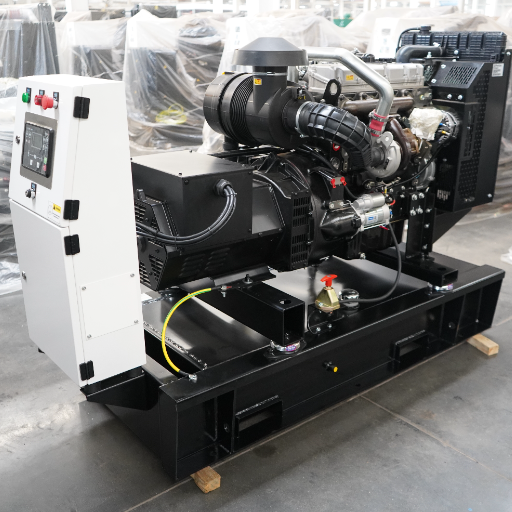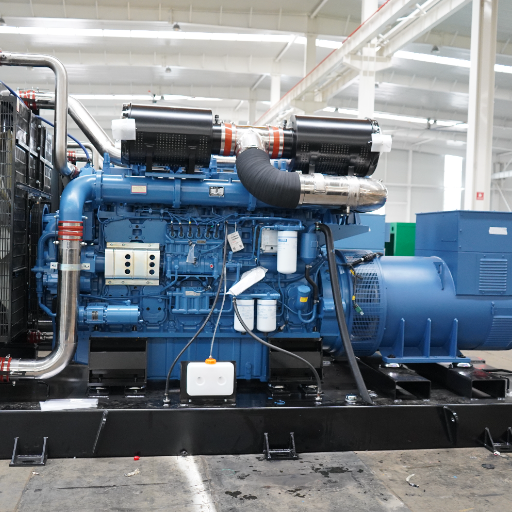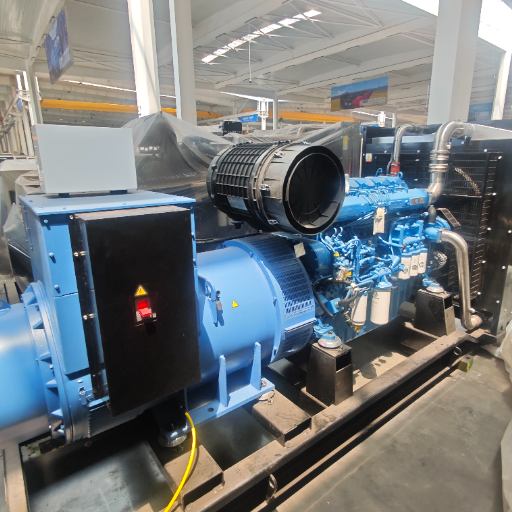

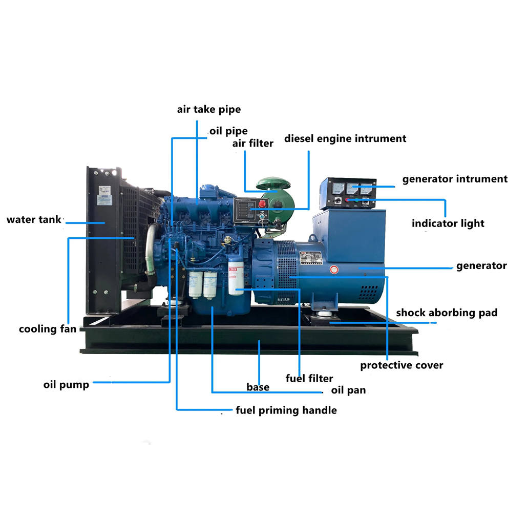
Generator parts fall into five assemblies: the engine, the alternator, the control and protection system, the fuel and starting system, and the enclosure and base. That list is the easy part, and every guide on the internet has it.
What most guides leave out is which of those parts break. When the US Nuclear Regulatory Commission analysed a database of diesel generator failures, it found that instrument and control systems accounted for 25% of them, and that the governor alone was the single most failure-prone component. The lubrication system, which receives the most maintenance attention on most sites, accounted for 7%.
That gap is what this article is about. It is written from a manufacturer’s side of the parts counter, and it treats a generator part as something you have to buy, store, identify and replace, not just something on a diagram.
Key Takeaways
– Instrument and control failures account for 25% of diesel generator failures, and the governor alone for 10%.
– The lubrication system accounts for 7%, which is less than the attention it usually receives.
– Alternator bearing life is quoted between 10,000 and 30,000 hours by different manufacturers for the same class of machine.
– The governor’s share of failures rises from 10% of all failures to 12% of aging-related ones, so it gets worse with time rather than better.
– The three parts that decide your outage calendar are the injection pump, the controller and the AVR, because those are the ones with the longest lead times.
What Counts as a Generator Part
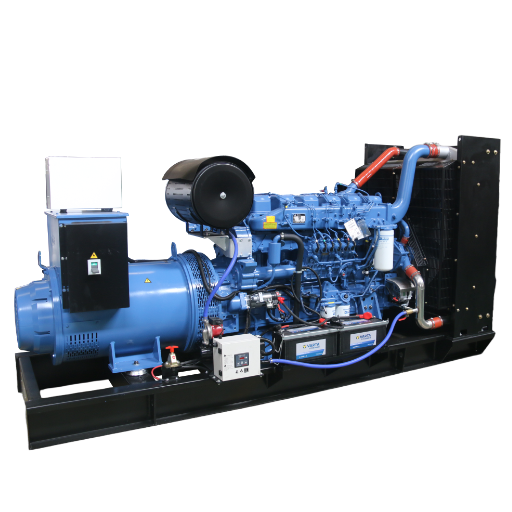
A generator part is any replaceable element of a generator set: a component such as the alternator, a part inside it such as the automatic voltage regulator, or a consumable such as an oil filter. The three are quoted differently, stocked differently and replaced on entirely different schedules, and buyers who treat them as one category get quoted the wrong thing.
The distinction matters because it changes the question you ask a supplier. For a consumable, you ask for an interval and a price. For a part, you ask for a part number and a supersession. For a component, you ask for a lead time and a warranty.
A generator set, usually shortened to genset, is a diesel engine coupled to an alternator, mounted on a base and controlled by a panel. Everything else is support: fuel, cooling, exhaust, starting and enclosure. When somebody says they need generator parts, they usually mean one of the first two categories, and they often mean a consumable while saying it.
Bought a set that came without a parts list? Send the nameplate photograph and the serial number, and our engineers will tell you which assembly each item belongs to and what the usual replacement interval is. Talk to our engineers
The Five Assemblies of a Diesel Genset
Each assembly below carries a paragraph on what fails inside it, because that is the part of the anatomy that has consequences. Sizes range from 8 kVA to 4000 kVA across the industry, but the assembly structure is the same at every rating.
The engine
The engine is the largest single block of generator parts: block, crankshaft, pistons, liners, cylinder head, camshaft, fuel injection, turbocharger, governor and the lubrication circuit. It converts fuel into rotation.
Two things inside it deserve separate mention. The fuel injection system runs at pressures up to 2,000 bar on modern common-rail engines, and its injectors and pumps are precision items that no site can repair. The governor controls engine speed and therefore frequency, and the failure data puts it at the top of the list. More on that in the next section.
Specification note: an engine model number tells you the family, not the build. Two engines with the same model designation can carry different injectors, different turbochargers and different governor types. Always order against the engine serial number, not the model.
The alternator
The alternator converts rotation into electricity. Inside it are the stator winding, the rotor, the exciter, the automatic voltage regulator (AVR), the rotating diode bridge and two bearings. The alternator is where the voltage quality comes from, and its parts fail in a different way from engine parts: slowly, and often without any mechanical noise until very late.
Bearings are the exception. They announce themselves, first as a rumble and then as vibration, and they are the alternator part most often replaced on a schedule rather than on failure.
The AVR is the other one, and it usually fails because a capacitor inside it has aged, not because anything wore out. If the voltage starts wandering on a set that has run for eight or nine years, suspect the regulator before you suspect the winding.
The control and protection system
The controller, the sensors, the relays, the breaker and the wiring that connects them. This is the assembly that the failure data says matters most, and it is the one most often treated as a black box.
A modern controller such as those from Deep Sea, ComAp or SmartGen handles start and stop logic, protection, metering and communication. When it fails, the engine may be perfect and the set still won’t start. Sensors fail more quietly: a coolant temperature sensor that drifts won’t stop the engine, it will just stop the protection from working when the engine actually overheats.
Protection relays sit alongside the controller. A relay that has never been tested is an assumption rather than a setting, which is why a protection relay settings study is worth nothing without secondary injection to prove the relay still operates at those values.
The fuel and starting system
Fuel tank, day tank, lift pump, filters, injection pump, injectors, pipework and valves on one side; batteries, starter motor, charging alternator and battery charger on the other. They are grouped here because they share a property: they are the parts that stop a healthy engine from starting.
Fuel system failures account for 11% of the total in the failure data, and the starting system for another 10%. In practice most of those are not dramatic. A clogged filter, a flat battery or a stuck starting solenoid will each take a set offline just as effectively as a seized bearing.
The enclosure, base and exhaust
The base frame, anti-vibration mounts, canopy, silencer, and the flexible bellows between engine and exhaust. Failure here is rare and expensive when it happens, usually because a mount has perished or a bellows has cracked and is now transmitting vibration into the building.
This assembly is also where the site’s own choices live. A canopy that was specified for 75 dB(A) at 7 m will not achieve it once the exhaust has been re-routed around a wall, and no amount of maintenance will fix a specification error.
For a wider view of how the electrical side of the installation fits together, the generator switchgear between the set and the board is the next thing to understand after the set itself.
Which Generator Parts Actually Fail
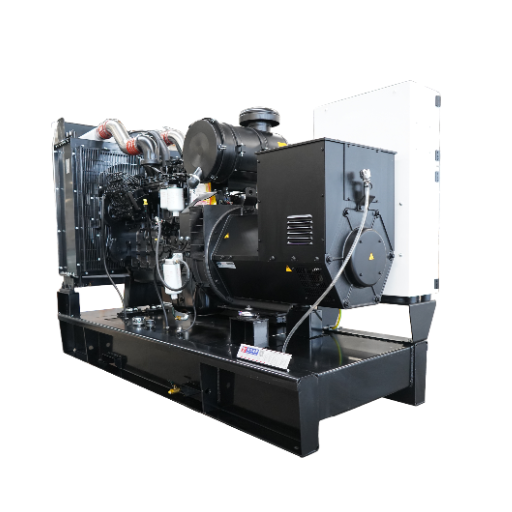
This is the section the other guides don’t have, and it comes from a public source that has been sitting there since 1989.
The US Nuclear Regulatory Commission sponsored a study of diesel generator aging at Pacific Northwest Laboratory. The report, NUREG/CR-5057, analysed a failure database and published the breakdown by subsystem and by component. The numbers below are read directly from its tables.
| System | Share of all failures | Leading components |
|---|---|---|
| Instrument and control | 25% | Governor 10%, sensors 3%, relays 2% |
| Fuel | 11% | Engine piping 3%, injector pumps 2% |
| Starting | 10% | Controls 3%, air valve 2%, motors 2% |
| Switchgear | 10% | Breakers 3%, relays 2%, instruments 1% |
| Cooling | 9% | Pumps 2%, heat exchangers 2%, piping 2% |
| Lubrication | 7% | Heat exchangers 2%, pumps 2% |
| Other systems | 28% | Not itemised in the source |
Read that again, and then think about your own maintenance contract. The control system, which most sites touch only when it breaks, is a quarter of all failures. The lubrication system, which gets an oil change every 250 or 500 hours on almost every site in the world, is 7%.
The governor problem
The report is blunt about it. The governor, it says, “was the single component most subject to failure from all causes”. Its own recommendation was that maintenance organisations should not treat engine governors as “black boxes” which are often left alone until a failure occurs.
The reason is straightforward. A mechanical or electronic governor is a control loop with feedback, and every element of it can drift: the actuator, the linkage, the speed sensor, the setting. Drift does not stop the engine. It changes the frequency, and frequency is the thing your load actually cares about.
What makes it worse is the aging pattern. In the same data, the governor’s share of failures rises from 10% of all failures to 12% of aging-related ones. The fuel system’s engine piping goes from 3% to 7%. These are parts that deteriorate quietly and then take a larger share of the failures as the set gets older.
What this data does and does not tell you
The caveat, stated plainly: this database is from nuclear-service emergency diesel generators, mostly from the late 1970s and early 1980s. A standby set at a data centre isn’t a nuclear emergency generator, and the absolute failure rates don’t transfer.
The ranking does transfer, because the machinery is the same. A Caterpillar, Cummins or Weichai engine has the same governor, the same fuel system and the same cooling circuit whether it is sitting in a reactor building or outside a hospital. Treat the order as reliable and the percentages as indicative.
The report also breaks failures down by cause, and that table is worth a paragraph of its own.
| Cause of failure | Share |
|---|---|
| Poor manufacturing or construction quality control | 22% |
| Adverse conditions: vibration, shock | 17% |
| Human error in maintenance | 13% |
| Adverse environment: dust, humidity, chemicals | 13% |
| Maladjustment or misalignment | 8% |
| Unknown or other | 27% |
The single largest cause is not wear. It is manufacturing and construction quality, at 22%. That is a procurement problem, not a maintenance problem, and it is the strongest argument in this article for knowing where a part came from.
Rosalind’s set had run for four years without a genuine governor fault. She was the plant engineer at a food processing site in Yorkshire, and the 1,250 kVA set had passed every annual service. What it had not had was a governor calibration. When the actuator finally drifted far enough, the set picked up load at the wrong frequency, the refrigeration compressors tripped on their own protection, and a 40-minute outage turned into a five-hour product loss. The parts cost of the repair was small. The reason it happened was that nobody had ever looked at the governor, because nothing had ever told them to.
Genuine, Will-Fit or Counterfeit
There are three categories of generator parts in the market, not two, and conflating them is how sites end up with the wrong one.
Genuine parts are made by or for the original equipment manufacturer to that manufacturer’s specification, and carry its part number. They are the only category the OEM’s warranty covers.
Will-fit parts are legal. They are reverse-engineered or produced to a similar drawing by a third party, sold under that third party’s own brand, and priced below genuine. Some are good. None carries the OEM’s warranty, and the OEM has no obligation to support an engine that has been running on them.
Counterfeit parts are illegal. They imitate the OEM’s brand, packaging and part number. They are not a cheap version of a genuine part; they are an unknown part wearing a genuine part’s identity.
The difference between the second and third categories is intent and labelling, not quality control. Both can fail. Only one is a crime.
The Kommandor Susan, and what a bearing can do
The clearest public example of the cost of getting this wrong is a UK accident report, and it is worth three sentences of your time.
On 25 January 2025, the site investigation vessel Kommandor Susan suffered a catastrophic failure of diesel generator 1 during sea trials in the Firth of Forth. The engine room caught fire and the vessel lost all power, then drifted because the anchor winches were electric.
The UK Marine Accident Investigation Branch found that a 2019 overhaul had used non-genuine pistons, connecting rods and bearings. It also found that the engine’s overhaul interval had been extended to 24,000 hours on the condition that genuine parts were used, and that the engine failed at just over 13,000 hours. A copper-backed aftermarket bearing with weaker bonding had worn through and let the connecting rod free.
Oil analysis had shown nothing abnormal beforehand. That is the detail to take away: the instruments were clean right up to the point where the engine destroyed itself.
The MAIB report 10/2026 was published in May 2026. It made no formal recommendations. It did not need to.
What this means for a normal site
You are not running a Caterpillar 3516 at sea. But the mechanism is the same one that applies to a 500 kVA standby set in a warehouse. An overhaul interval is a promise made on an assumption about parts. Change the parts and the promise is void, whether or not anybody tells you.
The practical position for a buyer is not “never use aftermarket”. It is to know which category you are buying and price the risk accordingly. A will-fit filter is a reasonable economy. A will-fit bearing inside an engine you plan to run for 20,000 hours is a different decision.
How Long Generator Parts Last
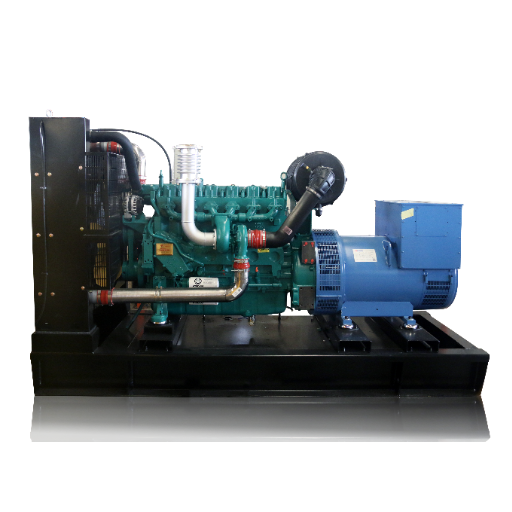
Service life is where suppliers quote ranges so wide that the number stops being useful. Bearings are the clearest illustration.
| Part | Quoted interval | Source |
|---|---|---|
| Alternator bearings, Cummins P7 | 30,000 h or 5 years | Cummins P7 operator’s manual |
| Alternator bearings, Onan EM series | 10,000 h or 2 years on prime; 5 years on standby | Onan EM series manual |
| Alternator bearings, MarelliMotori MJB | Around 20,000 h | MarelliMotori manual |
| AVR | Often 8 to 12 years on standby, from capacitor aging | Industry practice; check the manual |
Same class of machine. A threefold spread. The difference isn’t quality, it is duty: a prime-power set that runs continuously loads its bearings differently from a standby set that runs for two hours a month. Bearing makers don’t quote a fixed life at all, because the figure depends on load, grease type and vibration.
That is why the most useful sentence in this section is not a number. It is this: your own manual’s figure beats any table, including this one.
For consumables the intervals are more settled. Oil and oil filters at 250 to 500 hours, fuel filters at 500, air filters around 1,000 on a clean site, and belts and valve clearances from 2,000 hours upward. The generator service schedule for your set will state the exact figures, and the calendar equivalent matters as much as the hour count for a standby unit that rarely runs.
For electrical parts, age beats hours. An AVR that has run 300 hours in ten years is more likely to fail than one that has run 6,000 hours in three, because the capacitor ages whether or not the set runs. The same applies to controller backup batteries and to any electrolytic component in the panel.
What Generator Parts to Keep on the Shelf
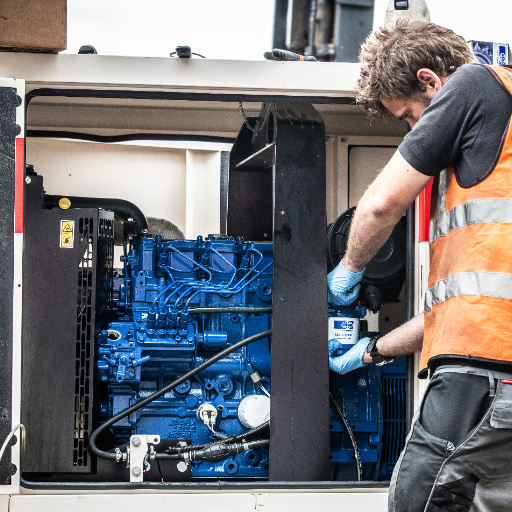
The question is not “what might I need”. It is “what can I not afford to wait for”.
Sort every part into three groups, and be ruthless about the third.
Hold on site. Oil and fuel filters, air filters, belts, hoses, a spare set of fuses and relays, a battery charger fuse, and one AVR if the site cannot tolerate a week of downtime. These are cheap, they degrade on the shelf slowly, and their absence turns a two-hour job into a two-week one.
Order on failure, but know the lead time. Injection pumps, turbochargers, starter motors, controllers and battery chargers. You won’t stock these, because the capital tied up is large and the failure rate on any individual unit is low. But you should know, in writing, how long each takes to arrive.
Never hold. Complete alternators, engines, and anything specific to a model you are about to retire. If the failure is that serious, the set is being replaced, not repaired.
Why lead time beats price
A filter that costs twice as much but arrives in two days is cheaper than one that costs half as much and arrives in six weeks, if your set is the only thing keeping a production line running.
Ifeanyi learned this at a bottling plant outside Lagos. The site held filters and belts, which is what the previous contractor had recommended. When an injection pump failed in August, the replacement took 34 days to arrive, and the plant ran on a rented 800 kVA set for the whole period. The rent alone exceeded the cost of every spare the site had ever held.
The lesson is not “stock more”. It is “stock by consequence, not by price”. The generator maintenance services that apply at any voltage will handle the engine work; what they cannot do is shorten a supply chain you never mapped.
If you are specifying spares for a new installation, the power band matters more than the brand. A 501 to 1000 kW generator typically carries larger fuel and cooling components than a smaller set, and those are the items with the longest lead times when they fail.
Planning a spares holding? Send us the model list and the site’s tolerance for downtime, and we will tell you which parts are worth holding and which are not. Request an engineering review
Ordering the Right Part
Most wrong-part deliveries are not supplier errors. They are incomplete orders.
Three fields prevent almost all of them:
- The engine serial number, not the model. The model identifies a family. The serial number identifies the build, including which injectors, which turbocharger and which governor were fitted on that day.
- The alternator frame and serial. Alternator parts are model-specific in ways engine parts are not. A bearing that fits one frame will not fit the next.
- A photograph of the nameplate. One clear image of the generator set nameplate answers more questions than an email of model numbers, because it shows the manufacturer’s own designation and the date of build together.
Two more things cause trouble. Superseded part numbers are normal: manufacturers revise and replace, and a part number from a manual printed in 2015 may no longer exist while the part does. And cross-references are only as good as their source. A third-party cross-reference list is not a manufacturer statement.
A practical habit: keep one photograph of every nameplate on the site in a shared folder, named by asset. It takes an hour to build and it saves weeks over the life of the installation. If the set is a medium voltage unit, add the alternator and switchgear nameplates too, because those parts are ordered on much longer lead times than anything on the engine.
Frequently Asked Questions
What are the main parts of a diesel generator?
A diesel generator has five assemblies: the engine, the alternator, the control and protection system, the fuel and starting system, and the enclosure and base. Each contains dozens of individual parts, but almost every failure traces to one of the first four.
Which generator parts fail most often?
Instrument and control parts. In the NUREG/CR-5057 failure database, that system accounted for 25% of all failures, with the governor alone at 10%. Fuel and starting systems followed at 11% and 10% respectively, and the lubrication system at 7%.
How long do generator parts last?
It depends on duty far more than on brand. Alternator bearings are quoted between 10,000 and 30,000 hours by different manufacturers for similar machines, because a prime-power set and a standby set load them differently. Consumables follow hour intervals; electronic parts such as the AVR age on the calendar instead, often failing between eight and twelve years on standby duty.
Is it OK to use aftermarket generator parts?
It is legal, and for consumables such as filters it is often sensible. The risk is not legality but consequence. Will-fit parts carry no OEM warranty, the manufacturer has no obligation to support an engine run on them, and an overhaul interval agreed on the assumption of genuine parts does not survive their use.
How do I find the right part number for my generator?
Start with the engine serial number and the alternator frame number, then check the manufacturer’s parts catalogue for that specific unit rather than the model family. Confirm whether the number has been superseded, and keep a photograph of the nameplate. Model numbers alone cause most wrong deliveries.
What spare parts should I keep for a standby generator?
Filters, belts, hoses, fuses, relays, and an AVR if downtime is expensive. Beyond that, the decision is about lead time rather than failure rate: anything that takes weeks to arrive and would stop the site is worth holding or worth contractually guaranteeing.
The Parts That Decide Whether You Have Power
Generator parts are easy to list and hard to buy well. The list is the same on every site: engine, alternator, controls, fuel and starting, enclosure. The judgement is what to do with it.
Four things are worth carrying out of this article.
Look at the control system before the engine. A quarter of failures sit there, and the governor is the single most failure-prone component in the machine. If your maintenance contract has a governor calibration line on it, you are ahead of most sites. If it does not, that is the first thing to add.
Stop over-serving the lubrication system and under-serving everything else. Oil changes address 7% of the problem. Nobody argues against them, but the attention they attract is out of proportion to the failure share they prevent.
Know which category of part you are buying. Genuine, will-fit and counterfeit are three different things with three different risk profiles. The Kommandor Susan report is what happens when the difference is not written down in the overhaul plan.
Stock by consequence, not by price. Lead time decides whether an outage lasts two hours or five weeks, and it is the one variable a site can actually control.
If you are reviewing a spares holding, writing a maintenance contract, or specifying a new set, send the nameplates and the site’s downtime cost. Our engineers will map the generator parts that matter to the risk they carry, and tell you honestly which ones are not worth the shelf space. Talk to our engineering team