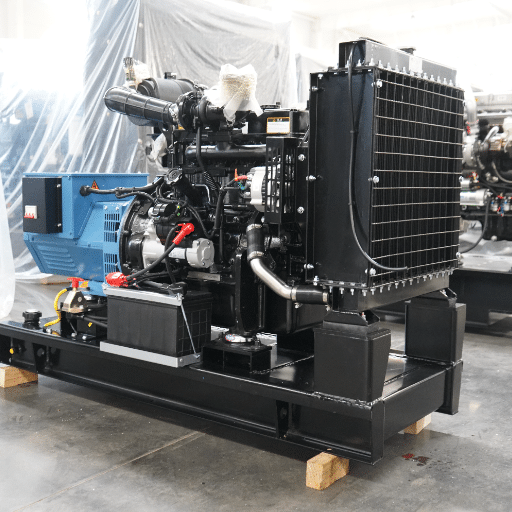



The top 5 industrial diesel generator brands of 2026 are Caterpillar, Cummins, Kohler/Rehlko, Perkins, and Generac, ranked by global market share, service-network depth, compliance coverage, and application fit for mission-critical and commercial sites. Caterpillar leads with roughly 10.5% of the global commercial-generator market. Cummins follows at 9 to 10%. Kohler (now branded Rehlko since the 2024 spin-off from Kohler Co.) sits in the 6 to 7% range. Perkins and Generac round out the top five with strong positions in the 50 to 500 kW band and in light-commercial standby respectively.
This guide is written for engineers, procurement directors, and OEM distributors who need a working brand decision before issuing an RFQ. It does not cover portable consumer generators (Honda, Yamaha, Westinghouse). Those are useful machines, but a different buyer evaluates them with different criteria.
Key Takeaways
- Caterpillar and Cummins are Tier 1 mission-critical brands. They dominate data centers, hospitals, and large industrial sites where 30-second cold-start and load-acceptance discipline are non-negotiable.
- Kohler/Rehlko and Perkins are Tier 2 Global GOEMs (genset OEMs). They cover commercial real estate, healthcare campuses, and construction at lower capital cost than Tier 1.
- Generac is the Tier 2 challenger for light-commercial and modular power. It is the volume leader in residential standby and is climbing the industrial ladder via the Ottomotores and Pramac acquisitions.
- Tier 3 brands (Weichai, Yuchai, Doosan, Shangchai) are absent from this top 5 but are critical for cost-sensitive buyers and are integrated into many custom genset builds, including those from Shandong Huali.
- Pick by application first, brand second. A data center should not consider Generac. A telecom reseller in West Africa should not over-spec Caterpillar.
How These 5 Brands Earned the 2026 Ranking

We ranked using four weighted criteria that mirror how industrial buyers actually compare brands:
| Criterion | Weight | What It Measures |
|---|---|---|
| Global market share (commercial diesel) | 30% | Volume, dealer reach, supply chain resilience |
| Service network density | 25% | Mean time to repair, parts availability, technician coverage |
| Compliance coverage | 20% | EPA Tier 4 Final, EU Stage V, ISO 8528-5, NFPA 110 |
| Application breadth | 25% | kW range served, fuel/cooling options, parallel-paralleling depth |
We deliberately did not weight residential or portable share. Including Honda or Westinghouse in an industrial brand ranking is a category error because the buyer profile, duty rating, and after-sales model are entirely different.
Brands evaluated but not making the top 5: MTU/Rolls-Royce (excellent but narrower commercial footprint), Mitsubishi (regional concentration in Asia-Pacific), Doosan (strong in 60 Hz markets, weaker in 50 Hz), Volvo Penta (engine specialist, not full genset OEM), Weichai/Yuchai (volume leaders in China but lower service density in EU/NA).
The 3-Tier Framework for Industrial Generator Brands
Most “top brand” articles list brands as a flat ranking. That hides the actual buying decision. Industrial buyers think in tiers because the tiers map to mission profile, capital budget, and acceptable risk.
Tier 1: Mission-Critical
| Brand | Strength | Typical Application |
|---|---|---|
| Caterpillar | Data center, EMCP controls, global dealer | Hyperscale and colocation data centers |
| Cummins | Integrated PowerCommand, healthcare focus | Hospitals, Tier III/IV data centers, oil and gas |
| MTU (Rolls-Royce) | Marine and large kW (>2 MW) | Naval, mining, very large data centers |
| Mitsubishi | Asia-Pacific industrial | Refineries, large manufacturing |
Tier 1 buyers value uptime over cost. A 30-second cold start, sub-10% voltage dip during step load, and 24/7 global service are the headline specs. Tier 1 brands cost 30 to 50% more than Tier 3 equivalents on a kW-for-kW basis, and that premium is justified by service density and load-acceptance proof.
Tier 2: Global GOEMs
| Brand | Strength | Typical Application |
|---|---|---|
| Kohler/Rehlko | SDMO heritage, 50 Hz dominance | Commercial real estate, healthcare campuses |
| Perkins | Caterpillar engine subsidiary, 50-300 kW | Construction, agriculture, off-highway |
| Generac | Modular industrial, fast-shipping standby | Light-commercial, retail, small healthcare |
| Doosan | 1500/1800 rpm range | Asian commercial, marine support |
Tier 2 brands cost 15 to 25% less than Tier 1 on assembled gensets. The trade-off is slightly less service-network depth and shorter mean-time-between-overhauls in continuous duty.
Tier 3: Vertical Giants
| Brand | Strength | Typical Application |
|---|---|---|
| Weichai | Volume, low cost, dealer network in Africa/SE Asia | Telecom, agriculture, light industrial |
| Yuchai | Marine and construction engine specialist | Construction, marine auxiliary |
| Shangchai | Heavy-duty, cost-sensitive industrial | Mining, oil and gas (Chinese market) |
Tier 3 engines cost roughly 40% less than Caterpillar or Cummins. They are not inferior on raw power output, but service density outside Asia and Africa is thinner. For cost-sensitive markets with strong local technician training, Tier 3 is often the right choice.
The rest of this article focuses on the top 5 Tier 1 and Tier 2 brands. Tier 3 brands appear in the OEM-integration section near the end because Shandong Huali integrates all three tiers into custom genset builds depending on the buyer’s needs.
Talk to our engineering team if you need help mapping your application to the right tier.
Brand 1: Caterpillar (Industrial Mission-Critical Leader)
Snapshot
| Field | Detail |
|---|---|
| Headquarters | Deerfield, Illinois, USA |
| Founded | 1925 |
| 2024 revenue | ~$64.8 billion (corporate) |
| Estimated commercial generator market share | ~10.5% |
| kW range | 9 kW to 17.46 MW (gas and diesel) |
| Signature industrial models | 3500 series (C175, 3516E), C32, C18 |
Why It Leads in 2026
Caterpillar is the brand most procurement teams short-list first for any project above 1 MW. Three reasons:
- EMCP control integration. The CAT EMCP 4.x panel is a known quantity for data center commissioning agents. Integration with Schneider, ABB, or Eaton UPS gear is documented and predictable.
- Global dealer network. CAT has 174 dealer organizations covering 192 countries. Mean time to a technician on-site in a major metro is under 4 hours.
- Load-acceptance proof. The 3500 series is documented at 100% block-load acceptance per NFPA 110 Level 1 with sub-10% voltage dip. This is what data center commissioning specs require.
Where It Is Not the Right Pick
- 50 to 200 kW band. CAT’s engine portfolio in this range is licensed Perkins. You can often get a better deal buying the Perkins-badged version directly.
- Cost-sensitive markets. The CAT premium of 30 to 50% over Tier 3 is hard to justify for a telecom site that runs 200 hours a year on diesel.
Recent Notable Activity
- 2023-2024: CAT expanded the 3512 portfolio for hyperscale data center demand
- 2024: 6 MW microgrid genset showcased at DataCenter Dynamics events
- 2025: Continued EPA Tier 4 Final coverage refresh on the C18 and C27
Brand 2: Cummins (Integrated Engine, Alternator, and Controls)

Snapshot
| Field | Detail |
|---|---|
| Headquarters | Columbus, Indiana, USA |
| Founded | 1919 |
| 2024 revenue | ~$34 billion |
| Estimated commercial generator market share | ~9 to 10% |
| kW range | 15 kW to 3.75 MW |
| Signature industrial models | QSK60, QSK95, C-Series (commercial), DQKAB |
Why It Is in the Top 5
Cummins is the only top-5 brand that designs and manufactures its own engines, alternators (Stamford was acquired), and controls (PowerCommand). For a buyer who wants single-supplier accountability on a warranty claim, this matters.
Strong points buyers cite:
- NFPA 110 Level 1 compliance. The QSK60 and QSK95 are widely deployed in U.S. hospitals.
- PowerCommand controls. The PCC 3300 panel is a competitor to EMCP and has gained share since 2020.
- Service density in North America and Middle East. Cummins has a particularly strong dealer footprint in the GCC region.
Where It Is Not the Right Pick
- Below 50 kW. Cummins is competitive here but the volume leader is Generac.
- Large kW (>3.5 MW). MTU and Caterpillar lead the >5 MW segment.
Recent Notable Activity
- 2024: Hydrogen-blended demonstration of the QSK60 at Power-Gen International
- 2025: Continued expansion of the Atlas series for hyperscale data centers
- 2026: Stamford acquisition consolidation underway, simplifying the integrated supply chain
Brand 3: Kohler/Rehlko (Formerly Kohler-SDMO)
Snapshot
| Field | Detail |
|---|---|
| Headquarters | Kohler, Wisconsin, USA (Rehlko corporate) |
| Founded | Kohler Co. 1873; energy spin-off branded Rehlko in 2024 |
| 2024 estimated market share | ~6 to 7% commercial |
| kW range | 8 kW to 4 MW |
| Signature industrial models | KD3300, KD2250, SDMO heritage 50 Hz line |
The 2024 Rebrand Explained
This is the brand that most procurement docs still get wrong. Here is the chronology:
- 2005: Kohler acquired French manufacturer SDMO. The combined business operated as Kohler-SDMO.
- 2016: Rebranding consolidated EU sales as Kohler-SDMO.
- 2024: Kohler Co. spun off its energy business. The spin-off was rebranded Rehlko. The portable lawn-and-garden engines remain with Kohler Co. Industrial generator products now sit with Rehlko.
- 2025-2026: Most legacy specs and dealer signage still say “Kohler.” New product literature carries the Rehlko logo.
For procurement, the practical guidance is to write specs as “Kohler/Rehlko” or “Rehlko (formerly Kohler-SDMO)” through 2027 to avoid confusion.
Why It Is in the Top 5
- 50 Hz coverage. SDMO is the strongest U.S.-affiliated brand in 50 Hz markets (Europe, Africa, Middle East, parts of Asia).
- Containerized industrial line. The KD2250 and KD3300 are popular for hospitals and large commercial buildings.
- Recognized after-sales in EU. The Brest, France factory and Changzhou, China manufacturing hub serve different regions.
Where It Is Not the Right Pick
- Hyperscale data centers. CAT and Cummins dominate the >2 MW data center segment.
- Strict NFPA Level 1 emergency where the U.S. service dealer network matters more than EU dealer presence.
Brand 4: Perkins (Caterpillar Subsidiary, 50 to 500 kW Sweet Spot)

Snapshot
| Field | Detail |
|---|---|
| Headquarters | Peterborough, UK |
| Founded | 1932; acquired by Caterpillar in 1998 |
| Estimated market share (engine only) | ~5 to 6% in 50 to 500 kW band |
| kW range | 8 kW to 2.5 MW (engine output) |
| Signature engines | 1100 series, 2200 series, 2500 series, 4000 series |
Why It Is in the Top 5
Perkins is the engine choice for a vast number of genset OEMs in the 50 to 500 kW band, including most European and Indian assembled gensets. As a Caterpillar subsidiary it benefits from CAT’s global aftermarket but is priced 15 to 25% below a CAT-badged equivalent of the same kW rating.
- EU Stage V coverage. Strong for off-highway and construction.
- Wide OEM acceptance. FG Wilson, Olympian (now phased out), and many Asian assemblers use Perkins as the engine.
- Spares availability. Parts are interchangeable across CAT and Perkins service networks.
Where It Is Not the Right Pick
- Above 1 MW. The Perkins 4000 series competes here but CAT 3500 series is the more common spec for mission-critical projects.
- Strict North American NFPA Level 1. Cummins and CAT have stronger U.S. dealer footprints for hospital projects.
Note on FG Wilson
FG Wilson is a Caterpillar-owned assembler that builds Perkins-powered gensets for the EU, Middle East, and African markets. It is essentially a sister product to Caterpillar in the 20-2500 kVA band.
Brand 5: Generac (Light-Commercial and Modular Power)
Snapshot
| Field | Detail |
|---|---|
| Headquarters | Waukesha, Wisconsin, USA |
| Founded | 1959 |
| 2024 revenue | ~$4.0 billion |
| Estimated commercial generator market share | ~5 to 6% (rising) |
| kW range | 6 kW to 3.25 MW (industrial Modular Power System) |
| Signature industrial models | Modular Power System (MPS), Industrial G-Drive |
Why It Is in the Top 5
Generac is the volume leader in U.S. residential standby and has aggressively moved into light-commercial since the 2018 Ottomotores acquisition (Mexico) and the 2021 Pramac acquisition (Italy). Strong points:
- Modular paralleling. Generac’s MPS lets buyers build redundancy by paralleling smaller (250 to 600 kW) gensets instead of buying one large unit. This is appealing for retail chains and modular data center deployments.
- Fast lead time. For stock Tier 2 industrial sizes, Generac is often faster to ship than CAT or Cummins.
- Aggressive natural gas portfolio. For sites with available gas infrastructure, Generac is a leader in industrial gas standby. See our most efficient gas generator guide for cross-reference.
Where It Is Not the Right Pick
- Hyperscale data centers and Tier III/IV mission-critical. The brand has not yet built the EU and Asian service density to compete with CAT and Cummins here.
- Extreme harsh-environment continuous prime. Tier 1 brands still lead for mining and offshore.
Recent Notable Activity
- 2023-2024: Pramac integration brought EU industrial gen presence
- 2025: Continued push into modular power for retail chains and small data centers
- 2026: Growing presence in industrial gas and bi-fuel for fleet operators
Brand-to-Application Decision Matrix
This is the working matrix many of our procurement clients keep on their desk. It is the fastest way to short-list a brand for an RFQ.
| Application | First Pick | Second Pick | Avoid |
|---|---|---|---|
| Hyperscale data center (>5 MW per unit) | Caterpillar | MTU | Generac |
| Tier III/IV data center (1-5 MW) | Caterpillar | Cummins | Tier 3 brands |
| Hospital NFPA 110 Level 1 (250 kW to 2 MW) | Cummins | Caterpillar | Tier 3 |
| Commercial real estate (200-800 kW) | Kohler/Rehlko | Cummins | None |
| Construction/rental (50-500 kW) | Perkins | Cummins | MTU (overspec) |
| Manufacturing plant (500 kW-2 MW) | Cummins | Kohler/Rehlko | Generac |
| Telecom tower (10-100 kW) | Perkins | Cummins | MTU |
| Retail chain modular standby (100-400 kW) | Generac | Cummins | MTU |
| Marine main propulsion auxiliary | MTU | Cummins | Generac |
| Mining (1-3 MW continuous prime) | Caterpillar | Cummins | Generac |
| Cost-sensitive emerging-market industrial | Tier 3 (Weichai/Yuchai) | Perkins | CAT/Cummins (over-budget) |
Mini Case: A Data Center in Frankfurt
A procurement director at a 12 MW Frankfurt colocation facility specified six Caterpillar 3516C units in N+1 redundancy. The decision came down to three points. The EMCP controls integrated with the existing Schneider EcoStruxure UPS layer without custom protocol bridging. The CAT Stuttgart dealer guaranteed 4-hour technician arrival under SLA. And CAT’s documented load-acceptance pass at 100% step load matched the data center commissioning agent’s spec sheet line-by-line. The 30% capital premium over a Cummins QSK60-based alternative was approved at the CFO level because the commissioning agent declined to certify any other brand on this site without additional load-bank testing.
Compliance and Certification by Brand

Procurement specs increasingly require not just the right kW but also certified emissions, sound, and reliability standards. The leading top 5 brands all carry these certifications, but coverage depth varies by region and engine family.
| Standard | Caterpillar | Cummins | Kohler/Rehlko | Perkins | Generac |
|---|---|---|---|---|---|
| EPA Tier 4 Final (USA) | Full | Full | Full | Full | Full |
| EU Stage V | Full | Full | Full | Full | Partial |
| ISO 8528-5 (G2/G3) | Yes | Yes | Yes | Yes | Yes |
| NFPA 110 Level 1 capable | Yes | Yes | Yes | Yes (with packager) | Yes |
| IMO MARPOL Tier III (marine) | Limited | Full (QSK series) | Limited | Limited | Not applicable |
| UL 2200 listing | Yes | Yes | Yes | Yes (via packager) | Yes |
External references for spec writers:
Mini Case: A Hospital in Jakarta
A 600-bed hospital project in Jakarta specified a Cummins QSK60 primary genset paired with a second QSK60 in N+1. The hospital’s compliance officer required documented 30-second cold-start under NFPA 110 Level 1 because the operating-room redundancy block could not tolerate a longer transfer window. Caterpillar was the alternate bid but the local dealer footprint in Jakarta was thinner than Cummins. The hospital paid 8% more than a Tier 2 alternative would have cost, and the project closed on the strength of the dealer SLA, not the engine itself.
The Asian Manufacturing Reality (Where These Brands Are Actually Built)
This is the section most “top brand” articles avoid because it is uncomfortable. The truth is that the top 5 industrial diesel generator brands are increasingly built, packaged, or partially manufactured in Asia.
| Brand | Notable Asian Manufacturing Hub |
|---|---|
| Caterpillar | Wuxi (China), Aurangabad (India) for selected engines and gensets |
| Cummins | Wuhan (China), Pune (India) for B/C/L series engines and assembled gensets |
| Kohler/Rehlko | Changzhou (China) for SDMO-line industrial gensets |
| Perkins | Wuxi (China JV with Cummins for some engines), Tianjin |
| Generac | Suzhou (China) post-Ottomotores integration |
This is not a critique of the brands. It is a statement about how the modern industrial supply chain works. Engine cores, alternators, and control panels move across continents. A “Caterpillar genset” purchased in Lagos may have been assembled in Aurangabad with a UK-built engine and a Stamford alternator built in Wuxi.
For Shandong Huali, this matters for two reasons:
- We are part of the same supply chain. Our factory in Shandong builds gensets that integrate Cummins, Perkins, Yuchai, Weichai, Stamford, Mecc Alte, and others. The same engines that appear in branded packages appear in our custom and OEM builds.
- We are transparent about it. A buyer who asks where the engine and alternator are made will get a clear answer with serial numbers and country of origin. This is the differentiator for international distributors who need to satisfy importing-country labeling requirements.
How Shandong Huali Integrates These Brands into Custom Gensets
This is the conversion bridge. If you are reading this guide because you need to specify a generator for a project, the question is not just “which brand” but “what configuration.” Shandong Huali assembles gensets using the same major engine and alternator brands that appear in the top 5 packages:
| Component | Brands Shandong Huali Integrates |
|---|---|
| Engine (Tier 1) | Cummins, Perkins (Caterpillar engines through OEM channels) |
| Engine (Tier 2-3) | Yuchai, Weichai, Volvo Penta, Doosan, Shangchai |
| Alternator | Stamford (Cummins Generator Technologies), Leroy Somer, Mecc Alte, Marathon |
| Control system | DSE (Deep Sea), ComAp, Smartgen, Woodward |
| Enclosure | Open skid, sound-attenuated canopy, ISO container, weather-protective |
| Fuel system | Standard, sub-base tank, double-walled, extended runtime |
Buyers commonly choose between three configuration models with us:
- Custom diesel genset (private end-user): Buyer specifies kW, voltage, frequency, enclosure, and a preferred engine brand. We build to the spec. See our custom diesel generator buyer’s guide for the full workflow.
- OEM/ODM (distributor or reseller): Buyer is a distributor who wants to private-label gensets under their own brand. We support both ODM (we own the design) and OEM (buyer owns the design).
- Branded reseller channel: Buyer is a stocking distributor of a known engine brand (Cummins, Perkins) who wants Shandong Huali to assemble the genset and ship it with the engine brand’s badging where authorized.
For most buyers in 2026, the question is not “which brand should I buy directly from CAT or Cummins” but “what is the right combination of engine, alternator, controls, and enclosure for my application, and who can assemble that combination reliably.” That second question is what custom genset OEMs answer.
Mini Case: A Telecom Tower Fleet in Lagos
A telecom reseller covering 28 towers across Lagos faced a fleet refresh in 2025. The original spec was Cummins QSB7 gensets at 50 kVA, but the project budget came in 35% over. The reseller approached Shandong Huali with two questions: could we deliver a comparable-spec genset using a Yuchai YC6A engine that holds up in West African fuel conditions, and could we add an enhanced fuel filtration system to handle the higher sulfur content found in some regional diesel supplies. We built a 30-unit batch with the YC6A engine, Stamford alternator, DSE 7320 controls, and a triple-stage fuel filtration upgrade. The reseller saved roughly 40% on capital expenditure compared to a Cummins-branded order. After 14 months of operation, the fleet’s mean time between minor service intervals matches the original Cummins fleet at the same network, with the only meaningful difference being parts source.
How to Compare the Top 5 Brands at the RFQ Stage

When you put the top 5 brands side by side in a procurement file, the right questions are not “which is best” but “which is best for this specific RFQ.” Here are the comparison points that matter:
- kW at site conditions. Brand spec sheets assume ISO ambient. De-rate for altitude, ambient temperature, and humidity. Cummins, Caterpillar, and Kohler/Rehlko publish detailed de-rate tables; smaller brands do not always.
- Voltage and frequency match. 50 Hz markets favor Kohler/Rehlko and Perkins. 60 Hz markets favor Caterpillar, Cummins, and Generac.
- Service network density at site. Mean time to a technician on-site under SLA. This is where Caterpillar and Cummins lead globally, Kohler/Rehlko leads in EU, and Generac leads in U.S. retail.
- Lead time to delivery. Stock industrial sizes ship in 4 to 10 weeks from the top 5. Custom configurations stretch to 10 to 16 weeks. Shandong Huali typically delivers custom gensets in 8 to 14 weeks.
- Capital cost per kW. CAT and Cummins price 30 to 50% above Tier 3 alternatives. Kohler/Rehlko and Perkins sit 15 to 25% above Tier 3. Generac is price-competitive in Tier 2.
- Total cost of ownership over 15 years. Includes fuel, scheduled maintenance, major overhaul, and resale. Tier 1 brands typically lead on resale value but trail Tier 3 on fuel consumption per kWh when run at partial load.
- Compliance and certification fit. NFPA, EPA Tier 4 Final, EU Stage V, ISO 8528-5 stamp on the nameplate.
For a deeper compliance walkthrough, see our industrial diesel generator guide.
Frequently Asked Questions
Who makes the best industrial diesel generator brand in 2026?
For mission-critical applications above 1 MW, Caterpillar leads the global market with approximately 10.5% commercial share. For hospitals and integrated-controls applications, Cummins is the dominant choice. “Best” depends on application, not on a single ranking number.
Is Kohler the same as Rehlko?
The energy and industrial generator business spun off from Kohler Co. in 2024 and was rebranded Rehlko. The industrial generators previously sold as Kohler-SDMO are now Rehlko-branded. The portable consumer power equipment business stays with Kohler Co. For procurement, expect to see both names through 2027 as legacy specs transition.
Is Caterpillar better than Cummins?
Both are Tier 1 brands. Caterpillar dominates the >2 MW data center market and has the larger global dealer network. Cummins dominates the NFPA Level 1 hospital segment in North America and offers the strongest integrated engine plus alternator plus controls package. Pick based on application and on which brand’s local service dealer is stronger at your site.
Why isn’t MTU in the top 5?
MTU (Rolls-Royce Power Systems) makes excellent large kW industrial gensets and dominates marine main propulsion and very large data center applications. Its global commercial generator footprint is narrower than the top 5, which is why it ranks just outside in our framework. For applications above 2 MW it deserves a short-list slot.
What about Honda, Yamaha, or Westinghouse generators?
These are excellent portable consumer generators but are not in the industrial diesel category. They serve households, RVs, and small commercial backup. The buyer profile and duty cycle are different from industrial diesel.
How much does an industrial diesel generator from the top 5 brands cost?
For Tier 1 brands (CAT, Cummins) in the 500 to 1000 kW range, expect 250,000to250,000to500,000 USD assembled and tested at site for a containerized standby unit. Tier 2 brands (Kohler/Rehlko, Perkins, Generac) run 15 to 25% less for the same kW rating.
Should I buy directly from the brand or through a custom genset OEM?
If you need a standard configuration in a standard market with a strong local dealer, buying through the brand’s authorized channel is straightforward. If you need a custom configuration, a specific engine plus alternator plus controls combination, or are buying for a non-mainstream market, a custom genset OEM like Shandong Huali can deliver the same components in a tailored configuration at lower capital cost. See our custom diesel generator buyer’s guide for the full decision framework.
Are Chinese-built generators reliable?
Modern Chinese-built industrial gensets, including those assembled by Shandong Huali, use the same Cummins, Perkins, Stamford, and Mecc Alte components used in Tier 1 and Tier 2 branded packages. Reliability depends on the components and the assembler’s quality control, not on the country of assembly. Many “top brand” gensets are themselves assembled in China for global markets.
What is the lead time for a top 5 brand industrial generator in 2026?
Stock sizes in mainstream kW ranges ship in 4 to 10 weeks. Configured or custom builds run 10 to 16 weeks. Shandong Huali custom builds typically ship in 8 to 14 weeks depending on engine availability and certification requirements.
Which brand has the best resale value?
Caterpillar and Cummins consistently lead the secondary market for industrial gensets. A 5-year-old Caterpillar in good service condition typically retains 55 to 65% of its original purchase value. Tier 3 brands retain 30 to 40%.
Conclusion: Choosing a Brand Is a Long-Term Decision
The top 5 industrial diesel generator brands of 2026 are Caterpillar, Cummins, Kohler/Rehlko, Perkins, and Generac. Each leads a different slice of the market and the right choice depends on application, region, service-network access, and capital budget.
The trap procurement teams fall into is comparing brands as if all 5 were equivalent. They are not. Caterpillar is the right answer for hyperscale data centers and is the wrong answer for telecom fleets in emerging markets. Generac is correct for retail standby and incorrect for hospital NFPA Level 1. Kohler/Rehlko is excellent for 50 Hz commercial real estate and a weaker match for U.S. hospitals where Cummins dealers run the show.
Past brand selection, the next question is configuration. Engine, alternator, controls, enclosure, fuel system, cooling system, and load-bank protocol all change the genset’s behavior more than the badge on the side. This is where custom genset assemblers and OEMs add value. We integrate the same engine and alternator brands the top 5 use, configure them to the buyer’s site conditions, and stand behind the build with documented testing.
If you have a project that does not fit neatly into one of the top 5 brand pre-packaged offerings, or if cost-engineering a Tier 2 or Tier 3 build is the right call, send our engineering team an RFQ. We will tell you honestly which engine and configuration matches your application, even when the answer is a major-brand package and not one of ours.