
Bulk generator supplier China orders are priced per unit and shipped per container. Those are different arithmetic, and the difference is where bulk orders go wrong. The container has four limits, not one, and the limit that decides how many sets travel is not the one most buyers check.
Most buyers check volume. It is the easiest number to find and the least often binding. For a generator, which is a dense load concentrated over a short length of floor, the binding limit is often floor loading or the door opening, and neither appears on a quotation.
This guide sets out the four limits, why the larger container is sometimes the wrong choice, what changes when a load is mixed, and the one document that turns a quotation into a shipment.
Key Takeaways
- A container is limited by volume, payload, floor loading and door opening. Which one binds depends on the generator and the mix, not on the order size alone.
- A 20′ container permits more weight per line metre of floor than a 40′ (4.5 t against 3.0, per TIS-GDV loading guidance), so a heavy run can need more containers in the larger size.
- The door opening is 2,340 × 2,280 mm on a standard box and 2,585 mm high on a high cube. A set can fit the volume and fail the door.
- Mixed ratings need a loading plan, not a pile: weight distribution, lashing points and bracing are decided per position.
- Ask for the loading plan with the quotation. A factory that can produce one has shipped bulk before.
Generator Container Loading: The Four Limits of the Box
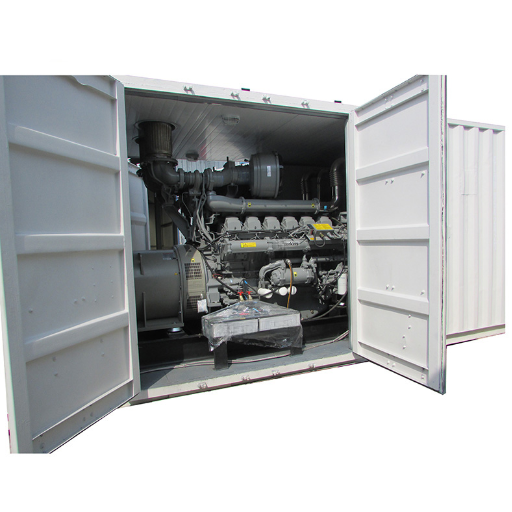
Every shipping container is governed by four numbers. Two are usually published, one is rarely quoted, and one is a fixed opening rather than a capacity.
| Limit | 20′ standard | 40′ standard | 40′ high cube |
|---|---|---|---|
| Internal volume | 33.2 m³ | 67.7 m³ | 76.4 m³ |
| Typical payload | ~28,000 kg | ~27,000–29,000 kg | ~26,500–29,000 kg |
| Maximum floor (line) load | 4.5 t per metre | 3.0 t per metre | 3.0 t per metre |
| Door opening (W × H) | 2,340 × 2,280 mm | 2,340 × 2,280 mm | 2,340 × 2,585 mm |
Internal dimensions are 5,898 × 2,352 × 2,393 mm for a 20′, 12,032 × 2,352 × 2,393 mm for a 40′ and 12,032 × 2,352 × 2,698 mm for a high cube. Volumes and dimensions from Triton International’s published fleet specifications; maximum line loads from TIS-GDV’s permissible loading capacity guidance; payloads vary by carrier and should be confirmed per booking. All three pages accessed October 2026.
Volume tells you how much space there is. It is the number a freight quotation is usually built on, and the one a buyer naturally checks.
Payload tells you how much total weight the box may carry. For a single set this is generous, because a set is heavy but a container is rated for around 28 tonnes.
Floor loading tells you how much weight the floor will take per metre of its length. This is the number nobody quotes, and for a dense machine it is the one that binds.
The door tells you whether the machine can get in at all. It is a fixed opening, and no amount of spare volume or payload changes it.
A load has to pass all four. The useful question is not “how much fits in a 40-foot container” but “which of the four limits does this particular set reach first”. A generator shipping container is chosen on those four numbers, and the right box for one set is often the wrong box for the next.
The four are also not independent. A heavier or taller set raises the floor load or the door height, so the limit that binds can change between two ratings that look similar on a specification sheet. That is why a mixed order’s container count cannot be derived from one unit’s rating.
Why the Bigger Container Can Be the Wrong One
Here is the counterintuitive part, and it is the reason this article exists.
Floor loading is not proportional to container size. It is lower on the larger box. The Transport Information Service (TIS-GDV) states a maximum line load of 4.5 tonnes per metre in a 20′ container and 3.0 tonnes per metre in a 40′.
A 40′ is roughly twice the length of a 20′, so at 3.0 tonnes per metre it carries about 36 tonnes of floor load in theory, against about 27 tonnes in a 20′ at 4.5. But the payload limit caps both at around 28 tonnes, so on paper the two are similar.
The difference appears when the load is concentrated. A generator sits on a base frame a few metres long, not spread across the whole floor. If each set presents its weight over a short length, the permitted load per metre is what matters, and the 20′ permits 50% more weight per metre than the 40′.
The arithmetic is simple once the base frame is known. Take a set weighing 12 tonnes on a 3-metre base frame. That is 4.0 tonnes per line metre.
In a 20′ container, with a permitted floor load of 4.5, it sits within the limit. In a 40′, with 3.0, it does not, unless beams are used to spread the load over more of the floor. The same machine fits the smaller container and fails the larger one, not because the 40′ is weaker, but because its permitted load per metre is lower and the set concentrates its weight over a short length.
Hassan ran into this on 14 sets of about 3.5 tonnes each on one-metre base frames. The quotation was built on volume and assumed two 40′ containers. At loading, the floor limit was reached with several sets still to go, and the order needed a third container. The same 14 units would have travelled in three 20′ boxes with floor capacity to spare.
The practical rule: count containers by floor loading, not by cubic capacity. Ask the factory for each set’s weight and the length of its base frame, divide by the permitted load per metre, and the container count follows. Volume is the check afterwards, not the basis.
The Door, the Flat Rack, and When a Container Is the Wrong Answer
The door opening on a standard container is 2,340 mm wide and 2,280 mm high. On a high cube it is the same width and 2,585 mm high.
A generator in a sound-attenuated canopy is a tall object. A set that occupies only half the internal volume can still be too tall for the door, and the failure happens at the loading bay rather than at the quotation.
The number to ask for is the packed dimension, not the nominal set size. A skid-mounted set with a lifting frame, a fuel tank and an exhaust stack may be dimensioned differently from the drawing, and the door is unforgiving. Ask for height, width and length as packed for shipment, and compare them with the door opening before anything else.
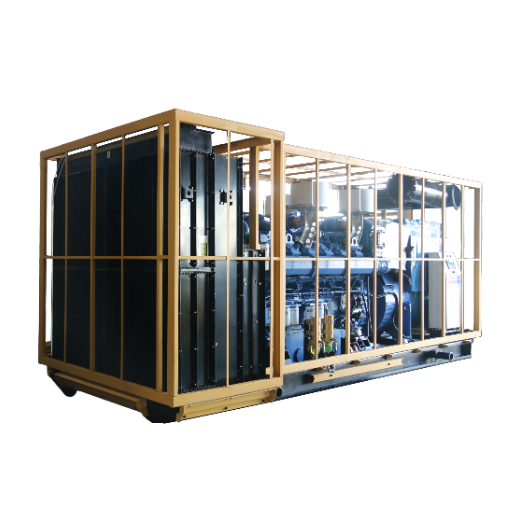
When a set will not pass, the answer is not a bigger container. It is a different kind of container: an open top, loaded from above, or a flat rack, loaded from the side or the end. Both change the lashing arrangement and the freight basis, and both need to be decided before the order is placed. The terms that govern the freight itself are a separate question, and they are covered in our online-buying guide.
A flat rack is not simply a container without walls. It has its own floor, its own lashing points and its own freight basis. The set is also exposed unless it is covered, which matters for a machine with a canopy finish. The decision is a packing decision made before the order, not a substitution made at the port.
Farida’s order arrived late at this point. A canopy height that cleared the internal volume by a comfortable margin did not clear the 2,280 mm door, and the switch to flat racks added cost and a week at the port. The packed height had been on a drawing the whole time.
Mixed Loads, Weight Distribution and Lashing
A bulk order is rarely twenty identical sets. It is more often a spread of ratings, and that changes the loading problem from arithmetic to layout. Generator container loading is therefore a layout discipline, not a volume calculation.
The per-metre limit applies per metre, not on average. A container with a heavy set at one end and light sets at the other can pass on total weight and still exceed the floor limit where the heavy set sits. Position matters as much as the total.
Lashing points are finite. A 20′ container carries around 10 lashing points per side and a 40′ around 20 per side, each rated in the region of a tonne. A set that needs four points per side uses two-fifths of a 20′ container’s lashing capacity on its own, and the plan has to account for that.
Concentrated loads need bracing. The UNECE Code of Practice for Packing of Cargo Transport Units expects a concentrated load to be spread with timber or steel beams sized to the load, rather than left to the floor alone. That is a factory-side calculation, and it is one of the things a loading plan records.
There is a second positional constraint that buyers rarely consider: the load has to be stable during the sea passage, not only at rest on the quay. A container rolls, and the lashing arrangement is designed for that motion. A plan that looks adequate in a static drawing can still fall short of the capacity the voyage requires.
Mixed ratings also change the destination. If the sets are going to different sites, the loading plan has to agree with the delivery plan. A container loaded for shipping efficiency can be a container that has to be unpacked twice.
Bulk Generator Supplier China: The Loading Plan to Ask For
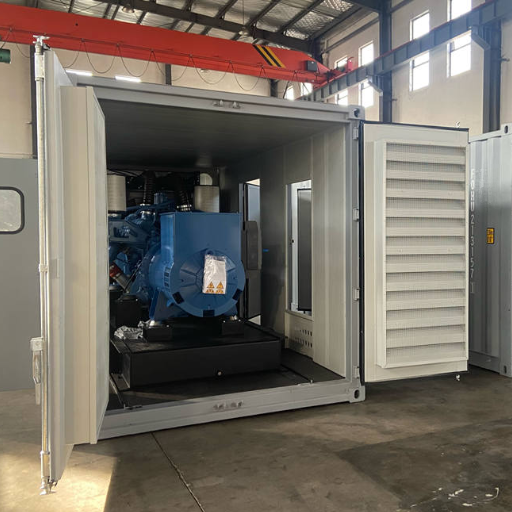
A generator bulk order turns from a quotation into a shipment on one document, the loading plan, and it should exist before the deposit rather than after it.
A useful loading plan shows:
- The container type and count, and why that type.
- Each unit’s position in the container, drawn in plan and elevation.
- Each unit’s weight and centre of gravity.
- The lashing arrangement, with the points used and the bracing specified.
- The packed dimensions of each unit, checked against the door.
Five questions get you there:
- What are the packed dimensions and weight of each unit? Not the nominal size.
- Which container type and how many, and which limit set that count?
- Where does each unit sit, and does any position exceed the per-metre floor limit?
- How is each unit lashed and braced, and to what?
- Does the loading plan agree with the delivery schedule?
A wholesale generator supplier that answers all five without hesitation has shipped bulk before. One that cannot produce a plan has quoted bulk, which is a different thing.
If you are still choosing between factories, our guide to choosing an industrial generator set supplier in China covers the assessment.
How manufacturers, partners, distributors and trading companies differ is the channel question, and the custom diesel generator guide covers how order quantity affects the terms.
That distinction matters more than the per-unit price, because the cost of a container that has to be reworked at the port is not in the quotation. What the freight itself costs is a separate question, and our guide to landed cost for distributors covers it; this article stops at what goes in the box.
Frequently Asked Questions
How many generators fit in a 40 foot container?
It depends on which limit binds. A 40′ holds 67.7 m³ and about 28 tonnes, but its floor takes about 3.0 tonnes per line metre and its door is 2,340 × 2,280 mm. Count by floor loading first, check the door, then use volume as the final check.
Do generators ship in containers or on flat racks?
Both. A set that fits through the door and within the floor limit travels in a standard or high cube container. A set that is too tall for the door, or too wide, moves on an open top or a flat rack, which changes both the lashing arrangement and the freight basis. The packed dimensions decide, not the rating.
What is floor loading in a shipping container?
Floor loading is the weight a container floor will accept per metre of its length. TIS-GDV gives a maximum line load of about 4.5 tonnes per metre for a 20′ container and 3.0 for a 40′. It matters because a generator concentrates its weight over a short base frame, so this limit can bind before the payload limit does.
Can one container carry different generator ratings?
Yes, and it usually does. The constraints are positional: each unit’s weight has to sit within the per-metre floor limit where it is placed, the lashing points are finite, and concentrated loads need bracing. A mixed load therefore needs a loading plan rather than a simple total-weight calculation.
What is a loading plan?
A document showing the container type and count, each unit’s position, weight and centre of gravity, the lashing and bracing arrangement, and the packed dimensions checked against the door. Ask for it with the quotation. It is also the record an insurer may ask for if cargo moves in transit.
Conclusion
Bulk generator supplier China orders are priced per unit and shipped per container, and the container is where the two calculations meet. Four limits decide what travels: volume, payload, floor loading and the door. Only the first is usually quoted.
The practical consequences are simple to state and easy to miss. Count containers by floor loading, because a 40′ permits less weight per metre than a 20′.
Check the packed height against the door, because a set can fit the volume and fail the opening. Plan mixed loads by position, because the per-metre limit applies where the weight sits. And ask for the loading plan before the deposit, because it is the difference between a quotation and a shipment.
If you are sourcing bulk generators from China, send us the ratings, the packed dimensions and the destination, and our engineering team will set out how the order packs and what the loading plan needs to cover.