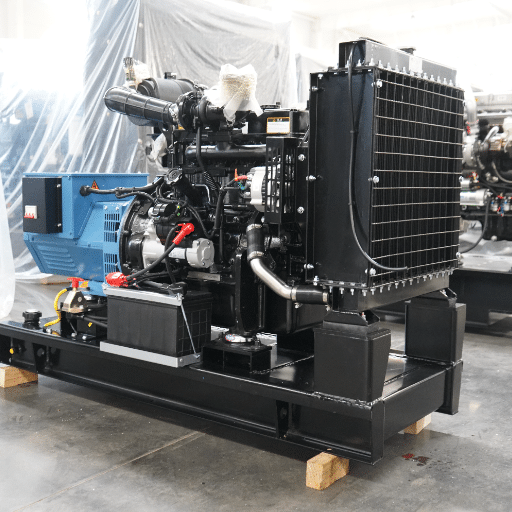



Generac portable generators and Predator portable generators serve the same need but target different buyers. Generac offers stronger build quality, a nationwide dealer service network, and a path to whole-home standby power. Predator offers lower upfront cost and competitive watt-per-dollar figures for intermittent use. The right choice depends on how often you run the unit, how long you need it to last, and whether you need dealer support.
This guide compares Generac vs Predator generators on specification, engine quality, warranty, noise, and total cost of ownership. We also flag the point where neither brand is the right tool, and an industrial diesel generator set becomes the better answer.
In early August 2023, Hurricane Idalia left the big bend of Florida without power, and David Martinez ran his Generac GP8000E for 14 hours a day over a period of four days. His neighbor with a Predator 9500 from Harbor Freight did likewise. They used the generator to keep their refrigerators and window units going. After the storm, David’s still started right up. It was good for two seasons. And his neighbor did have to replace his carburetor twice. At that point, the price difference between the brands was $350. Such reliability needs perhaps a higher price for substitutes, it must be noted.
Key Takeaways
- Choose Generac if you want longer service life, nationwide dealer support, and a path to whole-home standby power.
- Choose Predator if you need the lowest upfront cost for intermittent, short-duration use.
- Predator typically costs 30-45% less than Generac at the same watt class.
- Generac’s inverter THD is lower, making it safer for sensitive electronics.
- Neither brand’s portable line is built for continuous duty or three-phase loads; move to an industrial diesel generator set for those needs.
Generac vs Predator at a Glance

The fastest way to compare the two brands is side by side. The table below summarizes the specifications that matter most to buyers.
| Specification | Generac | Predator |
|---|---|---|
| Power range (portable) | 800W – 17,500W | 2,000W – 9,500W |
| Fuel options | Gas, dual-fuel, tri-fuel (select models) | Gas, dual-fuel |
| Engine | Generac OHV / OHVI in-house | Loncin-sourced OHV (rebadged) |
| Warranty (portable) | 3 years limited | 2 years limited |
| Dealer / service network | 3,000+ US dealers | Harbor Freight retail only |
| Noise level (typical 7,500W) | 65-74 dB at 23 ft | 67-76 dB at 23 ft |
| Inverter THD | < 3% on inverter models | < 5% on inverter models |
| Typical price (7,500W class) | 1,100−1,100−1,400 | 700−700−950 |
For build quality, service access, and inverter performance, Generac has the edge. For upfront cost and raw watts per dollar, Predator has the edge. Both are valid choices for portable, intermittent power.
Need more than portable backup power? Explore industrial diesel generator solutions for continuous-duty applications designed for commercial and industrial environments.
Brand Background and Market Position
Generac Power Systems
Generac is the No. 1 standby generator manufacturer for residential needs in North America. These systems constitute 75 percent of the entire residential supply backup systems. In addition to that, the company builds a full portable lineup and industrial diesel generator units to about 3,000kW. This three-tiered structure actually serves as a good thing, because a potential buyer browsing about Generac may want to compare the home standby type and not the portable type.
Newly in postmodernism and motor type, the Generac engine is also an in-house design and manufacture. OHV and OHVI families of engines, provided with continuous voltage stability and significantly extensive service interval, are the outcome. In basic terms, the company invests strongly in training and spare parts availability to the dealership networks, thereby providing service advantages to selective labels that have no competition from low-brands.
Predator (Harbor Freight)
Predator is Harbor Freight’s in-house brand. Generators are made overseas, mostly by Chinese engine manufacturers like Loncin and then branded for the US market. The brand has grown fast since 2018 by offering a lot lower prices than mainstream competitors.
Predator does not have any dealer network in its pockets. All sales, warranty repairs, and parts orders are through Harbor Freight retail or online. It becomes an excellent way to sideline the increasing administration costs leading to a high price; this commissions direct purchase from Harbor Freight retail stores. But it also deprives consumers residing in rural areas or with rapid turnaround options alike.
Why the Price Gap Exists
The 30-45% price difference is not arbitrary. Generac spends more on in-house engineering, US-based dealer support, and longer warranty coverage. Predator minimizes these costs by using proven but externally sourced engines and a direct retail model. The question for the buyer is whether those savings outweigh the service and durability advantages.
Power Output and Product Tiers
Generac’s Three Tiers
Generac organizes its product line into three distinct categories. Portable units range from 800 watts up to 17,500 watts. Home standby systems start at 10 kW and reach 26 kW. Industrial diesel generator sets scale from 20 kW to 3,000 kW. A buyer who starts by comparing portable units may discover that a home standby is the better long-term solution.
Predator’s Portable Lineup
Predator focuses exclusively on portable generators. The lineup covers open-frame models from 2,000 watts up to 9,500 watts, plus inverter units in the 2,000-watt to 4,000-watt range. Predator does not manufacture home standby or industrial systems. If your needs grow beyond portable, you must switch brands entirely.
Watt-for-Watt Price Comparison
At the 7,500-watt class, the most common home-backup size, a Generac GP8000E typically lists for 1,100to1,100to1,400. A Predator 9500 dual-fuel lists for 700to700to950. That gap narrows when you factor in warranty length, parts availability, and resale value, but the upfront delta is real.
Engine Quality and Build
Generac designs and builds its own OHV engines in the portable lineup. Engine displacement, compression ratios, and cooling are optimized for the load on that specific alternator. This means consistent regulation of volts and stable output over load changes.
Predators are sourced from existing, established Chinese suppliers, with Loncin being the most prevalent. These are respected engines running in many “value brand” technologies worldwide. The difference lies in basically any level of reliability. It’s tuning, cooling margin, maybe even long-term parts availability. Predator engines are uncomfortable when at high, continued load and are likely to last less under the full-working conditions.
Miguel Ortega was in charge of a 3-man crew at San Antonio doing trim carpentry. In 2022 he bought a Predator 9500 to power miter saws, compressors, and dust collection at job sites without grid power. This unit ran well for 18 months, at which time Miguel observed a voltage regulator had failed at the end of a Friday. He was unable to trace any local support for the Predator during the weekend. He ordered the spare part from Harbor Freight, which took 10 business days to be delivered. A competitor, with a Generac GP8000E, was fixed with the same failure within 48 hours by the local dealer. Miguel still operates the Predator, but never again without a spare voltage regulator in the truck.
Fuel Efficiency, Runtime, and Tank Capacity

Gasoline-Only Models
Both brands sell gasoline-only portables. These are the cheapest entry point. They are also the least flexible because gasoline has a short shelf life and is hardest to source during widespread outages.
Dual-Fuel Models
Dual-fuel is the most popular configuration in 2026. Both Generac and Predator offer strong dual-fuel lineups. Propane stores indefinitely and burns cleaner, which reduces carbon buildup. Running watts drop about 10 percent on propane versus gasoline, which is normal for any dual-fuel engine.
5-Year Real-World Fuel Cost
Fuel cost over five years routinely exceeds the sticker price of the generator. A simplified 5-year total cost comparison for a 7,500-watt dual-fuel unit, assuming 200 hours of operation per year, shows that fuel dominates the budget:
- Generac: ~1,200sticker+ 1,200sticker+ 2,650 fuel + ~280maintenance= 280maintenance= 4,130 total
- Predator: ~800sticker+ 800sticker+ 2,650 fuel + ~320maintenance= 320maintenance= 3,770 total
The five-year totals are within 9 percent of each other. The real cost driver is fuel, not the badge on the side panel.
Noise Level, THD, and Sensitive Electronics
Noise matters more than most first-time buyers expect. A 74 dB generator is roughly as loud as a vacuum cleaner running 10 feet away. The CDC NIOSH guidelines recommend hearing protection for sustained exposure above 85 dB. Consumer generators do not reach this threshold at proper standoff distance, but lower dB ratings improve comfort significantly.
| Use Case | Noise Tolerance | Brand Edge |
|---|---|---|
| Job site | 70-76 dB acceptable | Tie |
| Backyard home backup | 65-72 dB preferred | Slight Generac edge |
| RV park (quiet hours) | < 65 dB usually required | Generac (inverter line) |
| Hospital corridor / clinic | < 60 dB usually required | Neither; needs silent diesel |
The Generac inverter line has typically tested well below 3%, which is the threshold acceptable to run laptops, modern CPAP machines, and variable-speed appliances safely. The Predator inverter line tends to test closer to 5%, which is acceptable for most resistive loads, but marginal for sensitive electronics.
Warranty, Support, and Parts Availability
Generac portable generators carry a 3-year limited residential warranty. Home standby units carry up to 5 years. The company maintains a network of more than 3,000 authorized dealers across the United States. Parts are stocked at the dealer level, and most common failures can be resolved within 48 hours.
Predator portable generators carry a 2-year limited warranty. All service and parts orders route through Harbor Freight. There is no independent dealer network. For buyers in rural areas, this can mean days or weeks of downtime while waiting for parts to ship.
Resale value follows the same pattern. A used Generac portable typically retains 40-50% of its original price after three years. A used Predator portable typically retains 20-30%. The higher Generac resale partially offsets the upfront price gap.
Price and Total Cost of Ownership
The purchase price is only a fraction. If an individual lives in a residential circuit for five calendar years, then fuel, oil changes, filter replacements and battery replacements cumulatively cost two to three times the purchase price.
A simplified 5-year total cost of ownership comparison for a 7,500-watt dual-fuel unit, assuming 200 hours of operation per year:
- Generac: ~1,200sticker+ 1,200sticker+ 2,650 fuel + ~280maintenance= 280maintenance= 4,130 total
- Predator: ~800sticker+ 800sticker+ 2,650 fuel + ~320maintenance= 320maintenance= 3,770 total
A shift from $360 to under this value actually takes place over a time span of five years. Thus, the lower initial cost of acquisition seems a rational choice for the occasional user. For regular users, the inference usually goes completely along the lines of Generac having a longer performance life and a source of lower-cost repair parts.
Generac vs Predator: Which Should You Choose?

Use this decision framework to match the brand to your use case.
Choose Generac if:
- You run the generator more than 100 hours per year
- You want a nationwide dealer service network
- You need low THD for sensitive electronics
- You may upgrade to a home standby system later
- You plan to resell the unit within five years
Choose Predator if:
- Your budget is the primary constraint
- You use the unit infrequently (storm season only)
- You have access to a Harbor Freight store for quick parts pickup
- You accept a shorter service life in exchange for lower upfront cost
Skip both portable lines if:
- You need three-phase power
- You need continuous operation (more than 8 hours per day, every day)
- Your total load exceeds 12 kW
- You need EPA Tier 4 or EU Stage V emissions compliance for commercial use
Running heavy loads more than 200 hours per year? A diesel generator set delivers better fuel economy and longer service life. Learn how to choose the right diesel generator for your project.
When Neither Brand Is Enough: Moving to Industrial Diesel Power
In late 2024, Lisa Chen ran a small cold-storage warehouse just west of Cleveland. In a week-long power outage caused by a freezing rain, she attempted to take turns operating three Predator 9500 units in the hope of keeping her walk-in freezers running. Two units packed up from continuous-duty thermal stress within 72 hours. The third overheated and quit on day four. Unearned inventory can be estimated at $12,000.
Instead of the portables, she put a 100 kW industrial diesel generator set and automatic transfer switch to the task. The diesel system starts automatically in under 10 seconds when grid power fails. At a 38-percent decrease in fuel prices, the cost per kilowatt-hour dropped dramatically when comparing gasoline operation. There were zero breakdowns during its inaugural year.
Portable gasoline and dual-fuel generators are very effective tools in their intended use. They have perfectly good purposes for limited residential backup, recreational usage, or intermittent job-site power. They are not built for continuous use, heavy three-phase loads, or critical infrastructure.
Industrial diesel generator sets serve a different category of need:
- Continuous and prime power applications (24/7 operation)
- Three-phase power for commercial and industrial equipment
- Capacities from 20 kW to 3,000 kW and above
- Lower fuel cost per kilowatt-hour at sustained loads
- EPA Tier 4 and EU Stage V emissions compliance
- Remote monitoring and automatic transfer switching
Generac also manufactures industrial diesel generator sets, so buyers at this tier should evaluate engineering-grade options across the global market. Shandong Huali Electromechanical Co., Ltd manufactures diesel generator sets in this range for industrial, commercial, and OEM customers worldwide. The systems are designed for the continuous-duty applications that portable gasoline units cannot serve safely.
Frequently Asked Questions
Is Predator as good as Generac?
Predator is good enough for intermittent residential backup and light job-site use where upfront cost matters most. Generac is better for frequent use, longer service life, sensitive electronics, and any buyer who needs access to a nationwide dealer service network.
Are Predator generators reliable?
In typical residential use with regular maintenance, Predator generators deliver 3 to 5 years of reliable service. The most common failure points are carburetor fouling from stale fuel and voltage regulator fatigue, not catastrophic engine failure. Reliability is adequate for the price point.
Does Predator make a home standby generator?
No. Predator focuses exclusively on portable generators. Buyers who need whole-home automatic backup power must look at Generac’s home standby line or other standby manufacturers.
Can I run a Generac or Predator generator continuously?
No. Both brands’ portable lines are rated for intermittent or standby duty, not continuous operation. Running either brand at full load for more than 8 to 12 hours per day will significantly shorten engine life. For continuous operation, industrial diesel generator sets are the correct tool.
What size generator do I actually need?
Add up the running watts of every device you want to power simultaneously, then add the highest starting wattage of any motor-driven device (fridge, well pump, AC compressor). The total is your minimum running-watt requirement. Add a 20 to 25 percent safety margin for headroom.
For another popular comparison, see our Firman vs Champion generator guide.
Conclusion
The Generac vs Predator generator decision is rarely about which brand is best. It is about which brand fits your specific use case and ownership timeline. Generac delivers stronger build quality, a broader service network, lower inverter THD, and better resale value. Predator delivers the lowest upfront cost in its watt class and competitive performance for intermittent use.
The more important question is whether a portable gasoline or dual-fuel generator is the right tool for the job at all. Buyers running heavy continuous loads, three-phase equipment, or critical operations consistently outgrow consumer portable units. At that point, an industrial diesel generator set becomes the practical choice.
Key takeaways:
- Generac leads on service network, inverter quality, and long-term durability.
- Predator leads on upfront cost and watts per dollar.
- Five-year total cost of ownership narrows the sticker-price gap significantly.
- Both brands’ portable lines are intermittent-duty only.
- Continuous-duty, three-phase, or 20 kW+ needs require an industrial diesel genset.
Have a project that needs more than a portable generator can deliver? Shandong Huali designs and manufactures industrial diesel generator sets from 20 kW to 3,000 kW+ for commercial, industrial, and OEM customers worldwide. Contact our engineering team for a free project consultation.