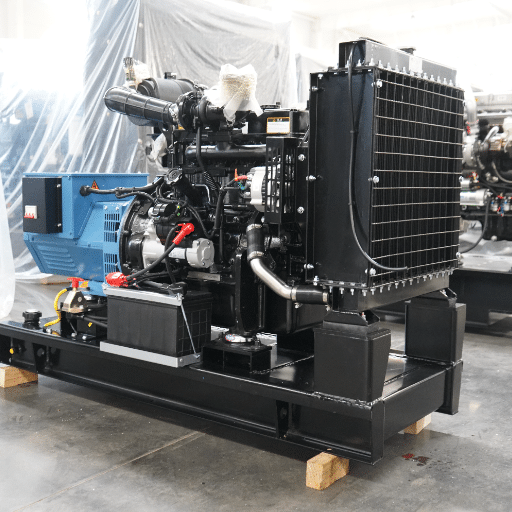



If you want to know how to choose a diesel generator, start by calculating your total electrical load, including motor starting surge. Convert kW to kVA using a 0.8 power factor, add a 20–25% safety margin, then match the duty rating to how often the unit will run. From there, select the phase type, engine and alternator brands, enclosure, noise level, emissions certification, and total cost of ownership before deciding where to buy.
Most generator problems don’t start in the engine. They start in the specification. A unit that’s too small will trip under motor starting surge. A unit that’s too large will run underloaded, causing wet stacking, carbon buildup, and wasted fuel.
Elena, a bakery owner in Eastern Europe, first searched for backup power and almost bought a 30 kW gasoline portable unit because the price was low. After adding the starting current for her refrigeration compressor and a 25% margin, she realized she needed a 50 kVA prime-rated diesel generator with an automatic transfer switch. The diesel unit cost more upfront, but the fuel savings covered the difference within two years.
This guide explains how to choose a diesel generator for home, business, or industrial use. You’ll learn how to size correctly, compare fuel types, select the right duty rating, and build a specification that matches real operating conditions. You can also browse our full diesel generator for sale range to compare power ratings and configurations.
Key Takeaways
- A diesel generator is the right choice for heavy loads, long runtime, remote sites, and fuel storage independence.
- Size in kVA, not just kW, because motor starting surge can be 5–7× the running current of direct-on-line motors.
- Run the generator at 70–80% of rated capacity for efficiency and longevity; add a 20–25% safety margin during sizing.
- Match the duty rating to runtime: standby for outages, prime for regular variable load, continuous for non-stop base load.
- Total cost of ownership matters: purchase price is often less than one-third of lifetime cost when fuel, maintenance, and parts are included.
How to Choose a Diesel Generator in 8 Steps

This guide breaks the decision into eight practical steps. Each step answers a key question that buyers face when they evaluate power requirements, site conditions, and long-term operating cost.
What to Know Before You Choose a Diesel Generator
Diesel vs. Gasoline vs. Natural Gas
Before asking how to choose a diesel generator, confirm that diesel is the right fuel for your application. Diesel is not always the best fit. The table below compares the three main generator fuel types.
| Feature | Diesel Generator | Gasoline Generator | Natural Gas Generator |
|---|---|---|---|
| Fuel efficiency | Highest | Lowest | Moderate |
| Upfront cost | High | Low | High (large units) |
| Lifespan | 20,000–30,000 hrs | Shortest | 15,000–20,000 hrs |
| Maintenance | Less frequent | More frequent | Spark/ignition upkeep |
| Noise | Louder (75–90 dB) | Quieter (small units) | Quietest (58–69 dB) |
| Emissions | Higher (NOx, particulates) | Moderate | Lowest |
| Fuel storage | Long shelf life, on-site tank | Short shelf life, volatile | Pipeline (no storage) |
| Best for | Heavy/continuous/industrial | Portable/occasional | Urban/clean/quiet needs |
When Diesel Is the Right Choice
Choose a diesel generator when you need long runtime, heavy load handling, or fuel independence. Diesel engines produce higher torque at lower speeds. That makes them better for motor loads and continuous operation. Diesel also stores more easily than gasoline and doesn’t depend on a pipeline like natural gas.
Diesel is the standard for factories, hospitals, data centers, mining camps, and construction sites. In these places, reliability and fuel efficiency matter more than the lowest upfront price. If your site has strict noise or emissions limits, a silent diesel generator with a sound-attenuated canopy can solve the noise issue while keeping diesel’s operating benefits.
Need help deciding which fuel type fits your project? Browse our industrial diesel generator overview for application-specific guidance.
Step 1: Calculate Your Power Requirement
The first step in any diesel generator sizing guide or how to choose a diesel generator process is to calculate the load. Start with a complete equipment list. For each item, record the running power and the starting power.
Motors, compressors, pumps, and refrigeration units draw far more current during startup than during normal operation.
List Every Load
Group loads into categories: critical loads that must never lose power, essential loads that support operations, and non-essential loads that can be shed during an outage. For each device, note:
- Running watts or kW
- Starting watts or kVA for motor loads
- Voltage and phase (single-phase or three-phase)
Apply Diversity and Demand Factors
Not every device runs at full power at the same time. A demand factor of 0.70–0.85 is common for commercial buildings. Continuous-process facilities such as factories or hospitals often use 0.85–0.95 because more loads run simultaneously.
Account for Motor Starting Surge
Motor starting is the most common cause of generator undersizing. Direct-on-line (DOL) starting can pull 5–7× the running current. Star-delta starting reduces this to about 3×. Soft starters and variable frequency drives (VFD) bring it down to 1.5–2×.
When you size the generator, use the highest motor starting kVA that can occur while the rest of the load is already running. Do not average the surge. Design for the peak.
Add a Safety Margin
Add 20–25% above your peak calculated load. This margin covers future expansion, measurement uncertainty, and transient loads. It also keeps the generator in its efficient operating range.
Convert kW to kVA: Diesel Generator kW kVA Sizing Guide
Generator ratings are usually stated in kVA. The relationship is:
kVA = kW ÷ power factor
For most three-phase diesel generators, the power factor is 0.8. A 100 kVA generator therefore delivers approximately 80 kW of real power. Always size in kVA for motor-starting capacity, not just kW.
Sizing Example: Small Workshop
Imagine a metal workshop with the following loads:
| Equipment | Running kW | Starting kVA |
|---|---|---|
| CNC machine | 25 | 30 |
| Welder | 15 | 18 |
| Air compressor (DOL) | 10 | 60 |
| Lighting and fans | 5 | 5 |
| Total | 55 | 113 |
Peak load = largest starting kVA + other running kW = 60 + (25 + 15 + 5) = 105 kVA. With a 25% safety margin: 105 × 1.25 = 131 kVA. The workshop should choose a 150 kVA generator set, not a 75 kVA unit based only on running load.
Step 2: Choose the Right Duty Rating

A diesel generator selection guide must explain duty ratings. The same physical engine can have different ratings depending on how long it runs and how constant the load is. Using the wrong rating shortens life and voids warranties.
Emergency Standby Power (ESP)
ESP rating is for emergency backup only. The generator runs no more than 200 hours per year with an average load factor of 70%. It is designed for grid outages, not regular operation.
Limited Time Power (LTP)
LTP rating allows up to 500 hours per year. It suits seasonal peak shaving or temporary backup where runtime is limited but more than standby.
Prime Rated Power (PRP)
PRP is for unlimited annual hours with variable load. The generator can handle 10% overload for one hour in twelve. PRP is the right choice for factories, mines, remote camps, and any site where the generator is the main power source.
Continuous Operating Power (COP)
COP is for unlimited hours at a constant 100% load. It is used for base-load power, grid-parallel applications, and continuous industrial processes.
Which Rating Should You Choose?
Use standby rating only for backup. Use prime rating when the generator runs regularly under variable load. Use continuous rating when the load is steady and the unit runs non-stop.
Choosing a standby-rated generator for prime-power duty is one of the fastest ways to destroy an engine.
Step 3: Select Single-Phase or Three-Phase Output
Single-Phase
Single-phase output is used for homes, small offices, and light commercial loads. Voltage is typically 220–240 V. Single-phase generators are usually available up to about 30 kVA.
Three-Phase
Three-phase output is used for industrial motors, factories, data centers, and large commercial buildings. Voltage is typically 380–480 V. Three-phase generators provide smoother power delivery and better motor starting performance.
If your facility has three-phase equipment, you must choose a three-phase generator.
Step 4: Factor in Environment and Site Conditions

Site conditions reduce generator output. Ignoring derating is a common sizing mistake.
Altitude Derating
Engine output drops because thin air reduces combustion efficiency. A common rule of thumb is roughly 1% power loss per 100 m above 1,000 m. Always confirm the exact derating curve with the manufacturer.
Temperature Derating
High ambient temperature reduces cooling capacity. A typical allowance is 3% per 10°C above 40°C. Hot climates, poorly ventilated rooms, and containerized installations all need extra capacity.
Dust, Humidity, and Ventilation
Dusty environments such as mines and construction sites need heavy-duty air filtration. Humid or salty environments need corrosion protection. Indoor installations need adequate ventilation, exhaust routing, and cooling airflow. Choose an enclosure rated for the site.
Step 5: Specify Engine, Alternator, and Controller
Engine Brands
The engine is the heart of the generator set. Common options include:
- Cummins: Widely supported, strong global service network
- Perkins: Reliable for industrial and commercial use
- Deutz: Compact design, good for mobile applications
- Volvo / MTU: Premium tier for mission-critical and data center use
- Weichai, Yuchai, SDEC: Cost-effective options with shorter lead times
Alternator Brands
The alternator converts mechanical power into electrical power. Branded brushless alternators such as Stamford, Leroy-Somer, Mecc Alte, and Marathon offer better voltage regulation, lower harmonic distortion, and easier parts availability.
Controller Features
Modern controllers manage start/stop, monitoring, and protection. Look for:
- Automatic mains failure (AMF) for backup systems
- Automatic transfer switch (ATS) integration
- Remote monitoring via GSM or ethernet
- Paralleling capability for multiple units
- Fault logging and alarms
Step 6: Choose Enclosure, Noise, and Emissions Configuration
Enclosure Types
- Open skid: Lowest cost, full airflow, loudest
- Silent canopy: Sound-attenuated steel enclosure, typically 58–70 dB(A) at 7 m
- Containerized: Weatherproof, transportable, suitable for harsh environments
Noise Levels
Check local noise ordinances before specifying. Residential and hospital sites often require below 65 dB(A) at 7 m. Industrial sites may allow higher levels.
ISO 8528-10 provides standardized noise measurement methods.
Emissions Certifications
Verify the required emissions level for your destination market:
- EPA Tier 4 Final: Required in the United States
- EU Stage V: Required in European Union member states
- CPCB IV+: Required for many projects in India
- CE marking: Indicates compliance with EU safety and environmental directives
Step 7: Calculate Total Cost of Ownership

When you choose a commercial diesel generator for business, purchase price is only part of the decision. Lifetime cost usually includes fuel, maintenance, spare parts, and downtime risk.
Fuel Consumption
Typical diesel generator fuel consumption ranges from 0.24 to 0.28 L/kWh. A 500 kVA generator at 75% load can use roughly 90–110 liters per hour.
Over 2,000 operating hours per year, fuel cost can exceed the purchase price.
Maintenance Intervals
Regular maintenance includes oil changes, filter replacement, coolant checks, battery inspection, and load bank testing. Follow a generator maintenance checklist so planned maintenance prevents unplanned downtime.
Spare Parts and Service Network
Choose engine and alternator brands with parts availability in your region. A premium brand without local support can cost more to maintain than a mid-tier brand with strong local distribution.
Upfront vs. Lifetime Cost
A low purchase price often means a lower-tier engine, unbranded alternator, or basic controller. Over 10–15 years, the savings can disappear.
Higher fuel consumption, shorter component life, and difficult repairs add up fast. Purchase price is often less than one-third of total lifetime cost.
Patel Contractors in Southeast Asia learned this when sourcing a 100 kVA mobile generator for a road project. They selected a silent diesel unit on a trailer because it handled welding surge and met local noise limits. The factory-direct order included a load bank test before shipment.
The unit ran reliably for the full six-month contract with only scheduled maintenance.
Step 8: Decide Where to Buy
The final step in how to choose a diesel generator is deciding where to buy.
Manufacturer-Direct
Buying manufacturer-direct is best for custom specifications, bulk orders, OEM branding, and export projects. You get the lowest unit price and the most flexibility. Lead time is typically 4–16 weeks.
Authorized Dealer
Dealers offer faster delivery and local warranty service. This channel suits urgent single-unit orders or buyers who need local commissioning support.
B2B Marketplace
Marketplaces such as Alibaba and Made-in-China are useful for comparing suppliers quickly. They work well for smaller orders, but always verify engine serial numbers, alternator brands, and factory acceptance test documentation.
Used / Surplus
Used generators can be cost-effective for budget backup if condition is verified. Always request operating hours, maintenance records, and a recent load bank test.
For more guidance on digital procurement, read our article on diesel generators for sale online.
Common Mistakes When Choosing a Diesel Generator
How to Choose a Diesel Generator Without Oversizing or Undersizing
Avoid these specification errors during the selection process.
- Undersizing: Ignoring motor starting surge and designing only for running load
- Oversizing: Buying a much larger unit than needed, causing wet stacking and poor fuel economy
- Wrong duty rating: Using a standby-rated generator for prime or continuous duty
- Ignoring derating: Failing to account for altitude, temperature, and ventilation
- Brand without support: Selecting an engine brand with no local parts or service network
- Neglecting fuel logistics: Underestimating tank size, fuel storage, and delivery schedule
- Price-only buying: Choosing the cheapest quote without comparing lifetime cost and documentation
Diesel Generator Selection Checklist

Use this how to choose a diesel generator checklist before you finalize your specification.
- Load inventory completed (running and starting watts)
- Diversity/demand factor applied
- 20–25% safety margin added
- kW converted to kVA using power factor
- Duty rating matched to runtime (ESP/LTP/PRP/COP)
- Phase type confirmed (single vs. three)
- Site derating calculated (altitude/temperature)
- Engine and alternator brands specified
- Controller/ATS/remote monitoring selected
- Enclosure and noise level confirmed
- Emissions certification verified for destination market
- Fuel consumption and tank runtime calculated
- Maintenance and spare parts plan in place
- Total cost of ownership estimated
- Supplier verified (factory audit, FAT, references)
Conclusion
Learning how to choose a diesel generator means moving beyond catalog browsing to real engineering decisions. The right generator matches your power requirement, duty cycle, environment, and long-term operating cost.
Start with an accurate load calculation. Size in kVA, not just kW. Add a safety margin. Match the duty rating to how the unit will actually run. Then select the engine, alternator, controller, enclosure, noise level, and emissions configuration that fit your site.
Whether you need a small backup unit or a large industrial diesel generator, the process is the same. Specify accurately. Verify components. Plan for total cost of ownership. Buyers who follow this process avoid the two most expensive mistakes: buying too small and buying the wrong rating.
If you’re evaluating how to choose a diesel generator for a project, start with your load list and site conditions. Then compare real specifications and documentation, not just marketing claims.
Ready to find the right diesel generator for your application? Contact our engineering team for a load assessment, specification review, and factory-direct quote.
FAQ
These answers cover the most common questions about how to choose a diesel generator.
How do I choose the right size diesel generator?
List all loads with their running and starting power. Add the largest motor starting surge to the other running loads. Apply a 20–25% safety margin. Convert kW to kVA using a 0.8 power factor. Choose the next standard generator size above the result.
What is the difference between kW and kVA?
kW is real power consumed by the load. kVA is apparent power, which includes reactive power. For most diesel generators, kVA = kW ÷ 0.8. Generator ratings are given in kVA because they account for motor starting surge and power factor.
What does standby, prime, and continuous power mean?
Standby power is for emergency backup with limited annual runtime. Prime power is for unlimited hours under variable load. Continuous power is for unlimited hours at constant full load. Using the wrong rating shortens engine life.
Should I choose diesel, gasoline, or natural gas?
Choose diesel for heavy loads, long runtime, and fuel storage independence. Choose gasoline for portable, occasional, low-cost backup. Choose natural gas if you have pipeline access and need clean, quiet operation.
How much fuel does a diesel generator use?
Typical fuel consumption is 0.24–0.28 L/kWh. A 500 kVA generator at 75% load can use roughly 90–110 liters per hour. Actual consumption depends on engine efficiency, load level, and site conditions.
What size diesel generator do I need for my house?
A typical home with essential loads such as lighting, refrigeration, pumps, and air conditioning needs 10–30 kVA. Larger homes with electric heating or multiple air conditioners may need 30–50 kVA. Always calculate actual loads before deciding.
What size diesel generator do I need for a factory?
Factory sizing depends on total running load plus motor starting surge. Small workshops may need 50–150 kVA. Medium factories often need 250–500 kVA. Large industrial plants may need 1,000 kVA or more.
How do I calculate motor starting surge?
Direct-on-line (DOL) motors can draw 5–7× running current at startup. Star-delta starting reduces this to about 3×. Soft starters and VFDs reduce it further to 1.5–2×. Size the generator for the highest surge that can occur while other loads are running.
How do I choose a diesel generator for an industrial site?
Start with the load inventory, motor starting surge, and duty rating for industrial diesel generator selection. Then specify the engine and alternator brands, enclosure type, noise limits, and emissions certification for the destination market. Finally, compare total cost of ownership and delivery terms from at least two suppliers.
What is the best engine brand for diesel generators?
Cummins and Perkins are widely supported globally. Deutz is compact and good for mobile use. Volvo and MTU are premium choices for mission-critical applications. Weichai, Yuchai, and SDEC offer strong cost-performance for budget-conscious projects.
Can I buy a diesel generator directly from a manufacturer?
Yes. Many manufacturers accept single-unit and bulk orders. Manufacturer-direct sourcing offers the best customization, lowest unit price, and OEM branding options. Lead times are typically 4–16 weeks.
How much does a diesel generator cost?
Prices for small, portable units start at approximately $3,000. Commercial units with power ratings between 30 and 100 kVA typically range from $8,000 to $28,000. Industrial units ranging from 250 to 1,000 kVA fall within the $45,000 to $180,000 price range. Factors such as the engine brand, generator (alternator) brand, enclosure type, and emissions certification influence the price.
Is it better to buy a new or used diesel generator?
Buy new when reliability, warranty, and long life matter. Buy used only when budget is tight and you can verify operating hours, maintenance records, and recent load bank test results. Used generators carry higher downtime risk.