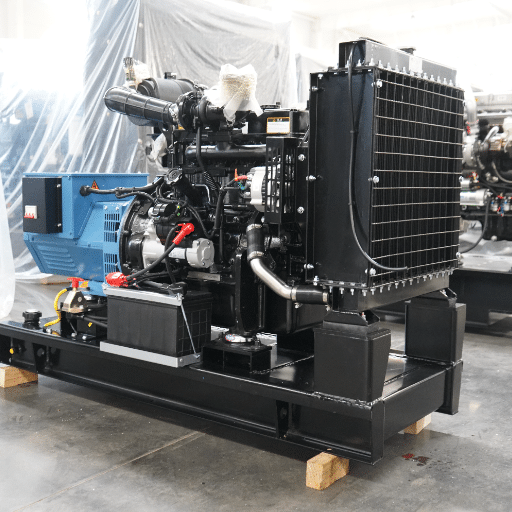

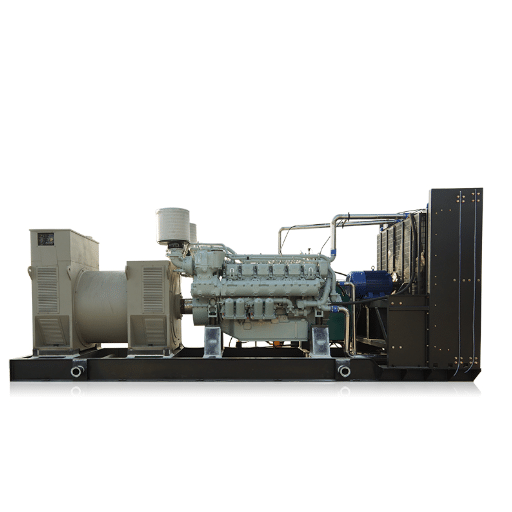
An industrial diesel generator is a heavy-duty genset built for factories, mines, hospitals, data centers, and other demanding applications where power failure is not an option. These units typically range from 150 kW to over 3,000 kW, run on three phase diesel generator power, and are engineered for prime or continuous duty rather than occasional backup.
A single hour of downtime can cost a manufacturing plant $10,000 or more. Yet many buyers still choose an industrial generator based on rough estimates or the lowest quoted price, then discover too late that the unit is undersized, overrated, or unsupported in their region. The result is voltage dips, production stoppages, or a generator that cannot start the largest motor on site.
This guide explains what makes a diesel generator for industrial use different from commercial units, where it is used, how to size it correctly, and what to specify when sourcing from a manufacturer. Whether you’re a factory manager, procurement officer, or project engineer, you’ll get a practical framework for selecting reliable power solutions.
Key Takeaways
- An industrial diesel generator is built for heavy, continuous, or critical loads, typically from 150 kW to 3,000+ kW.
- Correct sizing requires a load inventory, motor starting surge calculation, demand factor, safety margin, and site derating.
- ISO 8528-1 duty ratings matter: choose ESP for emergency standby, PRP for prime/variable load, and COP for continuous base-load.
- Factory-direct pricing in 2026 ranges from roughly 18,000for150–250kWsets∗∗to∗∗18,000for150–250kWsets∗∗to∗∗350,000+ for 2,000+ kW project-based systems.
- Total cost of ownership includes fuel consumption (~0.24–0.28 L/kWh), maintenance intervals, spare parts availability, and long-term support.
What Is an Industrial Diesel Generator?

Definition and Key Characteristics
An industrial diesel generator, or genset, combines a diesel engine with an alternator to produce electrical power for industrial applications. Unlike smaller commercial or residential units, it is designed for high load, long runtime, and harsh conditions.
Key characteristics of a heavy duty diesel generator include:
- Power range: typically 150 kW to 3,000+ kW (188 kVA to 3,750+ kVA at 0.8 power factor)
- Three-phase output for stable supply to large motors and facilities
- Heavy-duty frame, cooling, and air filtration for factory, mining, or remote sites
- Prime or continuous duty rating for extended operation
- Advanced control and monitoring including AMF, ATS, and remote diagnostics
These characteristics make an industrial diesel generator the right choice when failure cost is high and runtime expectations are demanding.
Industrial vs Commercial Diesel Generator
The terms “industrial” and “commercial” are not fuel-based categories. Both can be diesel-powered. The difference is capacity, duty cycle, build quality, and intended use.
| Feature | Commercial Diesel Generator | Industrial Diesel Generator |
|---|---|---|
| Power range | 20–750 kW | 150 kW–3,000+ kW |
| Duty cycle | Standby or limited runtime | Prime, continuous, or heavy standby |
| Phase | Single or three-phase | Usually three-phase |
| Build quality | Business-grade | Heavy-duty, reinforced components |
| Applications | Offices, retail, schools, hotels | Factories, mines, hospitals, data centers |
| Upfront cost | Lower | Higher, but longer service life |
| Maintenance | Standard schedules | Robust predictive and preventive programs |
Commercial units work well for short-term backup in business buildings. Industrial units are the correct choice for production lines, life-support systems, 24/7 remote sites, and mission-critical infrastructure.
Need to compare commercial options? Browse our commercial diesel generator range for business backup power solutions.
Why Diesel for Industrial Use?
Diesel remains the dominant fuel for industrial generators because it delivers high power density, strong load handling, fast startup, fuel efficiency, and durability under heavy load.
Industrial Diesel Generator Applications
Manufacturing and Factories
Factories use industrial diesel generators for both backup and prime power. A plastics plant in Vietnam learned this the hard way after three grid failures in one year stopped production and spoiled a batch worth $15,000 each time. After a formal load study, the plant installed a 1,500 kVA prime-rated genset with a Cummins engine and Stamford alternator. The unit now starts the full production line within seconds and has prevented four outages in the following year.
For manufacturing, the right diesel generator for factory use must handle motor inrush, accept load in one step, and run cleanly enough to avoid voltage dips that trip variable frequency drives.
Mining and Remote Operations
Mining operations rely on diesel generators for more than 70% of their power needs, especially where grid access is unavailable. These units must handle dust, high ambient temperatures, and 24/7 operation. Heavy-duty air filtration, oversized radiators, and reinforced frames are standard.
A remote drilling contractor in Africa used two 800 kVA industrial backup power generator units in a paralleled N+1 configuration. The setup provided prime power for the camp and allowed maintenance on one unit without shutting down operations.
Hospitals and Healthcare
Hospitals require emergency backup power for life-support equipment, operating rooms, ICUs, and emergency lighting. Multiple standby generators with automatic transfer switches are common. Noise, emissions, and transient response must meet strict local standards.
A hospital in Southeast Asia upgraded to two 500 kVA silent diesel generators with ISO 8528-5 compliant transient response and NFPA 110 certification. The project passed inspection because the gensets could accept rated load in one step without affecting sensitive medical equipment.
For noise-sensitive healthcare applications, explore our silent diesel generator for sale options.
Data Centers and Telecommunications
Data centers target 99.999% uptime. Diesel generators act as the final fail-safe behind UPS systems. They must start automatically, accept full load instantly, and run long enough to cover extended outages or fuel resupply delays.
Telecom towers and switching stations also rely on industrial backup power generators for continuity during grid failures.
Construction and Infrastructure
Construction sites need mobile or skid-mounted generators for tower cranes, welding machines, concrete mixers, lighting, and site offices. These units are often moved as the project progresses, so durability and ease of transport matter as much as power output.
How to Size an Industrial Diesel Generator

Sizing is the most critical step in selecting an industrial diesel generator. An undersized unit will trip on motor starting or overload. An oversized unit will run inefficiently, build carbon deposits, and suffer from wet stacking.
Step 1: Inventory All Loads
List every load that must run during an outage or off-grid operation:
- Motors and pumps
- HVAC and compressed air
- Lighting and control systems
- IT and communication equipment
- Safety and life-safety systems
Record both running kW and starting kW or kVA for each item. Motor nameplates usually show running current; starting current depends on the starting method.
Step 2: Apply Demand and Diversity Factors
Not all equipment runs at full load at the same time. Apply a demand factor based on your operation:
- Typical manufacturing: 0.70–0.85
- Continuous-process facilities such as pharma or food: 0.85–0.95
- Batch or intermittent operations: 0.60–0.75
Example: 1,000 kW of connected load × 0.80 demand factor = 800 kW running load.
Step 3: Add Motor Starting Surge
Motors draw 5–7 times their running current during direct-on-line (DOL) startup. This is the most common cause of undersizing.
| Starting Method | Starting Multiplier |
|---|---|
| Direct-on-line (DOL) | ~6× running kVA |
| Star-delta | ~3× running kVA |
| Soft starter or VFD | 1.5–2× running kVA |
Add the largest motor starting surplus to the running load of all other equipment. If multiple large motors start simultaneously, combine their surge requirements.
Step 4: Apply Safety and Growth Margin
Add 20–30% to cover future expansion, voltage drop, harmonics, and temporary peaks. A 25% margin is common for industrial projects.
Example: 1,232 kVA × 1.25 = 1,540 kVA → select a 1,600 kVA unit.
Step 5: Apply Site Derating
Standard ratings assume 25°C ambient, sea-level altitude, and clean air. Adjust for real conditions:
- Altitude: approximately 1% output reduction per 100 m above 1,000 m
- Temperature: approximately 3% output reduction per 10°C above 40°C
- Dust or humidity: may require upgraded filtration or cooling
A 2,000 kVA generator installed at 2,000 m altitude and 45°C may deliver closer to 1,600 kVA effective output without derating being calculated.
Sizing Example: Small Factory
A food processing plant needs backup for:
- 400 kW of motors and pumps
- 150 kW of refrigeration
- 100 kW of HVAC and lighting
- 50 kW of controls and IT
Total connected load: 700 kW
Demand factor (0.80): 560 kW running load
Largest motor DOL starting surge: +240 kVA
Subtotal: 800 kVA at 0.8 power factor
25% safety margin: 1,000 kVA
Site derating at 1,200 m altitude: ~2% → select 1,025 kVA, rounded to 1,100–1,250 kVA
This is the kind of calculation a manufacturer or experienced engineer should verify before purchase.
ISO 8528-1 Power Ratings Explained

ISO 8528-1 defines four duty-cycle ratings for reciprocating engine-driven generator sets. Choosing the wrong rating is a common and expensive mistake.
| Rating | Full Name | Max Hours | Avg Load | Overload | Typical Use |
|---|---|---|---|---|---|
| ESP | Emergency Standby Power | 200 hrs/year | 70% of ESP | None | Hospital backup, data center emergency |
| LTP | Limited Time Power | 500 hrs/year | 70% of LTP | 10% for 1 hr / 12 hr | Seasonal construction, events |
| PRP | Prime Rated Power | Unlimited | 70% of PRP | 10% for 1 hr / 12 hr | Manufacturing, mining, remote prime power |
| COP | Continuous Operating Power | Unlimited | 100% of COP | None | Base-load, grid-parallel, telecom |
Emergency Standby Power (ESP)
ESP is for short-duration grid outages. The unit can run at full rated power, but only for limited annual hours. Do not use ESP for prime or continuous duty.
Limited Time Power (LTP)
LTP allows more annual hours than ESP and is suitable for applications such as seasonal construction or planned grid support.
Prime Rated Power (PRP)
PRP is for unlimited hours at variable load. It allows a 10% overload for one hour in every twelve. This is the right rating for most diesel generator for industrial use applications where the unit is the primary or frequent source of power.
Continuous Operating Power (COP)
COP is for unlimited hours at constant, 100% rated load with no overload allowance. Use COP for base-load power stations, continuous industrial processes, or grid-parallel applications.
Which Rating Should You Choose?
- Rare outages, emergency only → ESP
- Seasonal or scheduled use up to 500 hrs/year → LTP
- Frequent or variable load, primary power → PRP
- Constant full load, base-load operation → COP
If you buy a standby-rated generator for a mining camp that runs 18 hours per day, you will shorten its life and void warranty coverage. Match the rating to the real duty.
Key Specifications to Check
Engine and Alternator Brands
The engine provides mechanical power; the alternator converts it to stable electrical output. Common combinations include:
- Engines: Cummins, Perkins, Deutz, Volvo, MTU, Weichai, Yuchai, SDEC, Baudouin
- Alternators: Stamford, Leroy-Somer, Mecc Alte, Marathon
Tier-1 engines cost more but offer global parts networks and longer service intervals. Regional engines can deliver strong value where parts and service support are available locally.
Controller and ATS
Modern industrial generators include digital controllers that handle AMF detection, ATS signaling, remote monitoring, paralleling, load sharing, and fault logging. For critical facilities, specify ATS integration and remote monitoring from the start.
Enclosure and Noise
Enclosure choice affects cost, footprint, and noise level. Open skid is lowest cost but needs shelter. Silent canopy reduces noise to 65–75 dB(A) at 7 m. Containerized enclosures offer the best protection and transportability, often used for 1,000+ kW units.
Hospitals, residential-adjacent factories, and urban data centers usually require silent diesel generator for industrial use enclosures.
Match certifications to your destination market. ISO 8528-1 covers power rating definitions. ISO 8528-5 covers steady-state and transient performance. ISO 9001 covers manufacturing quality.
CE applies to Europe, EPA Tier 4 Final to the U. S., and EU Stage V to European mobile and stationary engines. A factory-direct supplier should provide test reports, certificates of origin, and engine authorization letters to prove compliance.
Industrial Diesel Generator Prices in 2026

For buyers focused on industrial generator sizing, price is usually a function of power rating, engine brand, and configuration. The table below shows typical factory-direct price ranges for 2026.
| Approx. kW | Approx. kVA | Typical Price Range (USD) | Common Applications |
|---|---|---|---|
| 150–250 kW | 188–313 kVA | 18,000–18,000–45,000 | Small factories, hospitals, large commercial sites |
| 250–500 kW | 313–625 kVA | 35,000–35,000–85,000 | Manufacturing, data centers, mid-size mines |
| 500–1,000 kW | 625–1,250 kVA | 75,000–75,000–180,000 | Large factories, drilling camps, heavy industry |
| 1,000–2,000 kW | 1,250–2,500 kVA | 150,000–150,000–400,000 | Large mines, power plants, district backup |
| 2,000+ kW | 2,500+ kVA | $350,000+ | Project-based, paralleled systems, utilities |
What Moves the Price
- Engine brand and origin: Cummins or Perkins cost more than Weichai or Yuchai
- Alternator brand: Stamford, Leroy-Somer, and Mecc Alte add cost and stability
- Enclosure type: silent or containerized enclosures add 3,000–3,000–20,000+
- Controller and monitoring: AMF/ATS, remote monitoring, and paralleling increase cost
- Emissions certification: EPA Tier 4 Final and EU Stage V add engineering cost
- Fuel tank capacity: extended runtime tanks add material and shipping cost
- Order quantity and customization: OEM branding, custom voltage, and bulk orders affect pricing
For detailed pricing on a common mid-range unit, see our 500kW diesel generator price breakdown.
Total Cost of Ownership
Purchase price is only part of the equation. Over a 10–15 year life, fuel, maintenance, and parts often exceed the initial investment.
Fuel Consumption
Industrial diesel generators typically consume 0.24–0.28 liters per kWh. A 1,000 kVA genset running at 75% load (~800 kW) uses roughly 220 liters per hour. At 1.00perliter,thatis1.00perliter,thatis220 per hour of operation, or $5,280 per day for continuous use.
Fuel efficiency varies by engine technology, load factor, and maintenance condition.
Maintenance Intervals
Typical maintenance includes:
- Engine oil and filter changes every 250–500 operating hours
- Fuel filter and air filter replacement based on conditions
- Cooling system inspection and coolant replacement
- Battery, starter, and alternator checks
- Load bank testing at least annually
Sites with dirty air, high temperatures, or continuous duty need shorter intervals.
Spare Parts and Long-Term Support
Engine and alternator parts availability determines long-term operating cost. A Tier-1 engine may cost more upfront, but global parts distribution reduces downtime. Regional engines can be cost-effective if the supplier maintains local stock and technical support.
Factory-direct suppliers can often bundle spare parts kits with the initial shipment, reducing lead time for critical components.
For a structured maintenance plan, use our generator maintenance checklist.
Common Sizing and Buying Mistakes

Avoid these errors when selecting an industrial diesel generator:
- Undersizing: ignoring motor starting surge causes voltage dips and protective tripping
- Oversizing: running consistently below 30% load leads to wet stacking, carbon buildup, and poor fuel efficiency
- Wrong duty rating: using ESP for prime power voids warranty and shortens engine life
- Ignoring derating: altitude and temperature reduce real output below the nameplate rating
- Neglecting fuel logistics: storage, delivery, and contamination control are often overlooked
- Choosing engine brand without parts support: a low price is meaningless if service is unavailable
- Skipping factory acceptance testing: FAT with load bank verification confirms performance before shipment
Conclusion
An industrial diesel generator is not just a larger version of a commercial backup unit. It is purpose-built for heavy, continuous, or critical loads where failure has serious operational or safety consequences. The right choice depends on accurate load sizing, correct ISO 8528-1 duty rating, verified engine and alternator brands, and a clear understanding of total cost of ownership.
Factories, mines, hospitals, and data centers all have different requirements, but the decision process is the same: start with the load profile, apply real site conditions, choose the right rating, and verify supplier capability before purchase.
If you are evaluating an industrial diesel generator for your project, begin with a load list and duty estimate. Then compare real specifications, not just marketing claims or headline prices. For a deeper look at factory-direct options, explore our full range of diesel generators for sale.
Ready to specify the right generator for your application? Contact our engineering team for sizing support, specifications, and a factory-direct quote.
FAQ
What is the difference between industrial and commercial diesel generators?
Industrial diesel generators are built for heavier loads, longer runtime, and harsher environments. They typically start around 150 kW and use three-phase power. Commercial generators are smaller, lighter-duty units designed for offices, retail, and short-term backup.
How do I size an industrial diesel generator for my factory?
Start by listing all loads and their running power. Apply a demand factor, add the largest motor starting surge, include a 20–30% safety margin, and adjust for altitude and temperature. Convert the final kW figure to kVA using the power factor, usually 0.8.
What does kVA mean for an industrial generator?
kVA is apparent power. kW is real power. The relationship is kW = kVA × power factor. Industrial generators are usually rated at 0.8 power factor, so a 1,000 kVA generator delivers 800 kW of real power.
What is prime power vs standby power?
Prime power (PRP) allows unlimited hours at variable load with occasional overload. Standby power (ESP) is for short emergency operation, typically limited to 200 hours per year. Choose PRP for industrial sites without reliable grid power.
How much fuel does an industrial diesel generator use?
Typical fuel consumption is 0.24–0.28 liters per kWh. A 1,000 kVA unit at 75% load uses roughly 220 liters per hour. Actual consumption depends on engine efficiency, load factor, and maintenance condition.
Which engine brand is best for industrial diesel generators?
Cummins, Perkins, Deutz, Volvo, and MTU are widely used for heavy-duty industrial applications due to global support and proven reliability. Weichai, Yuchai, SDEC, and Baudouin offer strong cost-performance where local parts support exists.
Can industrial diesel generators run continuously?
Yes, if rated for prime (PRP) or continuous (COP) duty. Do not run a standby-rated (ESP) generator continuously. The duty rating determines allowable annual hours, average load, and overload capability.
What certifications does an industrial generator need?
Common certifications include ISO 8528-1 for ratings, ISO 8528-5 for performance, ISO 9001 for quality, CE for Europe, and EPA Tier 4 Final or EU Stage V for emissions. Specific requirements depend on the destination market and application.
How much does an industrial diesel generator cost?
Factory-direct prices in 2026 range from about 18,000fora150–250kWsetto18,000fora150–250kWsetto350,000+ for a 2,000+ kW project-based system. Engine brand, alternator, enclosure, controller, emissions certification, and customization all affect price. For current listings, browse our industrial diesel generator range.
Can I get a custom industrial diesel generator from a manufacturer?
Yes. Factory-direct manufacturers can customize voltage, frequency, canopy color and branding, fuel tank size, controller functions, ATS, remote monitoring, and emissions configuration. Customization is one of the main advantages of sourcing directly from a manufacturer.