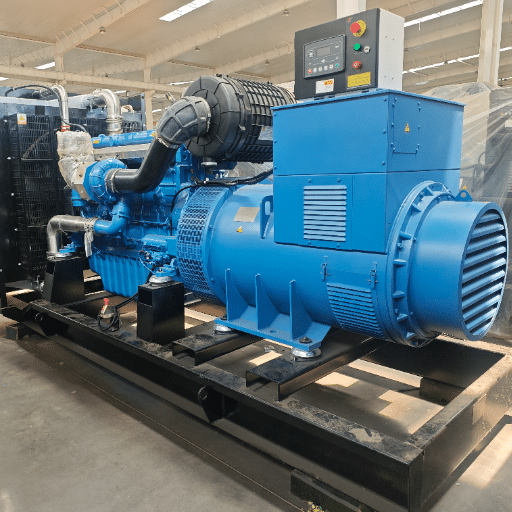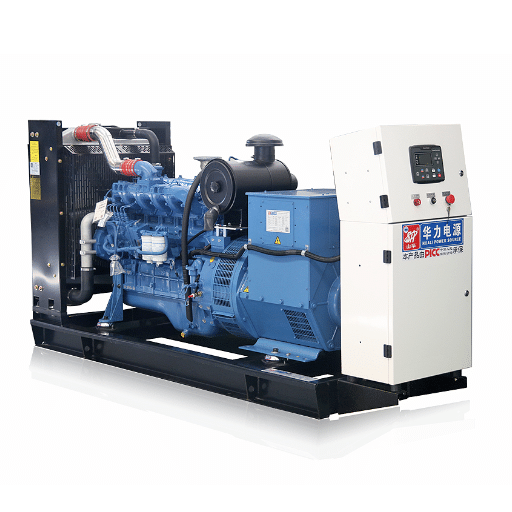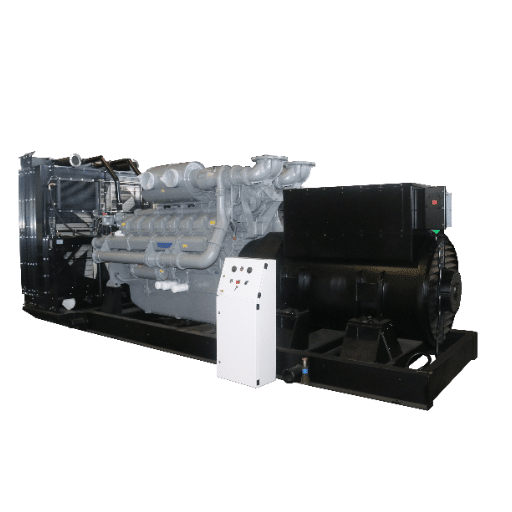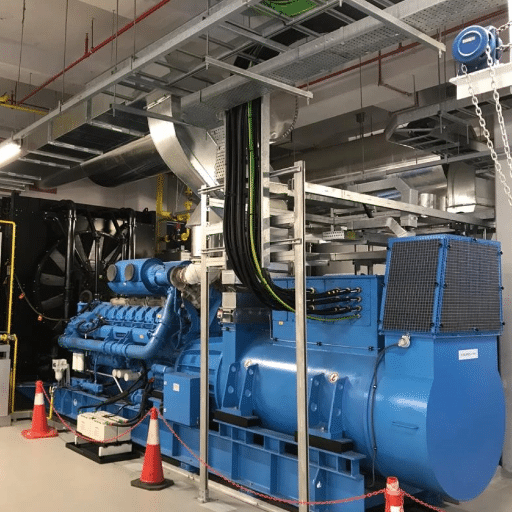



A generator for mining operations should be a prime-rated diesel unit, sized to total continuous load plus 20 to 30 percent reserve, with motor starting surge of 2 to 3 times rated current factored in. Environmental specs must match dust, altitude, and temperature at site. Most mid-to-large mines specify gensets between 500 kVA and 2,500 kVA, often paralleled for redundancy.
At 4,200 meters in the Andes, Carlos watched his ore-processing line slow to a halt for the third time in two weeks. The genset nameplate said 1,250 kVA. The unit was healthy. The problem was that nobody on the procurement team had factored in 12 percent altitude derating, plus another 6 percent for ambient temperature, plus 3 percent for the alternator above 40 degrees Celsius. The nameplate kVA was a fiction in his operating context. The fix was simple, but it cost his company eleven days of production and a $290,000 emergency airfreight bill for a turbocharged replacement.
Most mine operators know diesel power is non-negotiable on a remote site. Few of them go through the actual derating math, fuel logistics modeling, and compliance review before signing a purchase order. This guide gives you the same framework Shanghai Huali engineers use when scoping a mining genset project, from load profiling through after-sales spec, so the unit you specify will still be running in year ten. You will learn how to size for mining loads, how to apply altitude and temperature derating, how to model lifecycle fuel cost, where MSHA and EPA Tier 4 Final apply, and how hybrid solar and battery configurations are reshaping mine economics in 2026.
Key Takeaways
- Diesel still supplies roughly 72 percent of mining energy because of its energy density, fast cold-start, and global parts coverage
- Stacked derating for altitude (3 to 4 percent per 300 m above 1,000 m) and temperature (3 percent per 5 degrees C above 40) can cut nameplate output by 20 to 30 percent
- Remote mine power costs run from 20 cents per kWh to over $1 per kWh once trucking, storage, and partial-load inefficiency are included
- Hybrid solar plus battery plus diesel configurations cut diesel runtime 60 to 90 percent and have delivered fuel savings above 1.6 million liters per year at real mines
- MSHA, EPA Tier 4 Final, CARB Level 3+ DPF, and the 2026 Tier 5 workshop all reshape what counts as a compliant prime-power installation
Need a sizing review for your specific mine site? Talk to our engineering team for a free project assessment before you finalize a purchase order.
Why Mining Operations Demand a Different Class of Generator

Mining is one of the most demanding power environments on earth. A mine runs 24 hours a day, often in regions where the grid is absent, brittle, or simply too far away to reach. Diesel still supplies around 72 percent of the energy used in mining operations, which is a higher share than almost any other industrial sector.
The reason is simple. Mining gear pulls hard, starts hard, and runs hard. Crushers, ball mills, ventilation fans, dewatering pumps, and haulage equipment can pull two to seven times their rated current at startup. Solar and battery alone cannot handle that load profile in most operating conditions. A prime-rated diesel genset can.
Downtime in mining is expensive in a way that few other industries match. A copper concentrator that loses power for four hours can scrap a full batch and trigger ventilation and dewatering recovery sequences that take a full shift to re-stabilize. For long-life mines, the cost of one unplanned outage can exceed the capex of the genset itself.
The global diesel generator market reflects this dependency. Fortune Business Insights values the market at 22.33billionin2025,growingto22.33billionin2025,growingto23.94 billion in 2026 and $38.09 billion by 2034, with mining cited as one of the strongest end-use drivers alongside data centers and oil and gas. Asia-Pacific holds about a third of that share and is the fastest-growing region, driven by mining demand in Indonesia, Australia, and India where gensets often run 6,000 to 8,000 hours per year.
Our diesel generator solutions are built for exactly this kind of duty cycle, with engine and alternator combinations that hold stable output through demanding mine load profiles.
Mining Power Loads: What You Are Actually Sizing For
Before you can size a generator for mining operations, you have to understand the load profile. Mining is not one load type. It is at least four.
Surface haulage and processing. Crushers, conveyors, ball mills, and concentrator equipment dominate the load curve. A mid-sized mill alone can pull 600 to 1,500 kW continuously, with starting surges that test any genset.
Underground ventilation and pumping. Underground mines are dominated by ventilation. Studies summarized in MDPI’s 2025 review of mine ventilation energy show that ventilation accounts for 25 to 50 percent of total mine energy, with installed fan power often above 10,000 kW. Primary fans alone can be rated at 1,100 kW per unit.
Processing plants. Heap leach pumps, flotation circuits, and tailings handling add stable continuous loads on top of the variable mining loads.
Fly camp and accommodation. Lighting, HVAC, water treatment, communications, and life safety draw smaller but non-negotiable loads, typically 50 to 300 kW per camp.
| Mine Type | Typical Continuous Load | Recommended Generator Size | Notes |
|---|---|---|---|
| Exploration / fly camp | 50 to 200 kW | 80 to 250 kVA | Mobile, often containerized |
| Surface mine, small | 200 to 500 kW | 300 to 650 kVA | Single unit feasible |
| Underground, mid-size | 500 to 1,500 kW | 650 to 2,000 kVA | Multi-unit recommended |
| Open-pit, large | 2,000 to 8,000+ kW | Multiple 1,500 to 2,500 kVA in parallel | Microgrid topology |
| Major operation | 8,000 to 30,000+ kW | Multi-MW power plant | Utility-grade engineering |
Mining loads will not add together because they behave as non-additive elements. You need to understand what runs together, what starts when, and what cannot tolerate even a brief sag.
How to Size a Generator for a Mining Site

Sizing a generator for mining operations is a six-step process. Skipping any step is how procurement teams end up with a unit that is healthy but underpowered for the site.
Step 1: Inventory Continuous Loads
List every device that will be powered by the generator. Capture rated kilowatts, motor count, and whether the load is critical or deferrable. Use real measured values where possible, not nameplate fiction.
Step 2: Calculate Motor Starting Surge
Three-phase induction motors used in mining can pull two to seven times rated current at startup. Direct-on-line starting is brutal. Soft starters and variable frequency drives reduce inrush, but if you have not specified them you must size for the worst case.
Add the highest single starting surge to the sum of all continuous loads. That is the peak the generator must deliver without stalling.
Step 3: Apply Reserve Margin
Add 20 to 30 percent for measurement uncertainty, future expansion, and the simple reality that mining loads grow as new equipment arrives. A mine that opens at 1,200 kW often runs at 1,800 kW within three years.
Step 4: Convert kW to kVA
Multiply your peak kW by 1.25 (the inverse of a typical 0.8 power factor) to get the kVA rating. A peak load of 800 kW translates to a 1,000 kVA generator at minimum.
Step 5: Apply Altitude and Temperature Derating
This is where most sizing errors hide. Derating is real, stacked, and unforgiving.
| Factor | Typical Loss |
|---|---|
| Altitude (above 1,000 m) | 3 to 4 percent per 300 m |
| Ambient temperature (above 40 degrees C) | 3 percent per 5 degrees |
| Alternator (above 40 degrees C) | 3 percent per 5 degrees |
| Dust loading on radiator | 2 to 5 percent additional |
A 1,000 kVA generator at sea level becomes about 750 kVA at 3,500 meters in a hot dusty pit. Carlos learned this lesson the expensive way.
Step 6: Specify Turbocharging and Cooling Headroom
For mining sites above 1,000 meters, turbocharged engines with charge-air aftercooling partly recover lost power. Oversized radiators and dual-stage air filtration handle the dust and heat loads typical of mine environments.
For complete sizing methodology that also covers gas-fueled units, see our companion guide on how to size a natural gas generator for industrial applications.
Prime Power vs. Standby: Why It Matters for Total Cost of Ownership

A common procurement mistake is buying a standby-rated generator and running it as prime power. The price difference is real, but the consequences are worse.
Prime power ratings allow unlimited annual run hours at variable load, with overload capacity for short periods. This is what most off-grid mines need.
Continuous power ratings allow unlimited hours at constant load. This suits steady-state processing plants.
Standby ratings allow limited annual hours, typically under 200, at varying loads. Standby is for grid-connected mines where the genset only runs during outages.
A standby-rated genset run as prime will void warranty, accelerate engine wear, and fail at 30 to 50 percent of expected service life. The capex savings disappear in the first overhaul.
Adaeze led procurement for a nickel exploration camp in West Africa. She picked the cheapest 800 kVA unit on the bid sheet, labeled “prime” by the supplier but actually a re-badged standby model. Fourteen months in, with no bulk fuel polishing program and no day tank discipline, contaminated diesel clogged the injectors during a critical drill program. She lost $1.1 million in rig hours, plus a delay penalty her sponsor never let her forget. The lesson is not just about fuel quality. It is that “prime” on a spec sheet means nothing without a credible engine and alternator behind it.
Environmental Specs: Building a Mine-Ready Generator
A generator for mining operations is not a standard industrial unit in a slightly tougher box. It is a different specification.
Dust ingress protection. Mining sites generate fine particulates that destroy radiators, alternators, and control electronics. Specify IP54 or higher enclosures, sealed control cabinets, and dual-stage heavy-duty air filtration. Filter service intervals are shorter than standard industrial use.
Altitude compensation. Above 1,000 meters, naturally aspirated engines lose power steeply. Turbocharged engines with charge-air cooling maintain output more aggressively. For sites above 3,000 meters, specify engines that have been factory-tested at altitude.
Temperature tolerance. Oversize the radiator for the maximum site ambient plus 10 degrees Celsius of margin. Specify the alternator at the actual class of insulation needed, not the OEM default.
Vibration and shock. Skid-mounted gensets near blasting zones need shock-isolated mounts and reinforced control panels. Loose connections from sustained vibration cause intermittent faults that are hard to diagnose.
Cold start. High-altitude mines in the Andes, Mongolia, or northern Canada deal with sub-zero starting conditions. Specify block heaters, battery warmers, and cold-weather lubricants. A mine cannot wait two hours for a genset to warm up after a fuel changeover.
Corrosion. Powder-coated steel, sealed enclosures, and stainless hardware extend service life in humid coastal mines and acidic processing environments.
Fuel Strategy and the Real LCOE of Remote Mine Power
Most procurement decisions weigh capex too heavily and fuel logistics too lightly. For a remote mine, fuel is the dominant lifecycle cost.
A diesel generator consumes roughly 0.25 to 0.30 liters of diesel per kWh at optimal load. At low load, that climbs steeply. At very low load, you also wet-stack the engine and accelerate carbon buildup.
Thunder Said Energy’s analysis of diesel power generation puts the levelized cost at roughly 20 cents per kWh for sites within 150 km of a fuel depot. Each additional 100 km of trucking adds about 0.2 cents per kWh. Each $10 per barrel of oil price change shifts power cost about 2 cents per kWh.
For truly remote mines, the all-in cost runs 0.80to0.80to1.00 per kWh once trucking, storage losses, and partial-load inefficiency are factored in.
This is why hybrid configurations are no longer a fringe option. Real numbers from operating mines:
- Syama Gold Mine, Mali. Aggreko’s energy-as-a-service hybrid contract with Resolute saves about 2 million euros per month, a 40 percent reduction in cost of energy.
- Granny Smith mine, Australia. A solar-plus-storage retrofit saves 1.67 million liters of diesel per year and avoids over 4,400 tons of CO2.
- Essakane, Burkina Faso. A 15 MW solar PV array integrated with the existing 55 MW diesel station saves about 6 million liters of fuel per year.
- Fekola, Mali. A 30 MW solar plus 15 MWh battery system runs the mine on solar-only during peak hours and smooths cloud transients without genset ramping.
Kenji managed a remote Australian gold mine with a 12 MW diesel-only prime power plant. After two years of fuel cost reviews, his team retrofitted a 6 MW solar PV array and a 4 MWh battery energy storage system. Diesel runtime fell 65 percent. Annual fuel costs dropped by AUD $8.2 million. CO2 emissions fell by 17,500 tons per year. The genset still runs the load through cloudy periods, evenings, and storage shortfalls. It just runs a lot less.
For mines that need both diesel and natural gas flexibility, our dual-fuel industrial generators provide a cleaner emissions profile while preserving the reliability of diesel ignition.
Compliance: MSHA, EPA Tier 4 Final, CARB, and Tier 5

A generator for mining operations is a regulated piece of equipment in most jurisdictions. The compliance picture in 2026 is busier than it has been in a decade.
The Mine Safety and Health Administration establishes regulations for mining electrical equipment in the United States through 30 CFR Parts 75 and 77. Underground gassy mines require Part 18 explosion-proof certified equipment for circuits and enclosures. The MSHA rule which became effective in January 2025 establishes eight ANSI voluntary consensus standards to improve safety design requirements while permitting the use of new technologies.
EPA Tier 4 Final. The Tier 4 Final standard reduces nitrogen oxide emissions by approximately 90 percent and particulate matter emissions by 80 percent when compared to Tier 2. Selective Catalytic Reduction demands the use of Diesel Exhaust Fluid together with Diesel Oxidation Catalysts and Diesel Particulate Filters on nearly all substantial engines. The law exemptes standby gensets which operate less than 200 hours annually while prime-power mining gensets remain fully subject to regulations.
CARB ATCM. California mandates that stationary diesel engines exceeding 50 horsepower must install Level 3 Plus Diesel Particulate Filters which provide at least 85 percent PM reduction and obtain CARB verification.
Tier 5 outlook. The public workshop which CARB conducted on February 27 2026 focused on advancing the implementation of Tier 5 standards. The proposed targets require a 90 percent NOx reduction from current Tier 4 Final levels together with new DEF safe-harbor windows which permit 160 hours of operation after a fault detection on a 1 000 kW unit before severe derate enforcement begins.
If your mine spans multiple jurisdictions, the safest approach is to specify to the strictest applicable standard. A Tier 4 Final unit certified in California is accepted almost everywhere. The reverse is not true.
Ownership Models: CAPEX, Lease, and Power-as-a-Service
The right ownership model depends on mine life, capital availability, and in-house technical capacity.
CAPEX ownership. Buying the genset outright suits long-life mines with strong in-house maintenance teams. You build equity, control configuration, and depreciate the asset. A well-maintained industrial diesel generator retains 40 to 60 percent residual value after five years.
Operational lease. Leasing converts capex to opex. The lessor handles installation and routine service. Leasing fits exploration, construction, and short-life mines where the equipment will be redeployed.
Power-as-a-Service. The provider owns, operates, and maintains the system. The mine pays a monthly subscription per kWh delivered. PaaS suits mines that lack in-house power expertise or want to transfer all technical risk. Aggreko’s contract with Resolute at Syama is a clean example, with shared incentives for fuel efficiency improvements.
A simple decision rule: if mine life exceeds 12 years and you have a competent power and energy team on site, CAPEX usually wins. If mine life is under 5 years, or your team is stretched thin, lease or PaaS often beats ownership on a total-cost basis.
Our complete range of industrial power solutions covers prime, continuous, and standby ratings from 1,001 kW upward, with configurations available for purchase or supply to PaaS partners.
Specification Checklist: What to Demand From Your Supplier
Once size, fuel strategy, and ownership model are settled, the final spec determines whether your generator survives the next decade or becomes a liability.
Engine. Cummins, Perkins, Deutz, MTU, or Yuchai dominate mining backup. Confirm authorized service coverage and parts stock within 48-hour reach of your site.
Alternator. Stamford, Leroy-Somer, or equivalent quality. Specify automatic voltage regulation tolerance of plus or minus one percent. This protects PLCs, VFDs, and process controls from voltage swings.
Cooling. Radiator rated for site maximum ambient plus altitude correction. Verify the rating in writing, not just on the data sheet.
Control panel. Modern digital controllers with remote monitoring over GSM, Ethernet, or SCADA. Fault alerts, runtime hours, fuel levels, and load data should be visible off-site.
Fuel system. Integral day tank rated for at least 8 to 12 hours of full-load operation. Bulk storage with secondary containment, water-stripping filtration, and an automatic transfer pump.
Enclosure. IP54 or higher for outdoor mining sites. Powder-coated steel, lockable access, sealed cable entries, and integral lifting points for relocation.
Spare parts and service. Written commitment on critical parts lead time. Site-trained technicians within reach of your operation. Documentation in the working language of your maintenance team.
Specifying a mining generator is not a checkbox exercise. It is the foundation of the next ten years of production at your site.
Conclusion
Powering a mine is not a guess. It is a structured decision built on real load data, honest derating math, lifecycle fuel modeling, regulatory currency, and a specification that reflects the actual operating environment. Mines that follow this framework avoid the catastrophic outages that derail under-prepared sites. They treat the generator as production infrastructure, not as a contingency.
Start by quantifying your load profile and your downtime cost. Apply derating factors honestly. Choose a fuel strategy that balances diesel reliability with the increasingly attractive economics of solar and storage. Match the ownership model to your mine life and team capacity. Then build a specification that lasts.
If you are evaluating a generator for mining operations, contact our engineering team for a detailed site assessment. Shanghai Huali manufactures industrial generators from 50 kVA to 3,000 kVA, with custom configurations for mining, prime-power ratings, full global certification, and lifecycle support. We will help you specify a unit that keeps your production line running and your fuel costs under control.