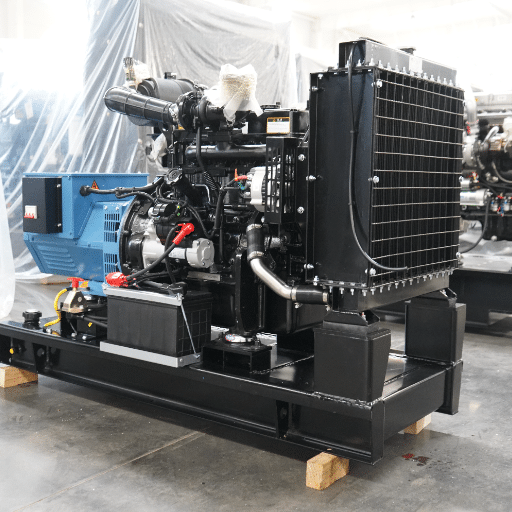



The process of generator sizing in natural gas systems requires you to determine the maximum electrical needs of your facility and add 20 to 25 percent for safety and include motor starting power requirements and environmental derating factors. The power requirements of commercial buildings range from 80 to 300 kW, while industrial facilities need 100 kW to more than 1 MW based on their specific operations and building height.
The costs of incorrectly sized generators exceed those of correctly sized generators because incorrect sizing results in expenses for your business. You will spend money for extra capacity that your business will never need when you select an oversized unit, which will operate inefficiently under partial load conditions. Your generator will fail when you need it during peak demand times or when powerful equipment starts up, if you make it too small.
The manufacturing facility director of Chen Wei in Vietnam learned this lesson through personal experience. He selected a 200 kW natural gas generator size based on the facility’s average daily operational requirements. The documents showed everything to be correct. The generator system failed when the air compressor attempted to start because peak production tested the system beyond its limits. His team needed to spend six hours on production suspension because they had to find a 300 kW generator. The undersizing mistake cost him ,000 in lost production plus unplanned rental expenses.
The guide provides you with a detailed procedure to accurately determine the correct size for a natural gas generator on your first attempt. The methods remain effective for all organizations, including hospitals and factories and data centers and retail chains.
Key Takeaways
- Use 4 methods to calculate load: Measurement (most accurate), Utility History, Motor Use, or Square Footage
- Always add a 20-25% safety margin above your calculated peak load
- Motor starting current is the #1 cause of undersizing — Direct On Line (DOL) starters need roughly 7x running amps
- Derate for environment: approximately 3.5-4% power reduction per 1,000 ft of altitude, and roughly 1% per 10 degrees F above 77 degrees F ambient
- Typical natural gas generator sizes: Retail 30-80 kW, Manufacturing 100-300 kW, Hospital 200-500+ kW
- Natural gas fuel supply lines must be sized alongside the electrical load — pressure and flow matter just as much as kW rating
For in-depth technical details regarding natural gas generator specifications, (please refer to our natural gas generator guide.)
Why Generator Sizing Matters

Generator sizing is not about getting close. It is about getting it right.
The natural gas generator requires more money for initial purchase than standard equipment. The system operates with less efficiency when it operates between 30% and 70% of its full capacity. The optimal operational range for natural gas engines requires 70% to 80% of their maximum power output. When equipment operates at less than 30% of its maximum capacity for long periods, unburned fuel and carbon will build up in exhaust systems and create wet stacking. The result of these factors causes increased maintenance requirements and shorter engine operational lifespan and fuel consumption.
An undersized generator is worse. The system lacks capacity to start large motors. The system fails during peak usage because it encounters overload conditions. The system creates hazards for connected devices through voltage drops and frequency instability. Medical facilities and data centers experience expensive downtime which also creates dangerous situations.
Standard procedure requires you to determine your maximum load, then use a multiplier between 1.2 and 1.25 to find your final number. The safety margin of 20-25% provides coverage for measurement errors and expected growth and unexpected increases in power consumption. The safety margin for generator sets which we design and develop as a manufacturing company needs to remain fixed because it ensures dependable performance over extended periods.
Four Methods to Size a Natural Gas Generator
There are four accepted methods to calculate the load your generator must carry. Each fits a different scenario. Use the one that matches the data you have available.
Method 1: Full Load by Measurement
This is the most accurate method if your facility already has electrical service. You measure actual current draw at the distribution panel during peak operation.
What you need:
- A digital clamp meter capable of reading your panel’s amperage
- Access to the main breaker or busbar during peak operating hours
How to measure:
- Identify your facility’s peak usage time — usually mid-morning or early afternoon for commercial buildings, or during active production shifts for factories.
- Open the main electrical panel safely.
- Clamp the meter around each phase conductor.
- Record the amp reading on each phase.
- Use the largest reading as your base current.
Formula for three-phase power:
kW = Amps x Volts x 1.73 x Power Factor / 1,000For most commercial and industrial facilities, use 0.8 as the power factor.
Example: Your meter reads 250 amps on a 480V three-phase system.
kW = 250 x 480 x 1.73 x 0.8 / 1,000 = 166 kWAdd 25% safety margin: 166 x 1.25 = 208 kW minimum generator size.
Method 2: Full Load by History
If you do not have access to the electrical panel or want to verify your measurements, use your utility bills.
What you need:
- 12 months of electricity bills
- The peak demand value in kW or kVA
How to calculate:
- Find the highest monthly peak demand value.
- If the bill shows kVA, convert to kW by multiplying by the power factor (0.8).
- Add the 20-25% safety margin.
Example: Your highest bill shows a peak demand of 200 kVA.
kW = 200 kVA x 0.8 = 160 kW
Safety margin: 160 x 1.25 = 200 kW minimum generator size
This method works well for facilities with stable, predictable usage. It is less accurate if your operation is seasonal or if you are adding new equipment.
Method 3: Extensive Motor Use
Manufacturing and industrial facilities with large motors must size for starting inrush, not just running load. This is where most sizing errors happen.
Motors draw significantly more current during startup than during normal operation. The multiplier depends on the starting method:
| Starting Method | Inrush Multiplier |
|---|---|
| Direct On Line (DOL) | ~7x running amps |
| Star-Delta | ~2.5x running amps |
| Soft Starter | ~3x running amps |
| Variable Frequency Drive (VFD) | ~1.75x running amps |
How to calculate motor starting load:
- List every motor the generator must start.
- Note the running amps and starting method for each.
- Multiply running amps by the inrush multiplier.
- Add all other non-motor loads.
- Size the generator for the highest simultaneous starting scenario.
Example: A 75 HP compressor uses a DOL starter. Its running current is 96 amps at 480V three-phase.
Starting amps = 96 x 7 = 672 amps
Starting kW = 672 x 480 x 1.73 x 0.8 / 1,000 = 446 kW
Even if the compressor only runs at 75 HP (roughly 56 kW), the generator must handle 446 kW during startup. If your generator is sized for running load only, it will stall or trip when the motor tries to start.
For facilities with multiple large motors, stagger startup sequences or use reduced-voltage starters. This can reduce your generator size requirement significantly.
Want to compare natural gas and diesel options for your motor load? Our diesel vs gas generator comparison breaks down starting performance, fuel efficiency, and long-term operating costs for industrial applications.
Method 4: Square Footage
This is the fastest method and the least accurate. Use it only for preliminary budgeting or early project planning.
Quick-reference formulas:
| Facility Type | Formula |
|---|---|
| Retail / Restaurant | 50 kW + 10 watts per square foot |
| Commercial / Office | 50 kW + 5 watts per square foot |
| Industrial / Manufacturing | 50 kW + 10-20 watts per square foot |
Example: A 20,000 square foot manufacturing facility.
Base load: 50 kW
Additional: 20,000 x 15 watts = 300 kW
Total: 350 kW
Safety margin: 350 x 1.25 = 438 kW minimum generator size
Never use the square footage method as your final sizing basis. Always verify with measurement or utility history before purchasing.
Sizing by Facility Type: Quick Reference

The table below shows typical natural gas generator size ranges by application. Use these as starting points, then refine with the methods above.
| Facility Type | Typical Size Range | Key Considerations |
|---|---|---|
| Small retail / restaurant | 30-80 kW | Refrigeration, HVAC, lighting |
| Office building (10,000 sq ft) | 80-150 kW | HVAC, elevators, server rooms |
| Manufacturing facility | 100-300+ kW | Motor starting, production loads |
| Hospital / healthcare | 200-500+ kW | Life safety, OR, ICU, elevators |
| Data center | 500 kW – 2+ MW | UPS support, cooling, 24/7 operation |
| School / campus | 150-500 kW | Kitchen, HVAC, emergency lighting |
| Apartment building | 100-300 kW | Elevators, pumps, common area power |
| Mining / remote operations | 200-1,000+ kW | Altitude derating, heavy motor loads |
Maria Santos, who serves as procurement manager at a Brazilian hospital with 180 beds, began her work by estimating 500 kW from the complete electric load of the building. Then she worked with our engineering team to classify loads into three categories: critical (operating rooms, ICU, elevators), essential (general lighting, refrigeration), and optional (administration, cafeteria). The startup process showed her how to separate optional loads which led to her final specification of 350 kW. The decision enabled her to save ,000 in project costs while maintaining patient safety throughout the entire process.
Critical Factors That Affect Sizing
Even after you calculate your base load, several factors can change the generator size you actually need.
Motor Starting and Inrush Current
Motor starting is the single biggest challenge in generator sizing. A generator can handle brief overloads, but the voltage dip during motor startup must stay within acceptable limits — typically 15-20% maximum drop for most equipment, and even less for sensitive electronics.
Code-letter ratings on motor nameplates indicate locked-rotor kVA per horsepower. Higher code letters mean higher inrush. Always check the motor nameplate or specification sheet, not just the running horsepower.
If your facility has multiple large motors, consider these strategies:
- Use reduced-voltage starters (soft starter, VFD, or star-delta)
- Stage motor startup so large motors do not start simultaneously
- Specify a generator with higher motor starting capability (some designs handle 300% overload for 10 seconds)
Environmental Derating
Generators produce less power in hot, high-altitude, or humid conditions. Natural gas engines are especially sensitive to air density because gas combustion relies on the oxygen content in intake air.
Altitude derating: Expect approximately 3.5-4% power reduction for every 1,000 feet above sea level.
Temperature derating: Expect approximately 1% power reduction for every 10 degrees F above 77 degrees F ambient.
Example: A 400 kW generator installed at 3,800 meters (roughly 12,500 feet) in a Bolivian mining operation.
Altitude derating: 12.5 x 3.5% = 43.75% reduction
Effective output: 400 kW x (1 - 0.4375) = 225 kW
Add summer temperature derating of another 10-15%, and the effective output drops to roughly 200 kW. The mining operator originally ordered a 400 kW unit. After our engineering team calculated derating, they upsized to 600 kW to maintain the required 350 kW of effective power. Ordering the right size the first time would have saved three weeks of project delay.
For export projects, always specify the installation altitude and maximum ambient temperature when requesting a quote. Generator manufacturers can adjust engine tuning, cooling systems, and turbocharging to partially compensate for derating — but only if they know the conditions upfront.
Power Factor and Efficiency
The typical power factor for commercial and industrial operations stands at 0.8. The generator needs to produce 1.25 kVA for every 1 kW of real power output that you need. The requirement for sizing demands that you use either kW or both kW and kVA as your measurement units.
Natural gas generators typically have slightly lower thermal efficiency than diesel units at full load. The equipment operates more efficiently between partial load and standby operations because it produces cleaner emissions.
Load Type Classification
Not every load needs generator backup. Separating loads into categories helps you right-size the unit and manage cost.
Critical loads: Must have power without interruption — life safety systems, operating rooms, fire pumps, security systems.
Essential loads: Important for operations but can tolerate brief interruption — general lighting, IT servers, refrigeration.
Optional loads: Nice to have during an outage but not required — HVAC for comfort, non-essential equipment, decorative lighting.
Size your generator for critical + essential loads. If budget allows, add optional loads with a load-shedding system that drops them if the generator approaches capacity.
Also plan for future expansion. A 20-30% growth allowance is standard for new construction projects. It is far cheaper to specify a slightly larger generator now than to replace an undersized unit later.
For a deeper technical breakdown of commercial and industrial natural gas generator installation standards and process protocols, see our natural gas generator installation guide.
Natural Gas Fuel Supply Considerations

Electrical sizing is only half the equation. A natural gas generator also needs adequate fuel supply.
Natural gas engines typically require inlet pressure of 5-14 inches water column for smaller units, and higher pressure for industrial systems above 300 kW. The gas line must deliver sufficient flow volume at the required pressure, accounting for pressure drop over the pipe run.
Key fuel supply checks:
- Confirm gas utility can deliver the required flow rate at your property
- Size the fuel line for peak generator consumption, not average
- Account for other gas appliances that share the line
- Consider pressure regulators if utility pressure is too high
- Plan for a dedicated shutoff valve near the generator
A manufacturing plant in Poland ordered a 250 kW natural gas generator based on electrical load calculations. The unit arrived, but the existing gas line could only supply enough flow for a 150 kW load. Extending and upgrading the gas line added ,000 and three weeks to the project. Electrical sizing and fuel supply sizing must happen together.
For large projects, involve a gas utility engineer early in the design phase. They can verify flow capacity, pressure at the meter, and any utility-side upgrades needed.
Thinking about a natural gas generator for your facility? Explore our types of diesel generators and natural gas options to find the right fuel type and configuration for your application.
Common Sizing Mistakes to Avoid
Even experienced engineers make these errors. Avoid them, and you will save time, money, and frustration.
- Ignoring motor starting requirements. Running load and starting load are not the same. A 75 HP motor can demand 400+ kW during startup even though it only runs at 56 kW.
- Forgetting environmental derating. Altitude and temperature can reduce effective output by 30-50% in extreme conditions.
- Using nameplate amps without diversity. Not every device runs at full load simultaneously. Apply a diversity factor based on actual operating patterns.
- Not planning for future expansion. If you are adding production lines, HVAC, or building extensions in the next five years, size for the future load now.
- Sizing based on average load instead of peak demand. Your generator must handle the worst-case scenario, not a typical Tuesday afternoon.
- Neglecting harmonics from VFDs and UPS systems. Nonlinear loads create harmonic distortion that can overheat generators sized only for real power. Add 10-15% capacity margin for high harmonic environments.
When to Bring in an Expert
For many projects, the methods above are sufficient. But some situations demand professional engineering support.
Consider bringing in a specialist or manufacturer engineering team when:
- The project exceeds 500 kW
- You have complex motor starting scenarios with multiple large motors
- You need multi-generator paralleling systems
- The application is life-safety critical (hospitals, nursing homes, high-rise emergency systems)
- You are installing at high altitude or extreme temperature
- Your facility has high harmonic content from VFDs, UPS, or LED drivers
- You need NFPA 110 or NEC Article 700 compliance documentation
What to prepare for a sizing consultation:
- Single-line electrical diagram
- Motor schedule with horsepower, starting method, and code letter
- Utility bills showing 12 months of peak demand
- Site elevation and maximum ambient temperature
- Description of critical, essential, and optional loads
- Future expansion plans
A qualified engineering partner can run load flow analysis, harmonic studies, and transient motor starting simulations. These tools pinpoint exactly what size generator you need — no guesswork, no margin for error.
At Shandong Huali Electromechanical Co., Ltd., our engineering team supports customers through every stage of generator sizing and selection. From initial load assessment to final specification, we ensure your generator delivers stable, reliable power for your application.
Conclusion
Sizing a natural gas generator correctly comes down to four principles: measure accurately, account for motor starting, respect environmental derating, and leave room for growth.
Use the full load by measurement method when you have access to the electrical panel. Use utility history when you need a quick verification. Use the motor use method when large compressors, pumps, or fans dominate your load profile. Use square footage only for early budget estimates.
Always add a 20-25% safety margin. Always check motor starting inrush. Always derate for altitude and temperature. And always size your natural gas fuel supply alongside your electrical load.
Getting the size right the first time protects your operations, your equipment, and your budget. An oversized unit wastes capital and fuel. An undersized unit fails when you need it most. The right size delivers reliable power at optimal efficiency for decades.
Ready to size your natural gas generator? Contact our engineering team for a free consultation. We will review your load profile, motor schedule, and site conditions, then recommend the right generator size for your project.
Once you know the size, the next step is understanding the investment. Read our guide to commercial natural gas generator cost for detailed pricing by kW range, installation factors, and total cost of ownership.