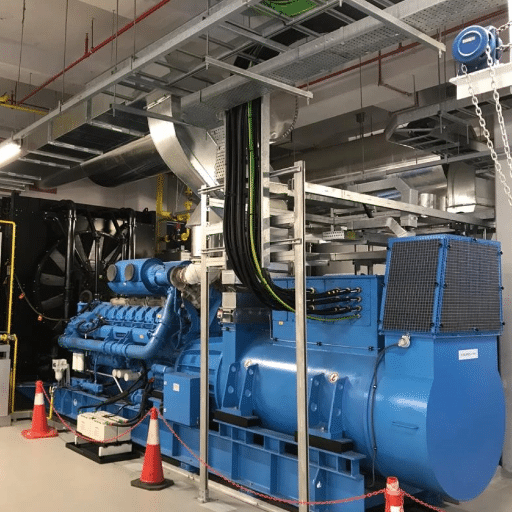



An industrial backup power generator is a permanently installed standby system, typically a diesel genset from 100 kVA to 3,000 kVA, that starts automatically within 10 to 15 seconds of a grid failure and carries your facility’s critical loads until utility power returns. That is the short answer. The longer answer is where most buying mistakes happen.
Here is the number that reframes the whole purchase: unplanned downtime now costs the average manufacturer about $260,000 per hour, according to 2025 benchmarks. A single eight-hour outage can exceed the entire cost of a properly specified backup system.
If you are evaluating an industrial backup power generator for a factory, processing plant, or commercial facility, you probably already believe outages are getting worse. They are. This guide walks you through the decisions in the order that prevents expensive errors: what an outage costs you, which generator type fits, how to size it correctly, which duty rating to specify, and how many hours of fuel autonomy to plan for.
Key Takeaways
- Manufacturing downtime averages roughly $260,000 per hour in 2025, so one avoided 8-hour outage can pay for an entire standby system.
- Diesel holds about 73% of the industrial standby market because of its 10-15 second start time, fuel storage flexibility, and high power density.
- Correct sizing requires four steps: categorize loads, apply a demand factor (0.6-0.85), account for motor starting kVA (5-7x running load for direct-on-line motors), and add a 20-25% margin.
- For grid backup, specify a standby (ESP) rated unit. Using a standby-rated generator for prime or continuous duty voids warranties and shortens engine life.
- Plan fuel autonomy for your realistic worst-case outage: 8 hours for stable grids, 24-72 hours for storm-prone or remote sites.
What Is an Industrial Backup Power Generator?

An industrial backup power generator is a stationary engine-generator set configured for standby duty. It sits idle while the grid is healthy, monitors utility voltage through an automatic transfer switch (ATS), and takes over the electrical load within seconds when the grid fails. When utility power stabilizes again, the ATS transfers the load back and the generator cools down and shuts off.
Three components make the system work as a unit: the genset itself, the ATS that detects the outage and switches the load, and the fuel system that determines how long the generator can sustain the load. A failure in any one of them defeats the other two.
Standby systems are standard equipment in hospitals, data centers, and water treatment plants, and increasingly common in manufacturing, food processing, and logistics, where even short outages destroy product, damage equipment, or break contractual delivery commitments.
What Does a Power Outage Cost an Industrial Facility?
The cost of an outage depends on your industry, but the 2025 benchmarks are uncomfortable reading across the board.
| Industry | Approximate Downtime Cost per Hour | Main Cost Drivers |
|---|---|---|
| Automotive | 1.3M−1.3M−2.3M | Just-in-time supply chain penalties |
| Semiconductor | ~$3M | Cleanroom contamination, yield loss |
| Pharmaceutical | ~$1.8M | Batch failure, compliance breaches |
| Food and beverage | ~$240,000 | Spoilage, safety recalls |
| General manufacturing (average) | ~$260,000 | Lost production, idle labor, recovery |
According to ABB’s 2025 survey of 3,600 manufacturers, 74% experience downtime at least annually and 44% face it monthly. Roughly 75% of plants take two hours or more to restore operations after an outage, at an average cost near $274,000 per incident.
Lost production is only 40-60% of the bill. Idle labor, expediting fees, raw material waste, contractual penalties, and post-restart quality defects make up the rest.
When Elena, the operations director at a dairy processing plant near Valencia, Spain, priced an 800 kVA standby diesel system in early 2024, the board questioned the cost. In November that year, a storm outage hit during a pasteurization cycle. The generator took the load in 12 seconds. The plant avoided an estimated EUR 180,000 in spoiled product and restart losses, more than the system cost, in a single event.
This is precisely the right perspective from which to view this investment. According to Intel Market Research, the market for commercial and industrial backup generators is projected to grow from approximately $19.4 billion in 2025 to $32.6 billion by 2034—a trend driven by the increasing number of facilities conducting such cost-benefit analyses. As the U.S. Department of Energy warns that AI-driven demand will place immense strain on an aging power grid—potentially leading to a sharp rise in the duration of outages before 2030—the focus is shifting from “whether backup power is needed” to “how much backup power is required.”
Want a downtime-cost estimate for your facility before you size anything? Talk to a Shandong Huali engineer about your load profile →
Types of Industrial Backup Power Generators

Four technologies compete for industrial standby applications. Each fits a different fuel infrastructure and runtime expectation.
| Type | Typical Range | Strengths | Limitations |
|---|---|---|---|
| Diesel | 20 – 2,500+ kW | 10-15 sec start, high power density, fuel stored on site | Emissions permits, fuel degrades in storage |
| Natural gas | 10 – 2,000 kW | Cleaner emissions, unlimited runtime via pipeline | Depends on gas grid staying live during disasters |
| Propane | 5 – 150 kW | Indefinite fuel shelf life | Limited to smaller loads, bulky storage |
| Hybrid (battery + diesel) | Varies | Cuts fuel use and emissions 50-80% | Higher capital cost, 3-5 year payback |
Diesel holds about 73% of the industrial standby market for practical reasons: it starts fast enough to protect sensitive processes, stores weeks of fuel on site, and scales from a small workshop to a multi-megawatt plant. Natural gas is attractive where pipeline supply is genuinely resilient and emissions rules are strict. Hybrids make sense for sites with frequent short outages, where batteries carry the first minutes and the engine only starts for longer events.
For a detailed fuel-type comparison with total cost of ownership math, see our guide on diesel generator vs gas generator.
How to Size an Industrial Backup Generator
Sizing errors run in both directions. Undersize, and the generator trips or voltage sags when big motors start. Oversize, and a diesel engine runs chronically underloaded, which causes wet stacking, carbon buildup, and 25-35% wasted fuel. The target is a unit that runs at 70-80% of rated capacity during an outage.
Step 1: Categorize Your Loads
Split your facility’s loads into three groups: essential production equipment that must keep running, facility support loads like HVAC, compressors, and IT, and life-safety loads such as emergency lighting and fire systems. Life-safety loads are usually code-mandated and may require their own dedicated circuit.
Step 2: Calculate Running Load With a Demand Factor
Sum the nameplate ratings of the loads the generator must carry, then apply a demand factor. Not everything runs at full draw simultaneously. A factor of 0.6 to 0.85 is typical for manufacturing, depending on how staggered your processes are.
Step 3: Account for Motor Starting kVA
This is the step that sinks most DIY sizing. Motors draw 5 to 7 times their full-load current for a few seconds during a direct-on-line (DOL) start. A 50 kW motor on a DOL start demands roughly 353 kVA of instantaneous capacity.
Soft starters or variable frequency drives cut that to 1.5-3 times running load. Your generator must survive the largest motor start while already carrying the rest of the load, or you must sequence starts so big motors never start together.
A real example of getting this wrong: an electronics assembly plant in Chonburi, Thailand, sized a 500 kVA unit on the simple sum of nameplate loads in 2023. Every time the air compressor kicked on during an outage test, the generator tripped on overload. The fix was a 750 kVA unit plus soft starters on the two largest compressors. The lesson stuck: motor starting kVA, not running load, governed the final size.
Step 4: Add Margin and Apply Derating
Add 20-25% for future growth, harmonic loads from drives and LED lighting, and environmental derating. Diesel engines lose about 1% of output per 100 meters of altitude above 1,000 meters, and roughly 3% per 10°C of ambient temperature above 40°C. A generator sized exactly to calculated load in a 45°C climate at elevation is effectively undersized on its hottest day.
For a fast first estimate, these facility benchmarks from industrial sizing guides give a realistic range:
| Facility Type | Typical Load Density | Common Generator Range |
|---|---|---|
| Light manufacturing | 0.15-0.25 kW/m² | 250-500 kVA |
| Food processing | 0.30-0.45 kW/m² | 500-1,500 kVA |
| Pharmaceutical | 0.40-0.60 kW/m² | 750-2,000 kVA |
| Chemical processing | 0.50-0.75 kW/m² | 1,000-3,000 kVA |
Treat these as a starting point, not an answer. Your load list and motor inventory decide the final number. Our industrial diesel generator guide covers the selection criteria in more depth, and a weekly test-run schedule from our diesel generator maintenance checklist keeps the unit ready to carry that load when the grid drops.
Standby, Prime, or Continuous? Picking the Right Rating

Generator ratings follow ISO 8528-1, and specifying the wrong one is a warranty and reliability problem.
| Rating | Capacity | Annual Hours | Best For |
|---|---|---|---|
| Standby (ESP) | 100% | Up to ~500 hrs/yr | Grid backup, emergency use |
| Prime (PRP) | ~90% | Unlimited, variable load | Primary power off-grid |
| Continuous (COP) | ~85% | Unlimited, steady load | Baseload, constant output |
For an industrial backup power generator protecting against grid outages, standby (ESP) is the correct rating. You get full nameplate capacity, a 10% one-hour overload allowance, and a lower purchase price than a prime-rated unit of the same size.
The trap is running a standby-rated set like a prime unit. If your site suffers long weekly outages and the generator logs hundreds of hours a month, you need a prime-rated machine instead. Our article on diesel generator for continuous power explains when to make that jump.
Fuel Autonomy: How Long Should Your Backup Run?
A standby generator without fuel planning is a very expensive 8-hour solution. Decide your autonomy target from your outage history and risk profile:
- 8 hours: Stable urban grids, short utility interruptions, refueling easy to arrange during business hours.
- 24 hours: Storm-prone regions, sites where overnight outages are realistic and refueling at 3 a.m. is not.
- 72 hours or more: Hurricane zones, remote plants, and facilities with regulatory autonomy requirements.
A chemical storage site on the Texas Gulf Coast learned this during hurricane season planning in 2024. Their compliance review required 72 hours of autonomy for fire pumps and process safety systems. The 1,000 kVA standby unit’s base tank covered barely 10 hours at expected load. A 20,000-liter bulk tank with an automatic day-tank transfer system closed the gap, and quarterly fuel polishing keeps the stored diesel within spec.
Fuel consumption scales with size and load, so autonomy is a tank-sizing calculation, not a guess. For the burn-rate tables and the runtime formula, use our guide on how long can a diesel generator run.
Single Unit or N+1 Redundancy?
One correctly sized generator covers most industrial facilities. But if your process cannot tolerate even a generator failure during an outage, consider N+1: two or more paralleled units where any one can carry the critical load alone.
Choose N+1 when a failed start during an outage would cost more than the second unit (pharma batch processes, cold storage chains, continuous chemical reactors). Choose a single larger unit when loads tolerate a maintenance window and budget discipline matters. Paralleling also lets you service one unit while the other remains on standby duty.
How Shandong Huali Builds Industrial Backup Power Systems

Shandong Huali Electromechanical manufactures standby diesel generator sets from 5 kW to 3,000 kW+, built on Cummins, Perkins, and Weichai engines with Stamford alternators and DSE digital control systems. Every standby package can be configured with ATS integration, base or day tanks, bulk fuel storage with automatic transfer, and parallel operation for N+1 configurations.
With 100+ completed projects and an engineering team of 80+ specialists, we size systems from your actual load list and motor inventory rather than nameplate sums, and we support the installation through commissioning and long-term maintenance.
Planning a backup power project? Contact our engineering team for a load assessment and fuel autonomy plan →
FAQ
What size backup generator does a factory need?
Most factories fall between 250 kVA and 3,000 kVA depending on facility type and floor area. Light manufacturing sites typically need 250-500 kVA, food processing 500-1,500 kVA, and chemical plants 1,000-3,000 kVA. The exact size comes from your load list, demand factor, and the starting surge of your largest motor, so treat facility benchmarks as a starting estimate only.
How much does an industrial backup generator cost?
A commercial diesel standby system typically runs from about 20,000forsmallerunitsto20,000forsmallerunitsto50,000 and well beyond for large industrial packages, before installation, ATS, and fuel system costs. Compare that against downtime averaging roughly $260,000 per hour for manufacturers in 2025. For most facilities, avoiding one significant outage pays back the entire investment.
Is diesel or natural gas better for industrial backup power?
Diesel suits most industrial sites because it starts in 10-15 seconds, stores fuel on site for multi-day autonomy, and scales above 2,500 kW. Natural gas offers cleaner emissions and unlimited runtime but depends on the gas grid surviving the same event that took out the power grid. Diesel currently holds about 73% of the industrial standby market.
How long can an industrial standby generator run during an outage?
The engine can run for days; the fuel supply decides the real limit. A base tank often covers 8-24 hours depending on load, while adding bulk storage with automatic transfer extends autonomy to 72 hours or more. Plan autonomy around your worst realistic outage, not the average one.
What is the difference between standby and prime power ratings?
A standby (ESP) rated generator delivers 100% capacity for up to about 500 hours per year and is designed for grid backup. A prime (PRP) rated unit delivers about 90% capacity for unlimited hours under variable load and serves as a primary power source. Using a standby-rated machine for prime duty voids warranties and causes premature engine wear.
Conclusion
Choosing an industrial backup power generator is really four decisions in sequence. Start with your outage cost to justify the investment, pick the fuel type that matches your infrastructure, size the unit from your real loads and motor starting demands with margin and derating, and plan fuel autonomy for your worst realistic outage.
Facilities that follow that order end up with systems that start when needed, carry the load without tripping, and run as long as the outage lasts. Facilities that skip steps end up like the Chonburi plant: buying the same generator twice.
If you are ready to move from estimates to a specification, request a load assessment from the Shandong Huali engineering team. We will size the system, plan the fuel autonomy, and configure the transfer equipment around your operation, so the next outage is a non-event instead of a six-figure line item.