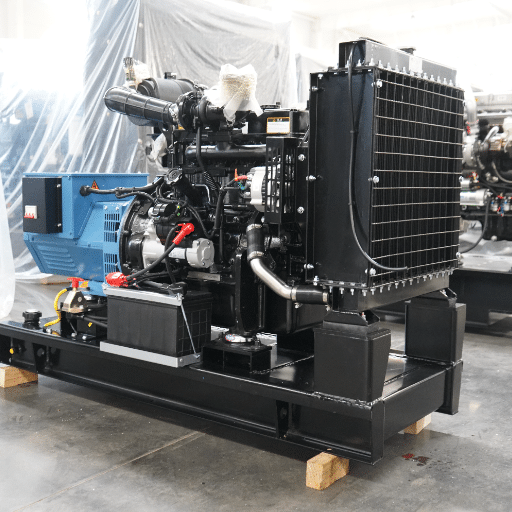



A diesel generator can run 6-12 hours on a portable unit’s tank, 24-72 hours for a standby unit with a base tank, and 500 hours or more for prime and continuous-duty models with refueling and scheduled maintenance. The honest answer to how long a diesel generator can run is that the engine itself is rarely the limiting factor. Your fuel supply, your oil change interval, and your duty rating decide when the run ends.
Here is what surprises most first-time buyers: a well-maintained diesel engine does not wear out mid-outage. It stops because the tank runs dry, the oil hits its service hour limit, or the unit was never rated for the duty you assigned it.
You probably already know diesel generators are built for long service. What you need is a way to calculate runtime for your specific unit, tank, and load. This guide gives you the runtime ranges by generator type, fuel burn-rate tables from 20 kW to 2,000 kW, a simple runtime formula with worked examples, and the fuel autonomy planning rules used for hospitals, data centers, and telecom sites.
Key Takeaways
- Runtime by type: portable 6-12 hours, standby 24-72 hours, prime around 500 hours, continuous-duty 500-1,000+ hours between service stops.
- Runtime formula: usable fuel divided by burn rate at your actual load. Only about 90% of tank volume is usable.
- Oil changes every 100-250 operating hours are the practical hard stop for unattended runs, not fuel.
- Run at 50-80% load for best efficiency; running below 30% load for long periods causes wet stacking and engine damage.
- Plan fuel autonomy by application: hospitals 96 hours, data centers 24-48 hours, telecom sites 72+ hours.
How Long Can a Diesel Generator Run? Quick Answer by Type

| Generator Type | Typical Continuous Runtime | What Stops It First |
|---|---|---|
| Portable (under 20 kW) | 6-12 hours per tank | Onboard fuel tank |
| Standby/backup | 24-72 hours with base tank | Fuel, then oil at 100-250 hrs |
| Prime power (PRP) | Up to ~500 hours | Oil change interval |
| Continuous duty (COP) | 500-1,000+ hours | Scheduled service stops only |
According to GenPower USA, continuous-duty diesel generators with proper maintenance have run for weeks at a time in hospitals, data centers, and military operations. The table above is your featured answer; the sections below explain what sits behind each number.
When a Midwest data center reviewed its storm readiness in March 2025, the facility manager found a 600 kW standby unit with a 2,000-liter base tank. The math gave roughly 26 hours of autonomy at 75% load. Their uptime requirement was 96 hours.
The generator was fine; the fuel plan was not. A 10,000-liter bulk tank with automatic transfer closed the gap without touching the genset itself.
Planning a long-runtime installation? Explore Shandong Huali diesel generator solutions →
The 3 Real Limits on Diesel Generator Run Time
Most guides list five or six vague factors. In practice, every runtime limit falls into one of three categories, and confusing them leads to bad purchasing decisions.
Fuel Supply: The Theoretical Limit
A diesel generator converts fuel into runtime at a predictable rate. Bigger tank, longer run. That is the entire equation, and it is why a generator with a bulk storage system can outrun an identical unit on an onboard tank by days.
Maintenance Intervals: The Practical Limit
Engine oil degrades with operating hours, not calendar days. Most industrial diesel engines need an oil and filter change every 100-250 operating hours, which is the real ceiling on any single unattended run. Some manufacturers also recommend a 15-30 minute inspection stop every 24 hours during extended operation.
A 100 kVA prime unit serving a mountain telecom site in northern Vietnam had 12 days of diesel on site in late 2024. The run ended on day 10, not for lack of fuel but because the unit hit its 250-hour oil limit. The operator now schedules service by runtime hours on the hour meter instead of by calendar, and the site has not missed an interval since. A diesel generator maintenance checklist built around operating hours prevents exactly this failure.
Duty Rating: The Engineering Limit
Every generator carries an ISO 8528-1 rating. Standby (ESP) units are built for short emergency runs, Prime (PRP) units for unlimited hours at variable load, and Continuous (COP) units for non-stop operation at fixed load. Asking an ESP-rated unit to do a COP job shortens engine life dramatically. For a full breakdown of ratings and when each applies, see our guide to choosing a diesel generator for continuous power.
Diesel Generator Fuel Consumption per Hour

Fuel burn rate is the number that turns tank size into runtime. Approximate consumption at 75% load, compiled from manufacturer data and the figures published by Uleengen:
| Generator Size | Burn at 50% Load | Burn at 75% Load | Burn at 100% Load |
|---|---|---|---|
| 20 kW | 3-4 L/hr | 5-6 L/hr | 7-8 L/hr |
| 50 kW | 7-10 L/hr | 10-15 L/hr | 14-19 L/hr |
| 100 kW | 13-19 L/hr | 19-30 L/hr | 26-38 L/hr |
| 250 kW | 34-46 L/hr | 53-72 L/hr | 70-95 L/hr |
| 500 kW | 66-90 L/hr | 98-136 L/hr | 130-180 L/hr |
| 1,000 kW | 130-180 L/hr | 197-272 L/hr | 260-360 L/hr |
| 2,000 kW | 260-360 L/hr | 397-530 L/hr | 520-700 L/hr |
Treat these as planning figures, not guarantees. Your exact burn depends on engine model, altitude, temperature, and fuel quality, so always confirm against the manufacturer’s fuel consumption chart for your unit.
One pattern matters for every size: running at full load burns 20-30% more fuel per kWh produced than running at 50-70% load. For brand-by-brand efficiency data and consumption curves, see our fuel efficient diesel generator analysis.
How to Calculate Your Diesel Generator Run Time
The Runtime Formula
Runtime (hours) = Usable fuel (liters) / Burn rate at actual load (L/hr)
For tank sizing in the other direction, the standard formula is: hourly consumption multiplied by desired runtime, plus a 10-20% safety margin. A unit burning 8 L/hr that needs 48 hours of autonomy requires roughly 450 liters of tank capacity.
Worked Examples
Example 1: A 100 kW standby unit at 75% load burns about 25 L/hr. On a 500-liter tank with 450 liters usable, expect roughly 18 hours of runtime.
Example 2: A 500 kW unit at 75% load burns about 30 gallons per hour. On a 500-gallon day tank with 450 gallons usable, expect roughly 15 hours. According to Remote Fill Systems, a 250-300 gallon day tank runs most generators about 24 hours at full load, but larger sets need proportionally more.
Why Only About 90% of Tank Volume Is Usable
Fuel pickups sit above the tank floor to avoid drawing sediment and water, and tanks need headspace for thermal expansion. Plan on 90% of nominal capacity, and your runtime estimates will match reality instead of disappointing you during an outage.
How to Extend Runtime: Day Tanks, Bulk Storage, and Refueling

Base Tanks vs Day Tanks vs Bulk Storage
A base tank mounts under the genset and typically holds 8-24 hours of fuel. A day tank is a small intermediate tank near the engine, usually sized for 8-12 hours, fed by a larger bulk tank elsewhere on site. Bulk storage holds days or weeks of fuel and pumps to the day tank automatically.
Automatic Fuel Transfer Systems
With an automatic transfer system, the day tank level sensor triggers the bulk tank pump whenever fuel drops below a setpoint. Runtime is then governed by total site fuel and delivery reliability, not by any single tank. This is the architecture behind every multi-day critical installation.
Can You Refuel a Generator While It Is Running?
Not safely, and most manufacturers prohibit it. Spilled diesel on a hot engine is a fire risk, and refueling introduces air and debris into the fuel system. If you cannot tolerate a refueling shutdown, a day tank with bulk transfer is the correct engineering answer.
Do Not Forget Fuel Shelf Life
Stored diesel degrades within 6-12 months. Oxidation, water absorption, and microbial growth quietly ruin fuel sitting in a tank. A rental fleet in Queensland learned this in early 2025 when standby units failed a planned 48-hour run: the diesel had sat untouched for 14 months. Fuel polishing and a strict 6-month rotation brought the fleet back to spec.
A runtime plan is only as good as the fuel in the tank. Budget for polishing, biocide treatment, and rotation as part of any long-autonomy design.
How Long Should You Plan For? Autonomy by Application
- Hospitals and critical care: 96 hours of on-site fuel autonomy is the common planning standard for regions with severe weather risk.
- Data centers: 24-48 hours typical, with refueling contracts as the backstop.
- Telecom and remote sites: 72+ hours, because access for refueling can take days after storms.
- Construction and rental: Daily refueling is normal; size the onboard tank for one full shift plus margin.
- Commercial standby: 24-72 hours covers most grid outage scenarios.
The question is never just how long the generator can run. It is how long your site must survive without the grid, plus a margin for the day the fuel truck cannot reach you.
Load Management for Long Runs
The 50-80% load band is the efficiency sweet spot for extended operation. Fuel burn per kWh is lowest here, and combustion stays clean.
Chronic light loading is the silent killer. Below roughly 30% load, diesel engines cannot reach full combustion temperature, and unburned fuel accumulates as wet stacking, fouling injectors and glazing cylinders. If your long-run duty is inherently light, either right-size the unit or schedule regular load-bank testing to burn off deposits.
How Shandong Huali Sizes Fuel Systems for Long Runtime

Shandong Huali manufactures diesel generator sets from 5 kW to 3,000 kW+ and integrates fuel systems into every project quote: base-frame tanks for standard autonomy, external day tanks for extended runs, and bulk storage with automatic transfer for multi-day critical sites. Our engineers calculate your fuel autonomy from real inputs: your load profile, your required hours, and your refueling logistics.
Because runtime questions are really system questions, we size the tank, the transfer pumps, and the maintenance schedule together. That is how industrial clients across 100+ projects get generator installations that meet their autonomy targets on paper and during actual outages.
Need a fuel system sized for your runtime requirement? Contact Shandong Huali engineers for a fuel autonomy consultation →
FAQ
Can a diesel generator run 24/7?
A continuous-duty (COP) rated diesel generator can run around the clock indefinitely, but it still needs shutdowns every 100-250 hours for oil and filter service. With bulk fuel supply, automatic transfer, and scheduled maintenance, 24/7 operation is routine in mining, telecom, and off-grid applications.
How long will a diesel generator run on a full tank?
Most standby and commercial units run 8-24 hours on their onboard tank at typical loads. Portable units run 6-12 hours. Divide your usable tank volume by your burn rate at actual load for an exact answer.
How long will a 500-gallon tank run a generator?
Count on roughly 450 usable gallons, then divide by burn rate. At 10 gallons per hour that is about 45 hours; at 30 gallons per hour (a 500 kW unit near full load) about 15 hours. The tank never changes; the load does.
How often does a diesel generator need oil during long runs?
Most industrial diesel engines need an oil and filter change every 100-250 operating hours, depending on engine model and duty. Check your manufacturer’s schedule and track runtime on the hour meter, not the calendar.
Is it bad to run a diesel generator at low load?
Yes, for extended periods. Running below about 30% load prevents full combustion and causes wet stacking, which damages injectors and cylinders over time. Occasional light-load operation is fine; chronic light loading is not.
Conclusion
How long can a diesel generator run? As long as your fuel supply, oil service interval, and duty rating allow, which ranges from 6-12 hours for a portable unit to 500-1,000+ hours for a continuous-duty set with bulk fuel. The engine rarely quits first; the system around it does.
Run the formula before you buy: usable fuel divided by burn rate at your actual load. Then check the answer against your autonomy requirement, whether that is 24 hours for a commercial building or 96 hours for a hospital. If the numbers do not meet the requirement, fix the fuel system, not the generator.
The Queensland fleet that lost a 48-hour run to stale fuel and the Midwest data center that met 96 hours with a bulk tank both prove the same point: runtime is a planning decision, not an engine specification.
Ready to size a generator and fuel system that meet your runtime target? Request a custom quote from Shandong Huali → Our engineers will model your load profile, calculate your fuel autonomy, and configure the tanks and transfer systems to match. Power your operations with confidence.