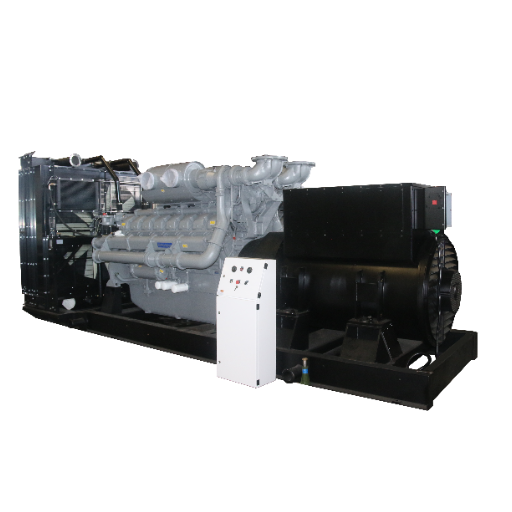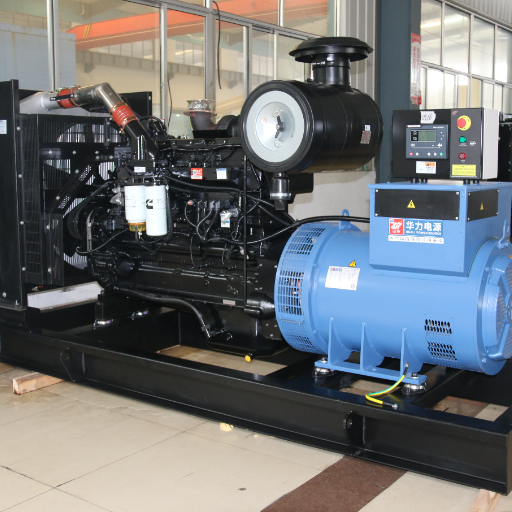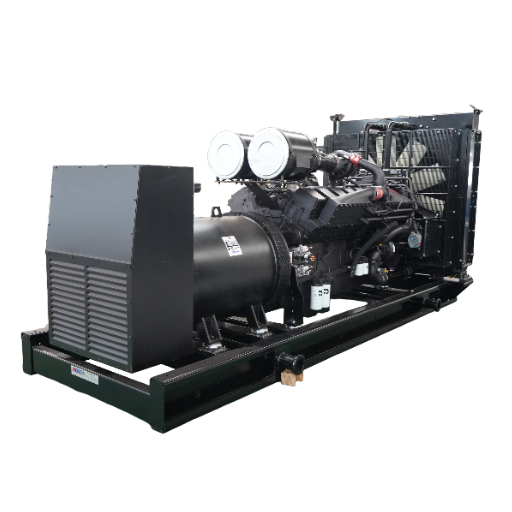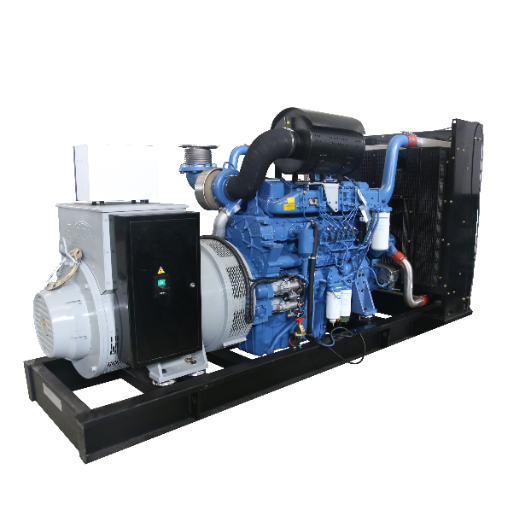


A remote radiator generator moves the cooling core off the machine and out of the room, usually onto a roof, an exterior wall, or the top of a container, and pipes the engine coolant to it. You need this setup when the room around the genset cannot move enough air through a unit-mounted radiator, when the site runs hotter than the radiator’s design point, or when fan noise has to stay out of the building.
Here is the part most people miss. A unit-mounted radiator works by throwing engine heat into the room and letting the room throw it outside. The room is part of the generator cooling system. When the room cannot do its half, the radiator has to leave.
Remote cooling is not exotic, and the engineering is well settled. What is rarely explained is when to choose it, how far the radiator can sit from the engine, and what quietly goes wrong when the install is underspecified. This guide covers the three configurations on one table, the signs that push you to remote, the distance and pump rules, and the two traps that send remote installs back to the shop. We build both kinds of setups, so what follows comes from real builds, not a textbook.
Key Takeaways
- A remote radiator moves the genset’s cooling core out of the room and is the answer when the room can’t move enough air, ambient heat exceeds the design point, or fan noise must leave the building.
- Unit-mounted cooling is the right default up to about 1,500 kVA while room static pressure stays under roughly 120 to 150 Pa; beyond that, remote is worth pricing.
- Factory remote kits allow about 3 m (10 ft) of separation; longer roof runs are fine but need bigger piping, a surge tank at the top of the loop, and an auxiliary pump.
- A single-core remote radiator is not enough for a turbo-aftercooled engine, which needs a second low-temperature pass for the charge-air cooler.
- Remote cooling removes the radiator’s fan duty, but the room still needs ventilation for engine and alternator heat, combustion air, and exhaust.
What Is a Remote Radiator Generator?

A remote radiator generator uses an electric-fan cooling core that sits away from the engine and connects to it through coolant piping. The engine water pump pushes hot coolant out to the core, the core sheds the heat to outside air, and the coolant returns cooled. The only real difference from a unit-mounted radiator is where the air moves.
Two questions decide whether this matters. Can the room move the airflow a unit-mounted core needs? Is the room allowed to get hot and loud? If the answer to either is no, remote is on the table.
The airflow number is not small. A 1,000 kVA engine shedding roughly 300 kW through its coolant needs around 8 m³/s of radiator airflow at 40 °C ambient, and roughly 25% more at 50 °C, the figures Jubaili Bros’ cooling systems guide cites. A remote loop moves that airflow outside, where it costs nothing in room design.
Want to see how this is packaged on a real set? Every build starts on our diesel generator range, and the cooling configuration is part of the spec we quote, not an afterthought.
Unit-Mounted vs Remote Radiator Generator: Three Configurations
Three configurations cover nearly every installation. The table shows where the core sits, what drives its fan, and what the room still has to handle.
| Configuration | Where the core sits | Fan drive | What the room still needs | Typical use |
|---|---|---|---|---|
| Unit-mounted radiator | On the genset, in front of the engine | Engine-driven, belt or hub | Full radiator airflow plus engine and alternator heat | Open, well-ventilated rooms up to about 1,500 kVA |
| Split radiator (split core) | Detached but in the same or an adjacent room | Engine or electric | Room airflow still carries the heat | Medium sets where the skid is short on space |
| Full remote radiator | Outdoors, roof, wall, or container top | Electric, often VFD-controlled | Only the engine and alternator radiated heat, combustion air, and exhaust | Confined rooms, hot ambients, noise-critical sites, containers |
Unit-mounted is the factory default because it is simplest and cheapest, and it stays right whenever the room cooperates. Split-core sits between the two, useful when the skid is crowded but the room still breathes. Full remote costs the most up front and gives the most freedom back. Mamo Power’s remote versus split comparison frames the same trade.
4 Signs Your Generator Needs a Remote Radiator
Ask these questions in order; they tell you when to use a remote radiator. If one of them bites, price a remote loop before you fight the room.
- The room cannot move the air. If total static pressure from louvers, ducts, or an enclosure pushes past roughly 120 to 150 Pa (about 12 mm of water), the engine fan is working uphill and losing flow.
- The site outruns the design point. Temperate radiator packs are rated at 40 °C ambient and tropical packs at 50 °C, and altitude costs about 3% per 300 m. Our high ambient and altitude derating guidance covers the math.When your site regularly climbs past that 40 °C design point, cooling margin disappears fast, and our guide to running a high ambient temperature generator explains exactly how the heat erodes that margin and when a remote core becomes the practical fix rather than an upgrade.
- The room cannot be hot or loud. Hospitals, data centers, offices, and residential sites push radiator fan noise out of the occupied space, and remote is the way to do it.
- The space is fixed and sealed. A container, a basement, or a plant room that cannot grow its louvre area leaves remote as the only clean answer.
The team at a 22-storey office tower in Lagos ran an 800 kVA standby unit in a basement plant room. Every hot month it tripped on high coolant temperature: the unit-mounted core was pushing air through a louvre path with about 170 Pa of back pressure, far past what the engine fan could beat. They had priced a bigger room fan and heavier ducting.
Instead they moved the radiator to the roof with a surge tank and an auxiliary pump, and the trips stopped. That is the airflow-path failure our generator overheating causes guide tells from the diagnostic side.
How Far Can a Remote Radiator Generator Be? The Engineering Budget

The distance rule surprises people. Factory remote kits for smaller gensets allow about 3 m (10 ft) of separation because the engine pump and fan stay in charge of the loop. That is a kit rule, not a physical ceiling.
Engineered loops run much farther, tens of metres to a roof or across a site, if you pay for it in four places: pipe size, an auxiliary pump, a surge and deaeration tank at the top of the loop, and vent lines at the high points. Keep coolant under about 2 m/s in the pipes so it does not erode tube interiors. Use EPDM coolant hose in the SAE 20R4 class or better, and put flexible sections where piping meets the engine so vibration never transfers into rigid lines.
Static head is the quiet killer. Every engine maker sets a limit on how high the radiator can sit above the engine before the water pump seal leaks. Above that limit you add an auxiliary pump sized for both flow and lift, or you move to a heat exchanger.
The expansion tank must stay the highest point in the circuit. If the radiator sits below the engine, it needs a surge tank so air never locks the loop. Vrcoolertech’s machine-mounted versus remote analysis covers the same ground.
A contractor we built for ran a 1,000 kVA set for a mine camp in Western Australia, where the radiator had to sit on the container roof to keep the box sealed. The run was short but the lift was real, so the build carried a surge tank at the top, an auxiliary pump, and EPDM flex sections where the piping met the engine. In 45 °C afternoons the unit held full load without a high-temperature event. The cooling was designed before the container was painted, not after the first trip.
Two Traps That Turn a Remote Install Into a Return Visit
Most failed remote installs are not bad radiators. They are the two mistakes below, and both are easy to miss at spec time.
Trap one: a single-core remote radiator on a turbo-aftercooled engine. A turbo engine needs two cooling passes. The jacket water is the high-temperature loop, and the charge-air cooler runs a second, low-temperature loop through the same radiator or a separate core. Spec a single core and the engine temperature looks fine while the charge air climbs under load, and the unit derates or trips exactly when it is working hardest.
If your engine has an aftercooler, ask for a split-core or dual-circuit remote radiator, never a single core.
Trap two: “Remote radiator means I can seal the room.” Remote removes the radiator’s fan duty from the room, and that is all it removes. The engine and alternator still radiate heat into the room, roughly 5% of the rated output, and the engine still needs combustion air and an exhaust path. A remote loop shrinks the room ventilation load but does not eliminate it, so our generator room ventilation requirements still apply.
Both traps show up in our returns as “we used a remote radiator and it still overheated.” The radiator was fine. The spec was incomplete.
Remote Radiators on Containerized and Soundproof Gensets
The clearest home for a remote radiator generator is the sealed container build. The radiator mounts on the roof or the end wall, outside the acoustic box, with top discharge so hot air never recirculates into the intake. Electric fans sequence off coolant temperature instead of running flat, which keeps a lightly loaded box noticeably quieter. Containerized gensets in this class run from small units up into the megawatt range, often rated for 50 °C ambient with sound-attenuated boxes in the 75 to 85 dB(A) range, the market figures CME’s container genset range publishes.
When a sealed enclosure is on the table, the cooling layout is decided before the box is built, not discovered after it ships. That is how we build containerized and soundproofed gensets across our large commercial and industrial generator range.
One boundary keeps this honest. If a site has no outdoor air path at all, a remote radiator has nothing to breathe, and the answer moves to a water-cooled heat exchanger. That is a different configuration for a different article. Remote radiators reject heat to air; heat exchangers reject heat to water.
What a Remote Radiator Adds to the Package

Unit-mounted cooling is the base price and the baseline maintenance. Going remote adds hardware in a predictable order: the separate core and electric fan, the piping run, an auxiliary pump when the loop is long or high, a surge and deaeration tank, and often insulation and a heater for cold climates. Each piece is simple on its own. Together they are why a remote loop costs more up front and carries extra maintenance points: pump seals, fan motors, and more joints to leak.Because each of those added parts needs its own attention, our guide to generator cooling system maintenance lays out the intervals and the how-to for checking pump seals, fan motors, and pipe joints before any of them turns into a leak.
That is not a reason to avoid it. It is a reason to specify it deliberately, because the alternative can be worse. A facilities manager in Dubai priced both routes for a 1,800 kVA set: a unit-mounted core with a heavily ducted, air-conditioned plant room, or a roof-mounted remote loop with an auxiliary pump and a surge tank. The remote build cost more to buy and a little more to maintain, and it still won, because the ducted room needed a bigger fan system and carried the risk of tripping every summer.
Frequently Asked Questions
What is a remote radiator generator?
A remote radiator is a cooling core that sits away from the genset, outdoors or on a roof or container top, and connects to the engine through coolant piping and an electric fan. It rejects the engine’s heat outside the room when a unit-mounted radiator cannot get enough air.
How far can a remote radiator be from the generator?
Factory kits for small sets typically allow about 3 m (10 ft). Engineered systems run much farther once the loop adds bigger piping, an auxiliary pump sized for flow and lift, a surge tank at the top, and vent lines at the high points.
Does a remote radiator reduce generator room ventilation?
It removes the radiator’s fan duty, which is the largest share of the room heat load. The room still needs ventilation for heat radiated by the engine and alternator, roughly 5% of rated output, plus combustion air and an exhaust path.
What size pump does a remote radiator need?
The engine’s own water pump is enough for short, level runs. Long or elevated loops need an auxiliary pump sized for both the coolant flow rate and the static head, with the expansion tank kept at the highest point of the circuit.
Can you add a remote radiator to an existing generator?
Yes, with retrofit kits for smaller units and engineered loops for larger ones. The engine’s static-head limit, pump capacity, and radiator airflow all have to be checked first, so a retrofit starts with the numbers, not the parts.
Conclusion
The remote radiator generator decision comes down to one question: what can the room do? A unit-mounted core is the cheapest cooling there is while the room moves the air, and it stays the right default for most open, ventilated sites. When the room is sealed, hot, or quiet, a remote loop is the clean answer, provided the loop is engineered for distance and head, the aftercooler gets its own circuit, and the room still breathes for the heat that stays behind.
Containerized builds make the choice for you: the core goes outside the box, and the box stays sealed. The engineering is settled. The only variable is your site, and that is exactly what you should send us. And where a site offers no outdoor air path at all, a remote radiator has nothing to breathe, so the answer shifts to a water-cooled setup, which our guide to generator heat exchanger cooling covers as the alternative that rejects heat to water instead of air.
If you’re pricing a genset for a confined room or a hot site, send us the room size, ambient temperature, altitude, and engine rating, and our engineers will spec the cooling configuration before you commit. (contact us)