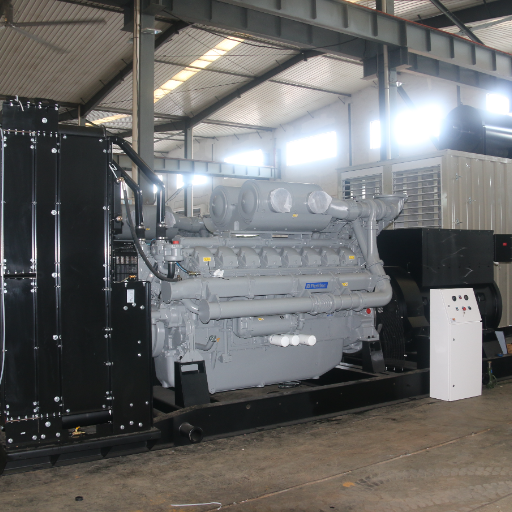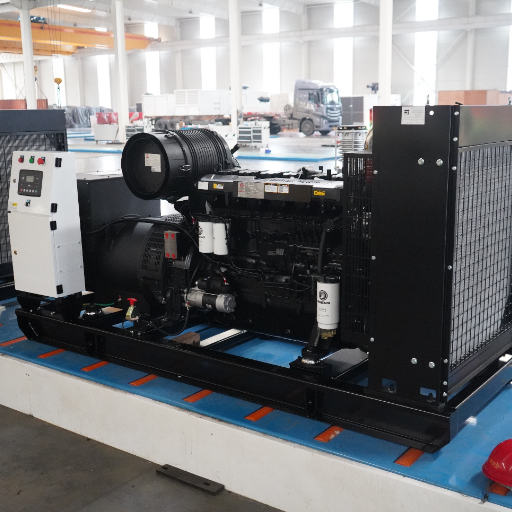


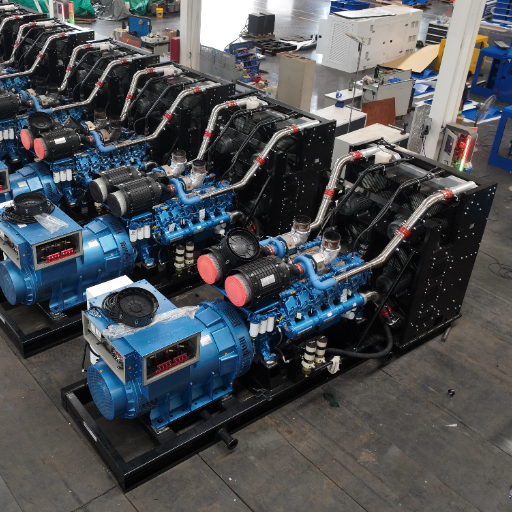
11kV generator specifications are not a longer version of a 400 V data sheet. They carry a second block of numbers, covering insulation level, reactance and short-circuit current, that a low-voltage sheet never shows. Most buyers read the first block and skip the second, and the omission tends to surface at protection commissioning rather than at delivery.
Here’s the counterintuitive part. A compliant offer can be rejected for printing “12 kV” on an insulation line. That number isn’t the machine’s voltage. It’s the insulation level the machine is built to, and it’s correct for an 11 kV set.
You already know how to read kVA, power factor and fuel consumption. This article covers the lines you probably don’t, and the three that buyers most often misread. If a supplier has already sent you a sheet, our engineers can read the second block with you before you compare prices.
Key Takeaways
- An 11 kV sheet carries two blocks: the nameplate block every buyer reads, and a system block written for the protection engineer.
- “12 kV” on the insulation line is Um, the highest voltage for equipment. It isn’t a mistake, and it isn’t the rated voltage.
- IEC 60071-1 pairs Um 12 kV with a 28 kV power-frequency withstand and a lightning impulse level of 60, 75 or 95 kV.
- A reactance percentage is per-unit on the machine’s own rating, so two sheets both saying 12% can describe different fault currents.
- “Short-circuit current” is at least three numbers. Ask which one each figure is before you size anything.
What 11kV Generator Specifications Include That a 400 V Sheet Does Not
Every generator sheet starts with the same family of lines. You’ll find rated kVA and kW, power factor, frequency, speed, insulation class, IP rating, ambient and altitude limits, fuel consumption and dimensions. At 11 kV, none of that disappears. A second family simply appears beside it.
| Block | Lines on the sheet | Who reads it |
|---|---|---|
| Nameplate | kVA, kW, power factor, frequency, speed, insulation class, IP rating, ambient, altitude, fuel, dimensions | Procurement, and anyone comparing offers |
| System | Rated voltage, Um, withstand voltages, winding type, reactances, time constants, short-circuit quantities, withstand duration, neutral arrangement, CT ratios and classes, cooling code | The protection engineer, and the person who has to commission the installation |
The second block exists because the sheet has to feed a fault study, not just an order. Its entries are the inputs a protection engineer works from, and a 400 V sheet has no counterpart for most of them.
Medium voltage generator specifications are usually assembled from two sources. The nameplate block comes from the manufacturer’s standard data sheet, built on the same generator set specification template we use for a 400 V set. The system block comes from the project’s electrical design. If your enquiry asks only for the first block, you’ll get offers you can compare on price and can’t compare on protection.
That distinction also answers a common early question. If the project hasn’t settled its voltage yet, the medium voltage versus low voltage comparison sets out what each route costs you in equipment and complexity.
Read the two side by side and the difference shows. A low voltage sheet is a nameplate document. An 11 kV sheet is a system-study input. That’s the useful mental model, and it explains why the second block looks unfamiliar.
Insulation Level Is Not Insulation Class
These two lines sit a few rows apart on the same sheet, and they answer completely different questions. One is thermal. The other is dielectric.
| Question | Insulation class | Insulation level |
|---|---|---|
| What it measures | Thermal endurance | Dielectric withstand |
| Typical label on the sheet | Class F or H | Um 12 kV, 28 kV, 75 kV |
| What it limits | How hot the winding can run | What voltage the insulation can survive |
The sheet says 12 kV. It is not a mistake
IEC 60038 sets standard voltages for three-phase systems. In its Series I table, an 11 kV nominal system voltage pairs with a highest voltage for equipment of 12 kV. That 12 kV figure is written Um. It’s the insulation reference for everything connected to the system, including the generator.
So the sheet is telling you two things at once. The machine is rated at 11 kV, and its insulation is built for a 12 kV system. Neither number is a typo, and neither one replaces the other.
Gareth Pryce learned that the slow way. He was a projects engineer at a water utility in Yorkshire, and in 2023 he rejected a compliant 11 kV offer because the insulation line read “12 kV, 28 kV, 75 kV.” He assumed the supplier had quoted a 12 kV machine against an 11 kV enquiry.
Two weeks passed before the supplier sent the standard extract and explained Um. The offer was correct. The evaluation lost a fortnight for a line Gareth had never been taught to read.
The two withstand numbers behind it
Um is the reference. The withstand values are what the insulation has to survive.
IEC 60071-1 is the insulation co-ordination standard, and it covers three-phase systems above 1 kV. For Um 12 kV, it lists a short-duration power-frequency withstand of 28 kV rms and a lightning impulse withstand of 60, 75 or 95 kV peak.
Treat the range as a design decision, not a single fixed number. The IEC 60071-1:2019 text is the reference if you need the full table.
The generator insulation level follows from the system, not from the machine’s size. A 1,000 kVA set at 11 kV and a 5,000 kVA set at 11 kV share the same insulation level, even though almost everything else on their sheets differs.
The machine side has its own standard. IEC 60034-15 covers impulse voltage withstand levels for form-wound stator coils on machines connected to a standard grid supply. That’s the line that tells you the winding was built for the surge environment it will actually see.
Now separate the two ideas cleanly. Class F or H is a thermal endurance rating. It tells you how hot the insulation can run and for how long.
Um and the withstand voltages are dielectric ratings. They tell you what voltage the insulation can survive.
A sheet can carry both, and a buyer who conflates them will misread one of the two.
One more number is worth knowing because it appears in test reports. IEC 60034-1 applies a power-frequency dielectric test of twice rated voltage plus 1,000 V for one minute. At 11 kV, that works out to 23 kV rms.
That’s the factory test, not the operating voltage. It’s our arithmetic from the test rule, and it’s worth labelling as such when you quote it.
For the thermal side of the same sheet, our guide to generator alternator specifications covers insulation class, excitation and temperature rise in detail.
The Reactance Block and Its Missing Base
Below the insulation lines, 11kV generator specifications usually carry a block of reactances.
| Symbol | Name | What it governs |
|---|---|---|
| Xd | Synchronous reactance | Steady-state voltage regulation and the sustained fault level |
| X’d | Transient reactance | Behaviour in the first cycles as the field responds |
| X”d | Subtransient reactance | The initial symmetrical fault current the switchgear sees |
| X2 | Negative-sequence reactance | Heating and protection during unbalanced faults |
| X0 | Zero-sequence reactance | Earth-fault current and earth-fault protection |
Larger machines often add a short-circuit ratio and three time constants. The subtransient value is the one that matters for fault current. It’s also the one most often compared badly, because a percentage on its own isn’t a quantity.
A percentage is per-unit, and per-unit needs a base
Every generator reactance value on that block is per-unit. Per-unit means “as a fraction of the machine’s own rating,” and the rating is the base. Change the base and the same percentage describes a different current.
Take two machines, both quoting X”d at 12%. One is rated 2,000 kVA at 11 kV, which is about 105 A of rated current by our arithmetic. The other is rated 4,000 kVA at the same voltage, about 210 A.
The percentage is identical. The fault current each one pushes into the switchgear is not, because the base has doubled.
The medium voltage generator guide works through why a 12% machine can fault at roughly eight times the current on its nameplate. The question this line answers is narrower: eight times which current? If two offers quote the same percentage on different kVA bases, you’re not comparing like with like until you convert both to amps at one base.
If the project reaches 11 kV through a step-up transformer, the impedance you need is the sum of the machine’s and the transformer’s. Our guide to the generator step-up transformer covers how that combination changes the fault level at the switchboard. A machine quoted on its own reactance can look quieter than the installation it feeds.
Saturated or unsaturated
In practice, some sheets print two columns, marked saturated and unsaturated. They aren’t interchangeable. The unsaturated value describes the machine before magnetic saturation, and the saturated value describes it under the conditions that actually apply during a fault.
Ask which one the quote uses, and ask for both if the protection study needs them. A single percentage with no label is not enough to coordinate a relay.
Short-Circuit Current Is Three Numbers, Not One
The line that says “short-circuit current” is where the ambiguity gets expensive. The same machine produces at least three different values, and a sheet often prints one without saying which.
What the sheet usually prints, and what it leaves out
The first value is the initial symmetrical current, set by X”d. The second is the sustained or de-excited current, which is what the machine can still deliver after the field has decayed. The third is the peak asymmetric current.
These differ by large factors. A sheet quoting “3 times rated current” might be describing the sustained figure, not the initial one and not the peak. If you size a breaker on that number, you may be sizing it on the smallest of the three. An unlabelled generator short-circuit current figure is the one to challenge first.
Relay coordination is where the three quantities meet. An overcurrent relay works from the sustained current, an instantaneous element works from the initial symmetrical current, and the switchgear’s making rating has to cover the peak. One number on the sheet can’t serve all three settings, which is why the protection engineer asks for the set.
Nomsa Dlamini ran into this at a platinum mine in Limpopo. She was comparing two 11 kV offers in 2022 and used the “3× In” line on the cheaper sheet to check the breaker rating. The initial symmetrical current was several times higher once the reactance was converted to amps. The breaker was replaced before energisation, and the delay pushed the commissioning window by three weeks.
What the standard actually requires
IEC 60034-1 sets a ceiling, not a target. Its short-circuit clause caps the peak current at 15 times the peak rated current, or 21 times the rms value. A machine that faults below that ceiling is compliant, so a lower figure isn’t a defect.
The same standard specifies a three-phase short-circuit withstand test held for 3 seconds. That’s a duration the machine has to survive, not a promise to hold three times rated current for the whole period. If your specification asks for the latter, treat it as a project requirement on top of the standard and ask the supplier to confirm it separately.
Keep the three quantities separate in your own comparison. Ask the supplier which one each figure represents, and ask for the base it was calculated on. If the answer is vague, the number isn’t ready to use.
The Three Lines Buyers Misread
Here’s the payoff, in one table. Each row is a line you’ll see on a real 11 kV sheet, the assumption buyers bring to it, and the check that settles it.
| Line on the sheet | What buyers assume | What it means | The check to run |
|---|---|---|---|
| Insulation level, such as 12 kV / 28 kV / 75 kV | The supplier quoted the wrong voltage | Um and the standard withstand values for an 11 kV system | Ask for rated voltage and insulation level on separate lines |
| X”d percentage, such as 12% | Percentages are directly comparable | Per-unit on the machine’s own kVA and voltage base | Convert both offers to amps at the same base, and ask saturated or unsaturated |
| “Short-circuit current,” such as 3× In | One number describes the fault | One of three quantities: initial, sustained or peak | Ask which quantity each figure is, and what it was calculated from |
Then there’s the protection interface. At 11 kV, the sheet should state whether the neutral is brought out, how it’s earthed, and what current transformers are fitted. Some medium voltage packages include a neutral earthing resistor, and the sheet should give its value.
At low voltage, those details are usually assumed. Here they’re design inputs.
Frequently Asked Questions About 11kV Generator Specifications
What do the specifications of an 11kV generator include?
They include the familiar nameplate block and a second block specific to medium voltage. The second covers rated voltage and Um, withstand voltages, winding type, reactances, short-circuit quantities, neutral arrangement and current transformers. That second block is what the protection engineer needs.
Why does an 11 kV generator data sheet say 12 kV?
Because 12 kV is Um, the highest voltage for equipment on an 11 kV system. It’s the insulation reference, not the rated voltage. The machine is rated at 11 kV and built to a 12 kV insulation level. A sheet showing both numbers is consistent, not contradictory.
What is the difference between insulation class and insulation level?
Insulation class is thermal. Class F or H tells you how hot the winding can run. Insulation level is dielectric. Um and the withstand voltages tell you what voltage the insulation can survive.
They appear on the same sheet and answer different questions.
Can I compare two offers by percentage reactance?
Not directly. A reactance percentage is per-unit on the machine’s own rating. Two machines both quoting 12% can produce different fault currents if their kVA bases differ. Convert both to amps at the same base, and confirm whether the figure is saturated or unsaturated.
What short-circuit current should an 11kV generator have?
There’s no single target. IEC 60034-1 sets a ceiling of 15 times peak rated current, or 21 times the rms value, and a three-phase withstand test held for 3 seconds. What matters is which quantity the sheet quotes and whether your switchgear is rated for it.
What is a neutral earthing resistor on an 11kV generator?
It’s an impedance placed between the generator neutral and earth to limit earth-fault current. At medium voltage, many packages include one, and its value should appear on the sheet. The value determines how much earth-fault current the protection can see and must be coordinated with the relay settings.
Read the Sheet the Way the Protection Engineer Will
11kV generator specifications read differently from those of a 400 V set, even when the first page looks familiar. The insulation line is not the rated voltage, the reactance percentage needs its base, and the short-circuit line is at least three numbers. Those are the three checks that pay for themselves.
Rizky Pratama, an EPC estimator in Jakarta, made the checks routine. In 2024 he started scoring every 11 kV bid against a one-page data schedule. It required Um and withstand voltages, reactances with their base and saturation state, each short-circuit quantity named, and the neutral and CT arrangement. The bids came back comparable for the first time, and his team cut the technical evaluation from three weeks to six days.
You don’t need a protection study to ask for those lines. You need the sheet to state them, and you need to know which ones to look for.
The same discipline applies to a generator set specification for tender: name the data you need before the bids arrive.
If you’re holding an 11 kV offer and the second block is thin, send it to our engineers. We’ll tell you what’s missing and what it changes before the order goes out.