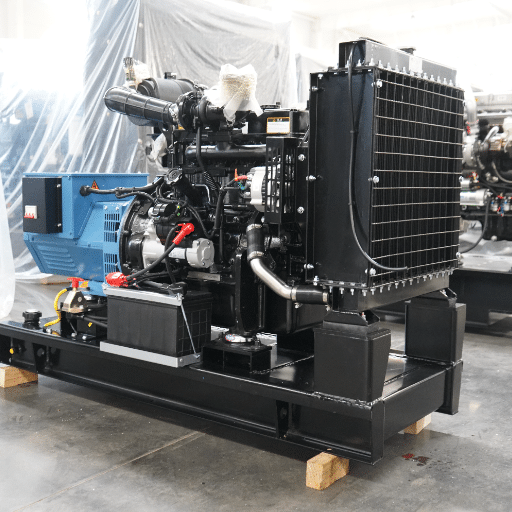

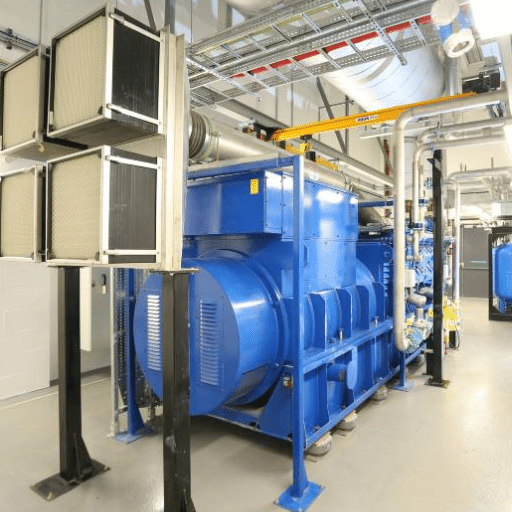
Industrial CHP cogeneration turns a single fuel source into two valuable energy outputs: electricity and useful thermal energy. A factory generates both electricity and thermal energy through its natural gas generator instead of purchasing grid electricity and using fuel for thermal energy production. The system achieves total efficiency between 75 and 90 percent which exceeds the 45 to 55 percent efficiency of separate heat and power production.
Most factories waste over half the energy they pay for. That waste leaves the building as exhaust heat, cooling tower vapor, and transmission losses. CHP captures that waste and puts it to work.
In this guide, you will learn how industrial CHP cogeneration works, how to size a system for your factory, which technology fits your sector, and what payback to expect. We wrote this from the perspective of a generator manufacturer that designs natural gas generator sets for continuous CHP duty. Every formula includes a worked example with real numbers.
Key Takeaways
- Industrial CHP cogeneration generates electricity and useful thermal energy from a single fuel source, typically natural gas
- Total system efficiency reaches 75-90% vs 45-55% for separate heat and power generation
- Size the system to match thermal demand first; electric output follows the heat-to-power ratio of the chosen technology
- Reciprocating gas engines suit 50 kW-20 MW factories; gas turbines suit 1 MW+ plants with high steam demand
- More than 80% heat utilization and over 5,000 operating hours per year are required for economic viability
- Typical payback period is 2-5 years with 20-40% total energy cost reduction
- Waste heat applications include process steam, hot water, drying, sterilization, and absorption cooling
For in-depth technical details regarding natural gas generator specifications, (please refer to our natural gas generator guide.)
What Is Industrial CHP Cogeneration?

Combined heat and power (CHP) which people also refer to as cogeneration generates electrical power and useful thermal energy through its operation as a system that uses one fuel source. The natural gas generator in industrial facilities generates mechanical power which operates an alternator to produce electrical energy. The system captures and reuses exhaust heat together with jacket water heat and oil cooler heat that would normally be wasted.
A typical industrial CHP system includes four main components:
- Natural gas engine or turbine: Converts fuel into mechanical power
- Generator (alternator): Converts mechanical power into electricity
- Heat recovery equipment: Heat exchangers or a heat recovery steam generator (HRSG) that capture waste heat
- Control system: Manages load following, grid synchronization, and heat distribution
The efficiency advantage is straightforward. A conventional power plant might convert 33% of fuel energy into electricity. The remaining 67% is lost as waste heat. A separate on-site boiler might convert 80% of fuel into thermal energy. Together, the two systems achieve roughly 50% overall efficiency.
A well-designed industrial CHP cogeneration system achieves 75-90% total fuel utilization because the same fuel molecule does two jobs. The U.S. EPA reports that existing CHP deployment avoids approximately 241 million metric tons of CO2 emissions annually compared to separate generation.
Want to see how this applies to your facility? Contact our engineering team for a free CHP feasibility assessment based on your heat and electric load profiles.
Why Factories Are Adopting Industrial CHP Cogeneration
Energy Cost Reduction
Factories that buy electricity from the grid and burn fuel in on-site boilers pay twice for energy that could come from one source. Industrial CHP cogeneration typically reduces total energy costs by 20-40%. The savings come from three areas:
- Lower fuel consumption for the same useful energy output
- Avoided transmission and distribution charges on self-generated electricity
- Reduced demand charges from the utility
A facility with a steady thermal load and high electricity consumption can often achieve payback in 2-5 years.
Energy Resilience and Reliability
CHP systems can function either as grid-connected systems or as independent systems running in island mode. A natural gas CHP system maintains production operations during power outages when it has been set up correctly. This element holds crucial importance for operations that require uninterrupted functioning because any downtime will result in thousands of dollars of losses every hour.
Natural gas pipeline systems provide greater weather-related durability than electric distribution systems during extreme weather conditions. A factory with on-site CHP maintains control over its own energy supply.
Emissions and Sustainability Goals
Because CHP systems require less fuel to produce useful energy their emissions decrease in direct relation to their fuel usage. The majority of industrial CHP systems reduce CO2 emissions by 30 percent or greater when compared to using separate boiler systems and grid electricity. Modern lean-burn natural gas engines can operate below strict NOx limits for thousands of hours. Ultra-low emission systems now achieve less than 5 ppm NOx.
CHP provides factories with a reliable method to meet environmental regulations and corporate sustainability goals while maintaining their operational efficiency.
Waste Heat Utilization
The thermal output from a CHP system can serve multiple factory needs:
- Process steam for sterilization, pasteurization, or chemical reactions
- Hot water for cleaning, washing, or space heating
- Direct drying air for textiles, paper, or food products
- Absorption chilling for process cooling or air conditioning
When in 2023 Marcus Chen became the energy manager of a Midwest-based food processing company, the plant was at a $1.2-million spend on grid electricity and natural gas for boiler steam. He installed a 1.5 MW natural gas engine CHP system with exhaust heat recovery and jacket water heat exchangers. The waste heat now preheats boiler feed water and supplies facility heating. Grid electricity purchases declined, saving $651.2 against spend values. He installed a 1.5MW natural gas engine CHP boiler system with heat recovery and jacket water heat exchangers that pre-heat boiler feed water via the waste heat thus contributing to the air-heating provision. The reduction in grid electricity purchases saved $340,000. The project paid for itself in 3.8 years.
CHP Technologies for Industrial Applications
Choosing the right CHP technology depends on your facility size, thermal demand profile, and heat quality requirements.
Reciprocating Gas Engine CHP
Reciprocating gas engines are the most common choice for industrial CHP in the 50 kW to 20 MW range. They offer high electrical efficiency, fast startup, and excellent load-following capability.
- Electrical efficiency: 40-48%
- Total system efficiency: 80-90%
- Heat-to-power ratio: 1.1:1 to 1.7:1
- Exhaust temperature: 850-1,100°F (450-600°C)
- Best for: Small to mid-size factories, variable loads, facilities needing hot water or low-pressure steam
Gas engines produce multiple heat streams: exhaust gas, jacket cooling water, and oil cooling water. This makes them ideal for factories that can use heat at different temperatures.
Gas Turbine CHP
Gas turbines are perfectly adapted to large industries that require high-pressure steam. They discharge at high exhaust temperatures, making them perfect for creating high-quality steam.
- Electrical efficiency: 30-42%
- Total system efficiency: 75-85%
- Heat-to-power ratio: 1.6:1 to 5:1 (with supplementary firing)
- Exhaust temperature: 850-1,100°F (450-600°C)
- Best for: Large plants (1 MW+), chemical processing, refineries, facilities needing high-pressure steam
Supplementary firing can be added downstream of the turbine to boost heat output, achieving heat-to-power ratios up to 5:1 where process steam demand is high.
Combined Cycle CHP
The combined cycle system joins a gas turbine with a heat recovery steam generator (HRSG as abbreviated), which then links up to a steam turbine as a second stage. This arrangement ensures maximum energy extraction from the fuel.
- Electrical efficiency: 50-60%
- Total system efficiency: Up to 90%
- Best for: Very large continuous operations with steady electric and thermal demand
The higher electrical efficiency comes at the cost of greater complexity and capital investment. Combined cycle CHP is typically viable for facilities above 10 MW.
Microturbine CHP
Microturbines occupy the small end of the CHP spectrum, from 25 kW to 500 kW. They have only one moving part, which means low maintenance and high reliability.
- Electrical efficiency: 25-35%
- Total system efficiency: 70-80%
- Best for: Small facilities, discrete production lines, remote sites
| Technology | Capacity Range | Electrical Efficiency | Total Efficiency | Heat-to-Power Ratio | Best For |
|---|---|---|---|---|---|
| Reciprocating Gas Engine | 50 kW – 20 MW | 40-48% | 80-90% | 1.1:1 – 1.7:1 | Mid-size factories, variable loads |
| Gas Turbine | 1 MW – 100+ MW | 30-42% | 75-85% | 1.6:1 – 5:1 | Large plants, high-pressure steam |
| Combined Cycle | 10 MW+ | 50-60% | Up to 90% | 0.8:1 – 1.5:1 | Very large continuous operations |
| Microturbine | 25 – 500 kW | 25-35% | 70-80% | 1.5:1 – 3:1 | Small facilities, remote sites |
How to Size an Industrial CHP Cogeneration System

Proper sizing is the most critical step in CHP project success. An oversized system wastes capital. An undersized system misses savings. The golden rule is simple: size to the thermal load first, then verify that the electric output matches your demand. If you are new to generator sizing, read our complete guide on how to size a natural gas generator before applying the CHP-specific rules below.
Step 1: Map Your Thermal Demand Profile
Collect hourly heat load data for at least one full year. Identify:
- Baseload thermal demand (the minimum heat load that exists nearly all the time)
- Peak thermal demand and how often it occurs
- Seasonal variation (heating loads often drop in summer)
- Heat quality requirements (temperature and pressure for steam, or temperature for hot water)
One food processing facility in Ohio took steam demand data over twelve months recording the low subdivision of its requirement of 800 kW thermal energy solely keeping sanitation and cleaning-as-you-go systems in July. This became the anchor for the size recommendation for the CHP system.
Step 2: Match Electric Load to Thermal Output
Once you know your baseload thermal demand, work backward through the heat-to-power ratio of your chosen technology.
Example: If your baseload thermal demand is 1,000 kW and you select a reciprocating gas engine with a heat-to-power ratio of 1.5:1, the required generator size is:
Generator size = Thermal demand / Heat-to-power ratio = 1,000 kW / 1.5 = 667 kW
Please confirm that the 667 kW electric nameplate of the turbine is sufficient for generating an appreciable portion of your base-budget energy demand. Any excess electricity produced can generally be sold back to the grid where favorable net metering or feed-in tariffs apply.
Step 3: Calculate Total System Efficiency
Total system efficiency measures how much of the fuel energy becomes useful work.
Total System Efficiency = (Net Useful Electric Output + Net Useful Thermal Output) / Total Fuel Energy Input
Worked example: A 1,000 kW natural gas generator produces 1,000 kW of electricity and 1,400 kW of useful thermal energy. The fuel input is 2,700 kW.
Total System Efficiency = (1,000 + 1,400) / 2,700 = 2,400 / 2,700 = 88.9%
Effective electric efficiency compares the electricity generated on-site against grid-purchased power, accounting for the thermal energy that displaces boiler fuel:
Effective Electric Efficiency = Electric Output / (Fuel Input – Thermal Output / Boiler Efficiency)
Using the same example with an 80% efficient boiler:
Effective Electric Efficiency = 1,000 / (2,700 – 1,400 / 0.80) = 1,000 / (2,700 – 1,750) = 1,000 / 950 = 105.3%
An effective electric efficiency above 100% means the on-site electricity is effectively free because the thermal energy alone would have consumed nearly as much fuel in a conventional boiler.
Step 4: Plan for Redundancy and Growth
Critical industrial processes require backup. Add N+1 redundancy for facilities where heat or power interruption would halt production. Also include a 15-25% growth margin for future expansion.
Ready to calculate CHP sizing for your facility? Request a custom sizing analysis from our engineering team with your load profile data.
Natural Gas Generator Integration in CHP Systems

Not every natural gas generator is suitable for CHP duty. Continuous operation places different demands on the engine, cooling system, and heat recovery equipment than intermittent standby service.
Engine Selection for CHP Duty
CHP generators run 5,000-8,000 hours per year or more. This requires:
- Continuous duty rating: Not standby or prime power rating. The engine must be derated for continuous operation.
- Lean-burn combustion: Lean-burn natural gas engines run at higher air-fuel ratios, which lowers combustion temperatures and reduces NOx formation. They are the standard for continuous industrial CHP.
- Robust cooling system: CHP engines need larger radiators or dedicated cooling circuits because the jacket water heat is recovered rather than rejected to ambient air.
Spark plug replacement intervals on continuous-duty gas engines typically fall between 2,000 and 4,000 hours. Valve adjustments come at 4,000-8,000 hours. Oil change intervals extend to 500-1,000 hours with quality synthetic oil.
Heat Recovery System Design
A complete CHP heat recovery system captures energy from three sources:
- Exhaust gas heat exchanger: Captures heat from engine exhaust (850-1,100°F) to generate steam or hot water
- Jacket water heat exchanger: Captures heat from the engine cooling circuit (180-220°F) for lower-temperature applications
- Oil cooler heat exchanger: Captures additional low-grade heat
The exhaust gas heat exchanger is typically the largest contributor, recovering 40-50% of the fuel energy input. Jacket water recovery adds another 20-30%.
HRSG Sizing and Steam Quality
The heat recovery steam generator must match both the quantity and quality of heat required by the factory process:
- Low-pressure steam: 15-150 psig for heating, cleaning, and sterilization
- Medium-pressure steam: 150-400 psig for process applications
- High-pressure steam: 400+ psig for power generation or specific chemical processes
HRSG sizing must account for the exhaust gas flow rate, temperature, and the allowable backpressure on the engine. Too much backpressure reduces engine efficiency and can damage exhaust valves.
Control and Monitoring Systems
Modern CHP control systems manage multiple operating modes:
- Grid parallel: Generator synchronized with utility, exporting excess power
- Island mode: Independent operation during grid outages
- Load following: Output adjusts to match real-time thermal demand
- Heat dump: Excess heat rejected through radiators when thermal demand is low
Heat dump capability is essential. If the factory cannot use all the recovered heat, the system must reject the excess to protect the engine. Facilities with seasonal thermal loads should plan for heat dump radiators or thermal storage tanks.
Industrial CHP Applications by Sector
Food and Beverage Processing
Food and beverage production plants require steam for the pasteurization and sterilization processes for cleaning-in-place systems and for the cooking operations. The cleaning and sanitation at a facility are done primarily using hot water. On a side note, the CHP system, run on natural gas, ensures all necessary heat energy is produced whilst also generating electric platform for refrigeration and packaging, and process equipment.
PepsiCo’s bottling plant at Mississauga brings in some combined heat and power systems using Jenbacher natural gas engines. The system thus will ensure the continuous production of beverages like Pepsi and Gatorade, given the dependable power and thermal energy developed.
Textile and Apparel Manufacturing
Textile mills have a massive requirement for steam for the dyes, finishes, and drying facilities. The thermal demand remains fairly constant, making textiles a good application for cogeneration systems.
A combined co-generation system with a post-combustion heat recovery has been installed in a Thailand textile mill. Under the new system, the overall efficiency was raised from an early value of 48% to a superb 78%. Savings in fuel reached over 20% within a year. The system operated flat out during total-load hours, since the steam demand necessitated maintaining uninterrupted annual operations for more than 7000 hours.
Chemicals and Petrochemicals
Chemical plants often require high-pressure steam for reactions, distillation, and separation processes. Gas turbine CHP with supplementary firing can deliver the heat-to-power ratios these facilities need.
Pharmaceuticals
Pharmaceutical manufacturing needs specific temperature control systems combined with clean steam sterilization equipment and continuous power supply for essential operations. The facilities need both reliable power supply and thermal energy capacity which CHP system provides.
A pharmaceutical production facility in Northern Italy installed two natural gas cogeneration units which each produce 1 MWe and operate an exhaust heat recovery boiler system. The system generates 16000 MWh of electricity together with 15750 tons of steam during each year. Energy costs decreased by 25 percent. The reduction in CO2 emissions reached 15 percent. The project proved that exact heat-to-power ratio matching produces both financial and ecological advantages.
Pulp and Paper
Pulp and paper mills have enormous thermal and electric demands. Many facilities operate biomass boilers alongside natural gas CHP systems to maximize fuel flexibility and minimize waste.
Metal and Metalworking
Heat treatment, surface coating, and parts washing all require controlled thermal energy. Natural gas CHP systems provide the steady, high-quality heat these processes demand.
CHP vs CCHP: Adding Cooling to the Equation
Combined cooling, heat, and power (CCHP), which people commonly refer to as trigeneration, enhances the CHP system through the incorporation of absorption chillers. The system generates thermal energy which powers a chiller system that creates chilled water used for process cooling and air conditioning purposes.
The system proves beneficial for manufacturing plants which require continuous cooling throughout the entire year because they operate cold storage and dairy processing facilities and they operate in regions with extreme heat. By implementing a third beneficial output trigeneration system enables total fuel efficiency to exceed 90 percent.
In 2024 a plastics manufacturer in Arizona replaced its electric chillers with absorption units powered by exhaust heat from a 2 MW natural gas generator. The chillers now operate independently from the grid which resulted in a 40 percent reduction of summer peak electric demand. The factory now uses waste heat productively in summer instead of rejecting it to the atmosphere.
For a deeper technical breakdown of hospital natural gas generator compliance requirements, sizing parameters and fuel planning strategies, see our hospital natural gas generator guide.
Total Cost of Ownership and Payback Analysis

Capital Costs
Industrial CHP system capital costs range from 1,200to1,200to2,500 per kW installed, depending on technology, scale, and site-specific requirements. For a detailed breakdown of equipment-only pricing, see our analysis of commercial natural gas generator cost before adding heat recovery and installation expenses:
- Reciprocating gas engine CHP: $1,200-1,800 per kW
- Gas turbine CHP: $1,500-2,500 per kW
- Microturbine CHP: $2,000-3,500 per kW
These figures include the generator, heat recovery equipment, controls, and basic installation. Grid interconnection, fuel supply upgrades, and building modifications add to the total.
Operating Cost Savings
A well-matched CHP system typically reduces total energy costs by 20-40%. The exact savings depend on:
- Local electricity rates and demand charges
- Natural gas prices relative to electricity
- Annual operating hours
- Percentage of recovered heat that is utilized
Maintenance Reserves
Continuous-duty CHP systems require more intensive maintenance than standby generators. Budget approximately $0.015-0.025 per kWh for maintenance over the system life. This covers oil changes, spark plugs, valve adjustments, heat exchanger cleaning, and periodic overhauls.
Incentives and Tax Credits
Many regions offer incentives for CHP installation:
- Federal investment tax credits (ITC) in the U.S.
- State rebates and grants for energy efficiency
- Accelerated depreciation schedules
- Renewable energy credits for biogas or hydrogen-blend systems
Payback Timeline
Well-matched industrial CHP systems typically achieve payback in 2-5 years. Facilities with high electricity rates, low natural gas prices, and steady thermal demand achieve the fastest returns.
| Cost Factor | Reciprocating Engine | Gas Turbine | Microturbine |
|---|---|---|---|
| CAPEX per kW | $1,200-1,800 | $1,500-2,500 | $2,000-3,500 |
| Electrical Efficiency | 40-48% | 30-42% | 25-35% |
| Maintenance per kWh | $0.015-0.020 | $0.010-0.015 | $0.020-0.030 |
| Typical Payback | 2-4 years | 3-5 years | 4-6 years |
| Best System Size | 200 kW – 10 MW | 2 MW – 50 MW | 100 – 500 kW |
Critical Design Considerations
Fuel Supply Reliability
Natural gas CHP depends on pipeline delivery. Before committing to CHP, verify:
- Pipeline capacity and pressure at your site
- Gas utility reliability history
- On-site LNG or CNG backup options for critical processes
Facilities in areas with unreliable gas supply may need dual-fuel capability or thermal storage as a bridge. Our natural gas generator vs diesel comparison explains when dual-fuel or backup diesel units make sense for critical industrial processes.
Emissions and Permitting
Industrial CHP systems must comply with local air quality regulations:
- NOx limits (typically 9-25 ppm for lean-burn gas engines)
- CO limits
- Title V operating permits for systems above certain thresholds
Selective catalytic reduction (SCR) and oxidation catalysts can reduce emissions to ultra-low levels where required.
Heat Utilization Planning
More than 80% of the produced heat must be used for CHP to be economically viable. Before sizing any system, map every possible heat user in the facility:
- Process steam demand by hour
- Hot water requirements
- Space heating loads
- Potential absorption cooling loads
- Thermal storage opportunities
Facilities that cannot achieve 80% heat utilization should consider smaller systems or hybrid configurations.
Grid Interconnection Standards
Parallel operation with the utility grid requires:
- Anti-islanding protection
- Synchronization controls
- Utility approval and interconnection agreement
- Net metering or power purchase agreement if exporting excess electricity
The interconnection process can take 3-12 months depending on the utility and local regulations.
Space and Ventilation
CHP equipment needs proper clearance for maintenance access, exhaust routing, and cooling air. Plan for:
- Generator room dimensions (typically 1.5x equipment footprint for access)
- Exhaust stack height and routing
- Cooling tower or radiator placement
- Fuel train and gas pressure regulation station
Industrial CHP Maintenance Best Practices

Continuous Duty Maintenance Schedule
CHP generators run far more hours than standby units, so the maintenance schedule reflects continuous duty demands. Our dedicated guide to natural gas generator maintenance covers the same intervals in greater detail, including oil analysis interpretation and spark plug selection for lean-burn engines.
- Daily: Visual inspection, leak checks, parameter logging
- Weekly: Battery check, air filter inspection
- Monthly: Oil analysis sample, coolant check, electrical connection torque
- 500-1,000 hours: Oil and filter change (vs 250 hours for standby)
- 2,000-4,000 hours: Spark plug replacement
- 4,000-8,000 hours: Valve adjustment, turbocharger inspection
- Annual: Load bank testing, control system calibration
- Major overhaul: 30,000-60,000 hours depending on engine type
Heat Recovery System Maintenance
Heat exchangers and HRSGs require regular attention:
- Tube cleaning every 6-12 months to prevent fouling
- Inspection of expansion joints and seals
- Water treatment for steam systems to prevent scaling
- Exhaust bypass damper testing
Fouled heat exchangers can reduce thermal recovery by 15-25%, directly impacting project economics.
Predictive Maintenance
Modern CHP systems benefit from digital monitoring:
- Vibration analysis for bearing and crankshaft health
- Oil analysis for wear particle detection
- Exhaust temperature monitoring for combustion balance
- Remote monitoring systems for off-site diagnostics
Predictive maintenance can extend component life and prevent catastrophic failures that cause unplanned downtime.
Common Industrial CHP Mistakes
Even well-intentioned projects fail when these fundamentals are overlooked:
- Oversizing the electric generator relative to the thermal load. The result is a system that produces more electricity than the factory can use while dumping excess heat.
- Ignoring seasonal heat demand variation. A system sized for winter heating loads may waste half its heat in summer.
- Inadequate heat utilization planning. If less than 50% of produced heat finds a productive use, the project economics collapse.
- Neglecting grid interconnection requirements. Utility approval can take months. Starting the process late delays project completion.
- Poor maintenance planning for continuous duty. Standby maintenance schedules do not work for CHP systems running 6,000+ hours per year.
- No redundancy for critical processes. A single generator failure should not halt production.
- Underestimating installation and integration costs. Fuel lines, exhaust stacks, cooling systems, and control integration add 20-40% to equipment costs.
When to Bring in an Expert
Industrial CHP projects benefit from experienced engineering support when:
- System size exceeds 1 MW
- Heat integration with existing processes is complex
- Multiple generators must operate in parallel
- Emissions permitting is required in non-attainment areas
- Grid interconnection involves export or net metering
Before contacting an engineer, prepare these documents:
- 12 months of hourly electric and thermal load data
- Site layout with available space for equipment
- Natural gas utility data (pressure, capacity, rates)
- Electric utility rate schedule and interconnection requirements
- Future growth plans that may affect load profiles
At Shandong Huali Electromechanical, we manufacture natural gas generator sets from 20 kW to 2,000 kW with integrated CHP capabilities. Our engineering team supports project sizing, heat recovery system design, and custom configurations for industrial applications worldwide.
For a deeper technical breakdown of dual fuel industrial generator specifications and key considerations for commercial buyers, see our dual fuel industrial generator guide.
Conclusion
Industrial CHP cogeneration systems change how manufacturing plants evaluate their energy needs. The operation of a natural gas generator enables the creation of both electrical power and essential thermal energy which factories use to produce their products. Total system efficiency jumps from roughly 50% to 75-90%. Energy costs decrease between 20% and 40%. Emissions reduction exceeds 30%.
Successful implementation requires matching your thermal load requirements with proper technological solutions while designing a system which meets your base load needs and maintains operational efficiency through its heat recovery systems. Reciprocating gas engines serve small to mid-size factories. Gas turbines power large plants with high steam demand. Combined cycle systems extract maximum efficiency at very large scale.
The global CHP market reached approximately $33.9 billion in 2026, with industrial facilities accounting for roughly 65% of installed capacity. Factories that act now capture both the economic savings and the operational resilience that CHP delivers.
Ready to explore CHP for your facility? Contact our engineering team for a feasibility assessment and custom natural gas generator sizing based on your specific heat and electric load profiles.