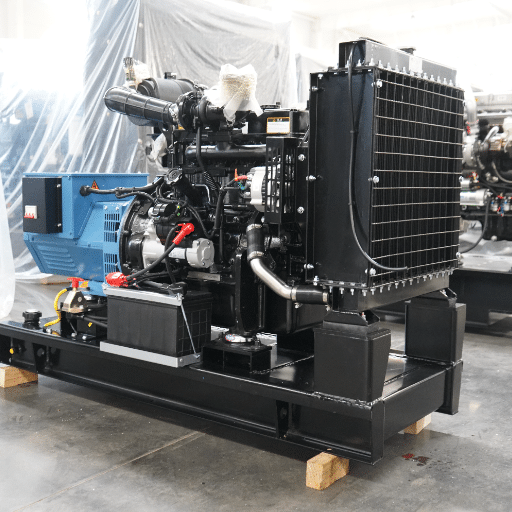



For industrial and commercial works, the names of the best commercial generator brands are Caterpillar, Cummins, Generac, and Kohler. Each brand is dominating a different section – Caterpillar for heavy industrial applications, Cummins for fuel-efficient commercial systems, Generac for light-commercial and standby market, and Kohler for real commercial reliability in mission with quick response time.
But, what most buyers do not know is that the corporate name on the nameplate isn’t necessarily the manufacturer of the generator. A contractor in Texas paid 85 ,000 for a Cummins-branded 500 kW unit for a construction project; the same unit with the same Cummins engine, Stamford alternator, and DSE controller for an ISO-certified OEM manufacturer would have cost 52 ,000. The components and the integration standard are the same. The difference is the brand markup, not build quality. The contractor’s project did not require any operational advantages associated with the dealership the global dealer network of Caterpillar provides, so the brand premium added no value.
This guide seeks to list the top commercial generator brands based on market data, engineering capability, and implementation in the field. We represent a power generator manufacturer outfit that is especially oriented toward the building of sets involving Cummins, Perkins, or some other top-ranked engine brand. We unpack the question of who is actually building your generator and when brand names matter, and explain how an OEM-direct-to-user supplier is a better value.For in-depth technical details regarding natural gas generator specifications, (please refer to our natural gas generator guide.)
Key Takeaways
- The top commercial generator brands are Caterpillar, Cummins, Generac, and Kohler, with Caterpillar holding approximately 10.5% global market share.
- The same engine in different brand integrations can vary 30-60% in price based on markup, not build quality.
- Caterpillar dominates heavy industrial and mining; Cummins leads fuel efficiency and global service; Generac wins light-commercial scale; Kohler excels in mission-critical reliability.
- The global generator market reached **31.6billionin2026∗∗,withcommercialgensetsrepresentingapproximately31.6billionin2026∗∗,withcommercialgensetsrepresentingapproximately15.95 billion.
- Buy a Tier 1 brand name for mission-critical applications with strict service requirements. Consider OEM-direct sourcing for project-based industrial needs where customization and value matter more than brand prestige.
- Evaluate generators on power requirements, application type, fuel availability, service proximity, and total cost of ownership — not brand name alone.
Understanding the Commercial Generator Market in 2026

Market Size and Growth
According to Fact. MR, the global generator market is expected by 2026 to reach a value of around $31.6 billion. Commercial gensets will reach a value of $15.95 billion alone in 2026 and grow at a CAGR of 7% to 2035. Increasing grid instability, the expansion of data centers, and a growing demand for backup power in health and critical infrastructure has driven this growth.
Diesel generators still take the largest share of the generator fuel type holdings, standing at almost 73%. Urban commercial applications with tougher emission standards and the availability of pipeline infrastructure, however, are seriously contemplating taking natural gas as generator fuel.
The Brand vs. Manufacturer Distinction
Understanding the commercial generator market requires understanding the difference between an engine brand and a genset packager. Caterpillar and Cummins are engine manufacturers. They design and build the engines that power generators. But the complete generator set — engine plus alternator, control system, cooling system, enclosure, and fuel system — is often built by an OEM packager.
This means two generators with the exact same Cummins engine can have vastly different prices. One carries the Cummins brand name, global dealer network, and integrated warranty. The other carries an OEM brand with the same core components but a different support structure. Both can be high quality. Both can be poor quality. The difference lies in the packager’s engineering standards, testing protocols, and quality control — not the engine badge.
Want to understand how generator sizing affects your brand selection? Read our guide on how to size a natural gas generator to match power requirements before comparing brands.
Top Commercial Generator Brands Ranked
Commercial generator brands fall into three tiers based on market presence, application focus, and manufacturing capability.
Tier 1: Market Leaders
According to GM Insights, Caterpillar is the source of approximately 10.5% of the generator sets market-the widest piece of market share therein. Caterpillar mostly controls duty-holding industries, mining, oil and gas, and large infrastructure projects. The power range delivered by these gensets stretches from 5 kW to 16 MW. Caterpillar’s best feature is the vertical integration; engines, alternators, switchgear, and control systems are all made and refined under the Cat banner. With true seamless system integration of components, such vertical integration, however, mandates an expensive price bracket.
Cummins tops the list, securing a spot in the top five manufacturers with approximately 40% of the generator set market cumulatively. With a power range both in terms of engine and total genset of 7 kW to 3,750 kW, Cummins boasts fuel efficiency, worldwide parts offerings, and digital monitoring with PowerCommand control systems. Besides the full-genset warranty from a single credence, the efficiency generates favorable points for the customers by one-stop service.
Generac is North America’s undoubted market leader when it comes to residential and light commercial backup systems and their expansion is now into ‘light’ industrial applications. With revenues estimated at around $2 billion, Generac offers the largest network of servicemen and technicians to do the servicing. Its strength is in numbers–enormous capacity and production volume, mass-volumed and easy-to-use automatic standby solutions. It is appropriate for small/mid-range commercial operation where local service is above consideration of the over-demanding hardiness.
Kohler generates over $1.5 billion in revenue from generator systems and remains a synonymous name within both commercial and industrial markets. The industrial and commercial-grade KD Series from Kohler is designed for reliability. Product strengths include quickest response times in the whole industry (about 10 seconds), PowerBoost technology for managing heavy loads during motor startup, and hydraulic valve lifters to eliminate periodic valve adjustment. Kohler stands out when it comes to the most critical applications, where safeguards for life and data center operation are essential, such as hospitals and data centers.
Tier 2: Industrial Specialists
Atlas Copco specializes in portable and mobile power solutions with variable speed technology that delivers up to 40% fuel savings during low-load operation. They are the go-to brand for construction, rental, and temporary power applications.
FG Wilson (a Caterpillar company) offers flexible configurations and strong aftermarket support with a 12-month genuine parts warranty. They are particularly strong in international markets where Caterpillar’s full product line is not available.
MTU (a Rolls-Royce Power Systems company) focuses on high-speed diesel and gas engines for mission-critical applications. MTU Series 2000 and 4000 engines are standard in data centers, healthcare, and defense applications where failure is not an option.
Perkins is an engine manufacturer whose engines power gensets built by dozens of OEM packagers worldwide. Perkins engines are known for reliability, parts availability, and cost-effective performance in the 5 kW to 2,500 kW range.
Tier 3: Regional and Emerging Players
Chinese OEM producers are marked by the dominance yet continuous increase as a proportion of global generator sales. Companies such as Shandong Huali, Jiangsu Starlight, and Guangxi Dingbo, manufacturers of generator sets provided with the same range of mostly Cummins, Perkins, Volvo, Deutz and Mitsubishi engines found on respective Western-own-branded sets, generally present much more process flexibility–customizing the equipment and delivering them for specialized, project-oriented clients. These companies find themselves without global dealer access that Tier 1 brands espouse.
| Tier | Brands | Best For | Power Range | Key Strength |
|---|---|---|---|---|
| Tier 1 | Caterpillar, Cummins, Generac, Kohler | Mission-critical and commercial applications | 5 kW – 16 MW | Global service networks, integrated warranties |
| Tier 2 | Atlas Copco, FG Wilson, MTU, Perkins | Specialized industrial and mobile applications | 5 kW – 4,000 kW | Fuel efficiency, aftermarket support, engine supply |
| Tier 3 | Chinese OEMs, regional manufacturers | Project-based and customized solutions | 5 kW – 3,000 kW | Customization, cost-performance, flexible configurations |
Brand-by-Brand Analysis
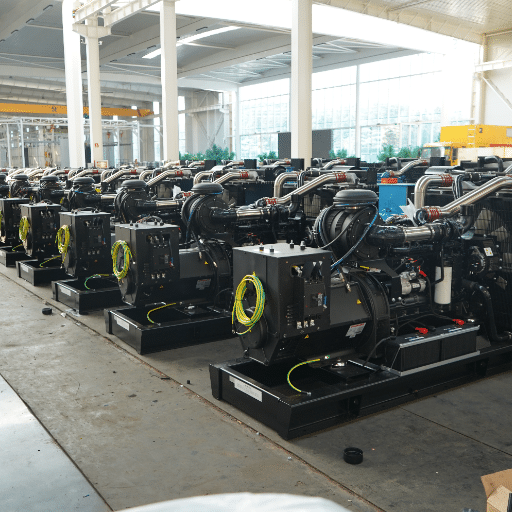
Caterpillar
Best for: Heavy industrial, mining, oil and gas, large infrastructure, extreme environments
Strengths: Caterpillar generators are designed for the extremes of Earth’s environment. Whether it be high-altitude, very cold, or dusty conditions, the engines of competitors’ brands often will not work. In remote industrial locations, no other network for spare parts can be compared with the Cat dealer network. The whole machine (engine, alternator, controls, and switchgear) are integrated into the power solution.
Weaknesses: Premium pricing. Caterpillar units typically cost 20-40% more than comparable Cummins or OEM-built systems. Parts and service are expensive and often require certified Cat technicians. For commercial buildings and standard industrial sites, the extreme-duty construction adds cost without adding value.
Power Range: 5 kW to 16 MW
Verdict: Buy Caterpillar when your application involves extreme conditions, continuous heavy-duty operation, or remote locations where dealer support is essential. For standard commercial backup power, the premium is hard to justify.
Cummins
Best for: Data centers, hospitals, commercial buildings, and applications needing fuel efficiency with flexible maintenance
Strengths: Cummins provides the most performance-efficient balance with global support. This QuietConnect series can cut noise levels for urban settings. It really stinks where the power unit is covered by warranty by Cummins, eliminating undue blame-shifting and enticing the ISO-certified Cummins from 1992 to 2004, to cover engine and alternator warranties given by different suppliers. Parts are fully available for maintenance at easily reachable workshops, not just dealer networks.
Weaknesses: While Cummins performs well across most applications, they are not as optimized as Caterpillar for extreme continuous-duty mining operations. Some buyers report that Cummins’ control systems have a steeper learning curve than Kohler’s or Generac’s interfaces.
Power Range: 7 kW to 3,750 kW
Verdict: Cummins is the safest choice for most commercial and industrial buyers. The combination of fuel efficiency, global parts availability, and reasonable pricing makes them the default recommendation for data centers, healthcare, and general commercial applications.
Generac
Best for: Light-commercial standby, retail, small business, budget-conscious buyers needing broad service availability
Strengths: Generac is the market leader in residential and light-commercial standby generators in North America. Their dealer network is the widest and most accessible. Mobile Link remote monitoring is user-friendly. Generac offers more power per dollar than Kohler or Cummins in the under-500 kW range. For small commercial buildings, retail stores, and restaurants, Generac provides reliable backup power at a competitive price.
Weaknesses: Generac’s commercial-grade construction is not equivalent to Kohler’s or Cummins’ industrial-grade standards. Some models require periodic valve adjustments every 400 hours, adding 350−350−500 per service. Mobile Link advanced features require a paid annual subscription. Generac is less suited for continuous prime power or heavy industrial loads.
Power Range: 10 kW to 2,500 kW
Verdict: Choose Generac for light-commercial standby applications where upfront cost and local service access are priorities. For industrial or mission-critical use, step up to Cummins or Kohler.
Kohler
Best for: Hospitals, data centers, and applications prioritizing fast response, low maintenance, and premium reliability
Strengths: Kohler’s response time is the fastest in the industry at approximately 10 seconds from outage to full power. Their PowerBoost technology handles large motor starting loads without voltage dip. Hydraulic valve lifters eliminate valve adjustment maintenance, saving 1,500−1,500−2,500 over the generator lifetime. OnCue Plus remote monitoring has no subscription fees. Kohler’s voltage regulation is superior for sensitive electronic loads.
Weaknesses: Higher upfront cost than Generac. More limited model range in the very large industrial segment compared to Caterpillar or Cummins. The specialized dealer network is smaller than Generac’s, though highly trained.
Power Range: 10 kW to 3,250 kW
Verdict: Kohler is the premium choice for mission-critical applications where response time, power quality, and minimal maintenance are non-negotiable. Healthcare and financial data centers should strongly consider Kohler.
How to Choose the Right Commercial Generator Brand

Selection Criteria Framework
Selecting the best commercial generator brand requires evaluating seven factors in order of priority for your specific project.
1. Power Requirements and Sizing
Accurate load assessment is the foundation of generator selection. Calculate running wattage plus inrush current for motors and transformers. Include a 20% headroom margin for future expansion.
2. Application Type and Duty Cycle
Standby power (emergency backup only, under 200 hours per year) has different requirements than prime power (unlimited runtime with variable loads) or continuous power (24/7 operation at constant load). Caterpillar and MTU excel at continuous duty. Generac and Kohler are optimized for standby. Cummins handles all three duty cycles effectively.
3. Fuel Type and Availability
Diesel remains the default for heavy industry due to energy density and disaster resilience. Natural gas is increasingly popular for urban commercial backup due to cleaner emissions and lower maintenance. Dual-fuel and bi-fuel options offer flexibility where fuel supply is uncertain.
4. Environmental Conditions
High altitude derates power output by 2-3% per 1,000 feet. Extreme heat requires oversized radiators. Dusty environments demand heavy-duty air filtration. Cold climates need block heaters and battery warmers. Caterpillar is the clear leader for extreme environments.
5. Service Network Proximity
A hospital in Arizona chose a brand with a weak regional service presence to save 12,000upfront.Whentheunitneededemergencyservice,thenearestcertifiedtechnicianwas400milesaway.Downtimeduringthewaitcostthefacility12,000upfront.Whentheunitneededemergencyservice,thenearestcertifiedtechnicianwas400milesaway.Downtimeduringthewaitcostthefacility40,000 in lost revenue and temporary power rental. The lesson: for critical applications, service network proximity is worth more than upfront savings.
6. Regulatory Compliance
Ensure the generator meets EPA Tier 4 Final, NFPA 110, and local emissions standards. California requires CARB certification. The EU requires CE marking and Stage V compliance. International projects may need custom voltage and frequency configurations.
7. Total Cost of Ownership
Sophisticated buyers look beyond purchase price to calculate:
- Initial investment plus installation
- Annual maintenance (15-20% of purchase price for quality industrial units)
- Fuel costs over the equipment lifecycle
- Downtime risk cost
- Warranty coverage terms
For a detailed cost breakdown, see our analysis of commercial natural gas generator cost.
Brand vs. OEM-Direct Decision Matrix
| Factor | Buy Tier 1 Brand (CAT/Cummins/Generac/Kohler) | Consider OEM-Direct |
|---|---|---|
| Mission-critical application (hospital, data center) | Yes | No |
| Requires global dealer network | Yes | No |
| Need single-source warranty | Yes | No |
| Custom voltage, frequency, or environmental package | Maybe | Yes |
| Project-based with tight budget | Maybe | Yes |
| Need containerized or mobile configuration | Maybe | Yes |
| Standard standby for commercial building | Yes | Evaluate both |
| Continuous prime power in remote location | Yes | Evaluate both |
Ready to explore custom configurations for your project? Our engineering team can recommend the right approach based on your power requirements, duty cycle, and budget. Contact us for a project assessment.
The OEM Manufacturer Perspective

Who Actually Builds Your Generator?
A commercial generator set is not a single product from a single company. It is an integrated system assembled from multiple suppliers:
- Engine: Cummins, Perkins, Volvo, Deutz, Caterpillar, Mitsubishi
- Alternator: Stamford, Leroy-Somer, Mecc Alte, Marathon
- Control System: DSE (Deep Sea Electronics), ComAp, Cat, Kohler Decision-Maker
- Enclosure and Integration: OEM packager or brand manufacturer
What happens is that you might see Cummins making the engine in-house with their alternator and controllers inside their generator package. Whereas when you buy the generator from the OEM manufacturer, that same Cummins engine gets mated with a Stamford alternator and a DSE controller before being exhaustively mounted inside a custom enclosure by the OEM’s engineering team.
The core components are often identical. The difference is in the integration standards, testing protocols, and support structure.
Evaluating Manufacturing Quality
Whether you choose a Tier 1 brand or an OEM manufacturer, evaluate these quality indicators:
- ISO 9001 certification: Ensures standardized quality management processes
- Factory Acceptance Testing (FAT): The generator should be run at full load for a defined period before shipment
- Test bed capacity: The manufacturer’s test facility must handle the full power output of your unit
- Engineering team size and expertise: A larger engineering team enables better customization and faster problem resolution
- Certification portfolio: CE, ISO 8528, EPA Tier 4, and other relevant standards
The Shandong Huali national-test center was to test every generating set before delivering. Eighty-plus engineers design custom configurations to suit voltage, enclosures, cooling, and control requirements that the standard product lines cannot meet.
Customization vs. Standard Product Lines
Tier 1 brands typically operate slightly traditional product lines optimized for high-volume production that keep costs low and maintain consistent quality but compromise on flexibility, which can be daunting in some projects such as where non-standard voltage, tropicalized cooling package, or containerized configuration is demanded if you plan or reconstruct on a project basis.
The recently set-up mining operation in Peru required generators with tropicalized cooling, thorough air filtration, and 440V/60Hz custom voltage; two Tier 1 brands quoted lead times of 16 weeks without almost any industry modifications. A third OEM delivered the custom-configured machines within 8 weeks with full tropicalization alongside on-site commission support.
OEM manufacturers excel where projects require:
- Non-standard voltage or frequency
- Custom enclosures for extreme environments
- Containerized or skid-mounted configurations
- Multi-megawatt paralleling systems
- Private-label manufacturing for distributors
Common Mistakes When Selecting a Generator Brand
Choosing based on brand name alone. The most expensive mistake in generator procurement. A Tier 1 brand name does not automatically mean better performance for your specific application.
Ignoring service network proximity. For critical applications, the nearest certified technician matters more than the brand logo. Map service coverage before finalizing your choice.
Undersizing for future expansion. Selecting a generator that exactly matches current load leaves no margin for growth. Industry best practice is 20% headroom minimum.
Neglecting total cost of ownership. A lower purchase price can mask higher lifetime costs through increased fuel consumption, expensive maintenance, or shorter service intervals.
Missing certification requirements. Importing a generator without proper CE marking, EPA certification, or local approval can result in customs delays, failed inspections, and project penalties.
Forgetting fuel system design. The generator is only one component. Fuel storage, delivery, and regulator sizing must be engineered as part of the system. Our natural gas generator installation guide covers fuel system design in detail.
When to Bring in an Expert
Some commercial generator projects require specialized expertise beyond standard procurement processes.
Projects over 500 kW typically involve complex electrical infrastructure, paralleling switchgear, and utility interconnection studies. An experienced power systems engineer reduces risk.
Multi-generator paralleling installations require synchronizing controls, load sharing systems, and protective relaying that most electrical contractors do not have experience with.
Non-standard voltage or frequency needs custom alternator winding and governor calibration. Not all manufacturers support voltages outside their standard product line.
Custom environmental packages for extreme heat, dust, or cold require thermal engineering and specialized enclosure design.
Before contacting an expert, prepare a load schedule, single-line electrical diagram, site conditions summary, and duty cycle requirements. These documents allow the expert to assess your project quickly and provide accurate recommendations.
Conclusion
The champion of commercial generator brands all lies in the high appraiser of your application, budget, and operational conditions. The Caterpillar brand grabbed the limelight in extremely large-scale industrial environments. For across-the-board marks, the allotropic brand Cummins is peerless: their engines epitomize power and efficiency with a worldwide network of support. The Generac brand would fit the light-commercial standby for all its range accessibility and great value. And for reliability in the most critical and high-duty cases, Kohler evidently leads with the least maintenance required.
However, be sure that the name on the enclosure is only one side of the story. The performances depend upon what range engines, alternators, and controls are employed. The packager’s engineering standards determine built-in reliability. How fast you are back online after any failure directly depends upon the service network.
Tier 1 brands are meant for mission-critical applications, demanding justified value on the end results. OEM-distribution may in some cases offer much cheaper products with more or less the same performance, but does not give a response about branding opinions, thus leaving room for nonbranded solutions if it appears feasible in terms of time, customization needs, cost, performance, etc.
If you decide on building a power project and start comparing few major diesel generator brands for standby/exercising capacities, it is our engineering department that can provide brand-neutral advice based on your power requirements, duty cycle, and site conditions. We are manufacturing power gensets ranged between 5 kW to 3,000 kW, sourced with diesel engines from Cummins, Perkins, and other prominent sources, and we can actually help in choosing whether a Tier 1 brand or OEM-direct should be considered.
For ongoing care after installation, follow our natural gas generator maintenance guide. If you are still evaluating fuel options, read our diesel vs gas generator comparison to confirm the right fuel type for your application.