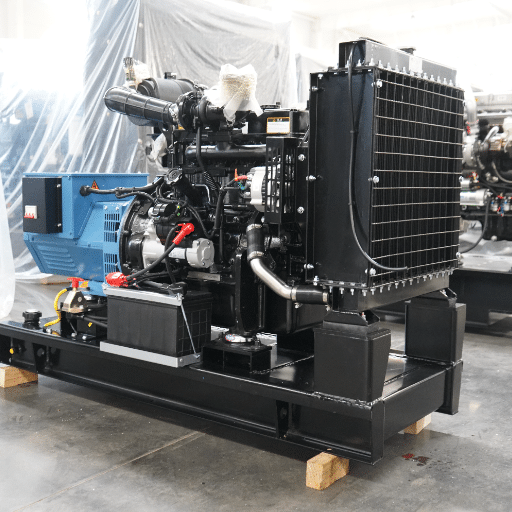



Cummins and Kohler are among the most reputable T1 worldwide suppliers of industrial standby and prime power generator sets. Cummins excels in terms of vertical integration, global dealer network coverage, and wide product line of industrial engines. Kohler wins in specialty mission-critical projects, compact design for residential standby generator sets, and regional dealers in Midwest/Southeastern US. Your specific case will define the best choice between them.
The following comparison focuses on the main areas that distinguish Cummins from Kohler, including engine technology, emissions compliance, power quality, accessibility of maintenance, and total cost of ownership. An important consideration that specification engineers have to make in the case of choosing between Cummins vs Kohler generators in 2026 is lead time.
Robert Chen, a facility manager at 400 bed hospital in Dallas, believed that specifying a 500 kW standby generator set in February of 2024 would be relatively simple. He expected that the choice of either Cummins or Kohler would come down to technical specifications alone, which left little room for any doubt. In fact, he found that both options would require a 42 week lead time, while he had only 24 weeks available.
Key Takeaways
- Choose Cummins if you need vertical engine integration, global dealer coverage, and the widest industrial power range (up to 4 MW+).
- Choose Kohler if you prioritize compact residential standby design, regional dealer strength, or specialty mission-critical configurations.
- Cummins is more vertically integrated; Kohler sources engines from Doosan, MTU, Volvo, and John Deere for larger industrial units.
- Standard warranty is typically 2 years/2,000 hours on standby units for both brands, with extensions available to 5-10 years.
- Lead times for Tier 1 brands have stretched to 30-60+ weeks in 2025-2026, making alternative engineering-grade manufacturers a practical option for time-sensitive projects.
Cummins vs Kohler at a Glance

The fastest way to compare the two brands is side by side. The table below summarizes the specifications that matter to industrial buyers.
| Specification | Cummins | Kohler |
|---|---|---|
| Power range (standby) | 8 kW – 4,000 kW+ | 8 kW – 4,000 kW+ |
| Engine sourcing | In-house (QSB, QSL, QSK, QSV, QST) | In-house (KD/KDI) + Doosan, MTU, Volvo, John Deere |
| Alternator sourcing | Stamford, Markon (in-house designs) | Marathon, Leroy-Somer (partner designs) |
| Emissions compliance | EPA Tier 4 Final, EU Stage V | EPA Tier 4 Final, EU Stage V |
| Standard warranty | 2 years / 2,000 hours standby | 2 years / 2,000 hours standby |
| Extended warranty | Up to 10 years (residential), 5+ (commercial) | Up to 10 years (residential), 5+ (commercial) |
| Global dealer network | 7,000+ locations | 1,000+ locations |
| Telematics platform | PowerCommand Cloud | OnCue Plus / APM |
| Typical lead time (2026) | 30-50 weeks | 35-60 weeks |
Both brands meet Tier 4 Final and Stage V. Both cover the same power tiers. The differences are in engine sourcing strategy, dealer density, and regional service strength.
Planning a standby power project? Explore industrial diesel generator solutions designed for continuous and backup applications from 20 kW to 3,000 kW.
Brand Background and Market Position
Cummins Inc.
Cummins is a world leader in power generation, earning more than $34 billion in revenue annually. In addition, Cummins Power System Division produces generator sets that range from 8 kW for residential applications up to 4,000 kW for utility-grade applications. The Cummins engines can be used for power generation as well as trucking, bus, marine, and mining applications.
Cummins builds engines, alternators, and controls in-house, offering an unparalleled degree of vertical integration. All PowerCommand products feature engine, alternator, ATS, and paralleling controls that are engineered together by one engineering staff. This is an important consideration for those seeking single source accountability.
Kohler Co. (Kohler Power Systems)
Kohler Power Systems belongs to the family of Kohler Company, a Wisconsin-based company that has been owned by a private entity since its establishment in 1873. Kohler introduced their generators in 1920, which has resulted in building an established name in the fields of residential standby generators, marine generators, and commercial power generation.
For small sized generators, Kohler makes use of its self-manufactured KD and KDI engine series, while for large sized industrial gensets, it works on the collaboration of Doosan, MTU (Rolls-Royce Power Systems), Volvo Penta, and John Deere.
Where Each Brand Wins
Cummins is the clear leader in the areas of heavy industry, mining, and utility prime power applications. Kohler leads in the market segment for residential standby, marine, and small commercial applications where enclosure size and noise control are important.
Power Range and Product Tiers

Residential Standby (8-60 kW)
Both manufacturers provide air and liquid-cooled residential standby generators. The residential series from Kohler is characterized by small-sized enclosures and low-noise level performance. Cummins provides more voltage choices and bigger liquid-cooled residential generators.
Commercial Standby (60-600 kW)
This is the highest level of competition. In both brands, the diesel generator sets operate under the EPA Tier 4 Final category and come within an acoustically insulated housing. More standardized products by Cummins are often available at every kW interval while Kohler usually provides custom solutions.
Industrial and Mission-Critical (600 kW – 2 MW)
At this tier, Cummins offers its QSK and QSV engine families with in-house engineering support. Kohler sources engines from Doosan, MTU, and Volvo Penta for this range. Both brands meet data center and hospital step-load requirements.
Utility-Scale Prime Power (2 MW+)
Cummins offers the QST and QSV families up to 4,000 kW. Kohler partners with MTU and Volvo Penta for utility-scale units. Both brands support paralleling and grid-code compliance for prime power applications.
Engine Technology and Sourcing
Cummins Engine Lineup
Cummins designs and manufactures its own engines across the full power range. Key families include:
- QSB: 30-275 kW, compact inline-six
- QSL: 250-430 kW, medium-duty inline-six
- QSK: 500-2,000 kW, heavy-duty V-engine
- QSV: 800-2,250 kW, high-speed V-gas (for gas gensets)
- QST: 1,500-4,000 kW, large-bore diesel
Vertical integration means Cummins controls piston design, fuel system calibration, cooling package design, and emissions tuning. Parts availability is global because the same engines power trucks, construction equipment, and marine vessels.
Kohler Engine Lineup
Kohler uses a mixed sourcing strategy:
- KD/KDI: In-house diesel engines up to approximately 100 kW
- Doosan: Sourced for mid-range commercial units
- MTU: Sourced for high-performance mission-critical and data center units
- Volvo Penta: Sourced for marine and industrial applications
- John Deere: Sourced for agricultural and select industrial units
This model gives Kohler flexibility. It can select the best engine for each application without designing every displacement class. The trade-off is that parts and service expertise may vary by engine supplier.
What Engine Sourcing Means for Parts Availability
Cummins parts are available through 7,000+ global locations because the engine platform is shared across multiple industries. Kohler parts flow through Kohler’s network but may require sourcing from the original engine manufacturer for some industrial units. For remote or international projects, this difference can affect maintenance planning.
Alternator, Voltage Regulation, and Power Quality
Cummins utilizes Stamford and Markon alternators, which are manufactured by Cummins themselves to fit perfectly with the Cummins engine. DVR ensures that the voltage accuracy remains within ±0.25%. The step-load performance generally conforms to NFPA 110 Level 1 standards for hospitals.
Kohler uses Marathon and Leroy-Somer alternators, sourced from established partners. Voltage regulation is comparable. Both brands meet the IEEE 446 standard for data center backup power. The practical difference is in excitation system design and transient response tuning, which varies by specific model.
Emissions, Cooling, and Enclosures

EPA Tier 4 Final and EU Stage V Compliance
Both brands offer EPA Tier 4 Final-compliant diesel generator sets for stationary emergency applications. The EPA emissions standards require NOx and particulate matter limits that are met through selective catalytic reduction (SCR), diesel oxidation catalysts (DOC), and diesel particulate filters (DPF).
For prime-power and non-emergency applications, Tier 4 Final compliance is mandatory in the United States. Both Cummins and Kohler offer certified packages.
Sound-Attenuated Enclosures
Both products provide weatherproofing levels 1, 2, and 3 enclosures. Noise ratings normally go from 65 dB at a distance of 23 feet for sound-dampening packages level 3 to 85 dB for the open models. Hospitals and residences will normally specify level 2 or 3.
Sub-Base Fuel Tank Options
Both brands offer sub-base fuel tanks sized for 24, 48, or 72 hours of runtime at full load. For mission-critical applications, extended runtime is often specified by code.
Automatic Transfer Switch and Paralleling
Cummins PowerCommand and OTPC ATS
Cummins offers the PowerCommand family of automatic transfer switches and paralleling controls. The PowerCommand 3.3 and 1.1 controllers handle single-unit and multi-unit paralleling. The Open Transition Transfer (OTPC) and Closed Transition Transfer (CTTS) switches support different switching strategies.
Kohler MPAC and RDT/KSS ATS
Kohler offers the MPAC 1500 paralleling system and the RDT (Residential), KSS (Commercial), and KCM (Industrial) transfer switch lines. The APM603 and APM402 controllers manage paralleling and load demand.
Paralleling for Redundancy
Both brands support N+1 and 2N redundancy configurations for data centers and hospitals. Cummins tends to emphasize PowerCommand’s unified control architecture. Kohler tends to emphasize application-specific customization.
Telematics and Remote Monitoring
Cummins PowerCommand Cloud
Cummins PowerCommand Cloud provides real-time monitoring, fault alerting, and predictive maintenance recommendations. The platform integrates with building management systems (BMS) via Modbus and BACnet protocols.
Kohler OnCue Plus and APM
Kohler OnCue Plus is the residential and light commercial monitoring platform. The APM (Advanced Power Management) system handles industrial and mission-critical telemetry. Both platforms offer mobile app access and email alerting.
Warranty, Service Network, and Dealer Support
Standard Warranties
Both brands typically offer 2 years or 2,000 hours (whichever comes first) on standby diesel generator sets. Extended warranties are available up to 10 years on residential standby and 5+ years on commercial units.
Global Dealer Footprint
Cummins maintains more than 7,000 dealer and distributor locations worldwide. Kohler maintains approximately 1,000+ locations, with stronger density in the Midwest and Southeast United States.
For international projects, Cummins’ dealer network is broader. For US regional projects, Kohler’s regional dealers often provide faster response times in their core markets.
Lead Time Reality in 2025-2026
Lead times for Tier 1 industrial generator sets have stretched significantly. In 2026, typical quoted lead times are:
- Cummins: 30-50 weeks for commercial standby
- Kohler: 35-60 weeks for commercial standby
The lead times mentioned are those associated with restrictions on supplies of engines, alternators, and emission aftertreatment equipment. For jobs where schedules are extremely tight, the lead time becomes the decisive selection factor.
In March 2025, an electrical contracting firm in Phoenix, USA, called Derek Holt, submitted a bid for a 1.2 MW backup data center job. The spec required a Tier 1 manufacturer capable of meeting the NFPA 110 Level 1 standard. Both Cummins and Kohler qualified technically. However, neither could make it inside the 28-week deadline. In the end, Derek split the capacity into two 600 kW units sourced from other manufacturers in order to fit the schedule.
Total Cost of Ownership Over 10 Years
Sticker price is only a fraction of the real project cost. A simplified 10-year total cost of ownership model for a 500 kW standby diesel generator set, assuming 50 hours of annual exercise and 2 outage events per year (average 12 hours each), shows the following breakdown:
| Cost Category | Estimated 10-Year Cost |
|---|---|
| Capital cost ( genset + ATS + installation) | 180,000−180,000−220,000 |
| Fuel (exercise + outage runtime) | 45,000−45,000−60,000 |
| Scheduled maintenance (oil, filters, belts) | 35,000−35,000−48,000 |
| Extended warranty (optional, years 3-5) | 12,000−12,000−18,000 |
| Load bank testing (annual, years 2-10) | 18,000−18,000−27,000 |
| Total 10-Year TCO | 290,000−290,000−373,000 |
Fuel and maintenance dominate the 10-year cost. The capital cost difference between Cummins and Kohler at the 500 kW tier is typically 5-12%, which becomes a small fraction of the total lifecycle cost.
Cummins vs Kohler: Which Should You Specify?

Use this decision framework to match the brand to your application.
Choose Cummins if:
- You need single-source accountability (engine, alternator, controls from one manufacturer)
- Your project is outside the United States and requires global dealer support
- You are specifying prime power or utility-scale applications above 2 MW
- Parts availability across multiple industries is important
Choose Kohler if:
- You need compact residential standby with quiet operation
- Your project is in the Midwest or Southeast US with strong Kohler dealer coverage
- You need specialty mission-critical customization
- You prefer the flexibility of best-in-class engine partnerships for each power tier
Consider both brands if:
- You are specifying 100-600 kW commercial standby
- You need NFPA 110 Level 1 or data center step-load compliance
- Budget and delivery schedule are secondary to technical compliance
Need help sizing a standby generator for your facility? Learn how to choose the right diesel generator with our step-by-step selection guide.
When an Alternative Manufacturer Belongs on the Bid List
Tier 1 brands deliver proven reliability, but they are not the only option for every project. Three factors make alternative engineering-grade manufacturers worth evaluating:
Lead time pressure. When project schedules demand delivery in 12-20 weeks, Tier 1 lead times of 30-60 weeks can disqualify a bid regardless of technical merit.
Export and OEM requirements. International distributors and private-label customers often need flexible branding, voltage configurations, and control system integrations that Tier 1 brands do not offer.
Project budget constraints. For applications where 100% Tier 1 redundancy is not required, engineering-grade alternatives can deliver comparable voltage regulation, emissions compliance, and runtime at a different price point.
Shandong Huali Electromechanical Co., Ltd manufactures diesel generator sets from 20 kW to 3,000 kW+ for industrial, commercial, and OEM customers worldwide. The company sources Cummins engines and Stamford alternators for many models, integrates DSE digital control systems, and offers ISO9001, CE, and CCC certified production. For export markets, OEM partnerships, and lead-time-sensitive projects, Huali provides a credible engineering alternative to Tier 1 brands.
In 2024, a power solutions distributor in Jakarta needed forty 250 kW standby units for a hospital construction program across Indonesia. Tier 1 brands quoted 48-week delivery. The distributor worked with Shandong Huali to configure Cummins-powered, Stamford-alternator gensets with tropical cooling packages and local-language control panels. Delivery was 16 weeks. All forty units passed load bank testing on arrival. The distributor’s client met the hospital opening schedule.
Frequently Asked Questions
Is Cummins better than Kohler?
Neither brand is clearly superior to the other. Cummins has the edge in terms of vertical integration, worldwide dealership presence, and prime power production capacity. Kohler has the advantage when it comes to product size and customization, especially within regional service areas.
Which is more reliable, Cummins or Kohler?
Both have excellent reliability ratings in mission critical operations. Cummins’ strength comes from its uniformity of engines among trucks, boats, and industries that generate massive reliability data. Kohler’s strength lies in the selection and proper tuning of engines according to their power classes. Failure rates for both are relatively similar if proper maintenance programs are followed.
Who makes Kohler generator engines?
For smaller generators, where there is less than 100 kW output, Kohler uses its own KD and KDI engines. However, for higher-capacity generators, Kohler purchases engines made by Doosan, MTU, Volvo Penta, and John Deere companies.
What is the lead time for a Cummins or Kohler generator in 2026?
Lead time for units manufactured in 2026 is expected to range from 30 to 50 weeks for Cummins engines and 35 to 60 weeks for Kohler commercial standby generators. The lead time will depend on the size of the engine and enclosure type chosen.
What size standby generator does a hospital or data center need?
Hospital emergency systems typically require NFPA 110 Level 1 compliance with enough capacity to power life safety, critical care, and essential equipment loads. Data centers typically size standby units at 100-150% of the critical IT load, with N+1 or 2N redundancy depending on tier requirements. A licensed MEP engineer should perform the load analysis.
For more generator comparisons, see our guides on Generac vs Predator and Firman vs Champion portable generators.
Conclusion
When it comes to Cummins versus Kohler, the decision is seldom a case of one manufacturer being better than another. This decision is about which brand works for your project’s needs in terms of technical specifications, geography, support, and time frame. What Cummins offers you is vertical integration and large scale production. What Kohler offers you is versatility and strength within the region.
From a specification engineer’s and procurement perspective, the single most important point is that brand choice is but one aspect of a project. In many cases, time, total cost of ownership, support, and parts supply can be far more important than small differences in displacement and alternators.
Key takeaways:
- Cummins leads on vertical integration, global dealer coverage, and prime-power scale.
- Kohler leads on compact design, regional service, and mission-critical customization.
- Ten-year total cost of ownership is dominated by fuel, maintenance, and testing, not capital cost.
- Lead times of 30-60+ weeks in 2026 make delivery schedule a primary selection factor.
- Alternative engineering-grade manufacturers can be a credible option for export, OEM, and time-sensitive projects.
Have a project that needs reliable standby or prime power? Shandong Huali designs and manufactures industrial diesel generator sets from 20 kW to 3,000 kW+ for commercial, industrial, and OEM customers worldwide. Contact our engineering team for a free project consultation.