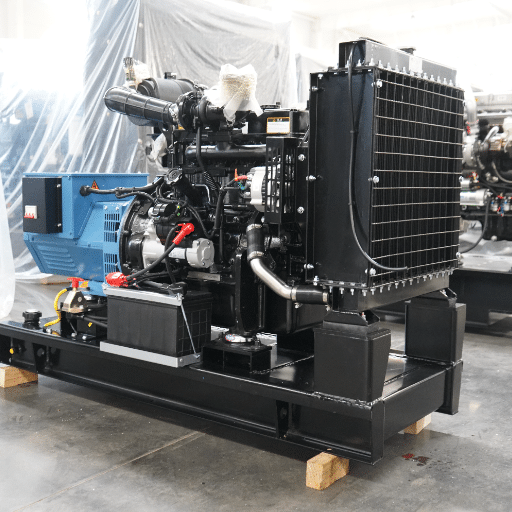



The best diesel generator for a factory is a three-phase industrial unit sized 20–25% above your peak load. It needs a duty rating matched to runtime, a proven engine brand, and an automatic transfer switch for seamless failover. For most factories, that means 250 kVA to 1,000 kVA of prime or standby power from brands like Cummins, Perkins, Weichai, or Yuchai.
A single power interruption can halt a production line, spoil a batch, or cost a facility thousands of dollars per hour. Factory buyers often struggle to balance upfront price against runtime needs, motor starting surge, and long-term reliability. This guide explains how to choose the best diesel generator for a factory, from load calculation and brand selection to supplier evaluation and total cost of ownership.
Key Takeaways
- The best factory diesel generator is sized 20–25% above peak kVA demand and matched to standby, prime, or continuous duty.
- Most factories need a three-phase unit in the 250–1,000 kVA range from proven engine brands.
- Diesel beats gasoline and natural gas for heavy motor loads, long runtime, and fuel storage independence.
- Total cost of ownership over 10 years usually exceeds the purchase price by 2–3×, so fuel efficiency and parts availability matter.
- Manufacturer-direct sourcing gives buyers better customization, pricing, and long-term support than marketplace listings.
Why Diesel Is Usually the Best Fuel Choice for Factory Power

Factories need generators that start fast, run long, and handle heavy motor loads. Diesel engines deliver higher torque at lower speeds. That makes them ideal for starting large compressors, pumps, and conveyor motors. They also consume less fuel per kWh than gasoline and can store fuel on site for weeks or months.
A plant manager we worked with in Vietnam chose a 500 kVA Cummins diesel generator after a grid outage cost his textile mill two full production shifts. The unit now provides prime power during peak-demand hours. It also serves as automatic backup when the grid drops. Fuel consumption stayed close to 0.24 L/kWh, and payback against lost production came within 14 months.
Diesel vs. Natural Gas vs. Gasoline for Factory Use
| Feature | Diesel Generator | Natural Gas Generator | Gasoline Generator |
|---|---|---|---|
| Fuel efficiency | Highest | Moderate | Lowest |
| Upfront cost | Moderate–High | High | Low |
| Lifespan | 20,000–30,000 hrs | 15,000–20,000 hrs | Shortest |
| Maintenance frequency | Lower | Moderate | Higher |
| Motor load handling | Excellent | Good | Poor |
| Fuel storage | Long shelf life, on-site tank | Pipeline only | Short shelf life, volatile |
| Emissions | Moderate–High (improving with Tier 4/Stage V) | Lowest | Moderate |
| Best for | Heavy/continuous factory loads | Clean/quiet urban sites | Small/occasional use |
Diesel wins for factories because it combines load handling, fuel independence, and long service life. Natural gas is cleaner and quieter, but it depends on pipeline access. Gasoline is rarely suitable for industrial use.
Standby, Prime, and Continuous Duty: Match the Rating to Factory Runtime
ISO 8528-1 defines how a generator is rated. Choosing the wrong rating can shorten engine life or leave the plant underpowered.
- ESP (Emergency Standby Power): Runs only during grid failure. Typical for backup-only factories with reliable mains.
- LTP (Limited-Time Running Power): Up to 500 hours per year at variable load. Useful for seasonal peak shaving.
- PRP (Prime Rated Power): Unlimited hours at variable load. Ideal for factories with weak grids or off-grid sites.
- COP (Continuous Operating Power): 24/7 base load at near-constant demand. Used for remote mining or continuous process plants.
If your factory loses grid power once a month, ESP is enough. If the grid is unstable and the generator runs daily, choose PRP. For 24/7 base load, specify COP. A factory diesel generator bought with the wrong rating will fail early or cost more to operate.
How to Size a Diesel Generator for a Factory

Sizing is the most important step in finding the best diesel generator for a factory. Undersizing causes voltage collapse and overheating. Oversizing leads to wet stacking, carbon buildup, and wasted fuel.
Step 1: List Every Factory Load
Split equipment into three groups. Critical loads include safety systems, fire pumps, emergency lighting, and refrigeration. Essential loads include production lines, compressors, HVAC, and control systems. Non-essential loads include break rooms, general lighting, and charging stations.
Record running kW and starting kVA for each item. Motors are the deciding factor because their starting surge can be 5–7× running current.
Step 2: Apply Demand and Diversity Factors
Not every machine runs at full load at the same time. Multiply connected load by a demand factor:
- General manufacturing: 0.70–0.85
- Continuous-process plants: 0.85–0.95
- Batch or intermittent operations: 0.60–0.75
Step 3: Account for Motor Starting Surge
Direct-on-line (DOL) motors draw the most surge. Starting method changes everything:
- DOL starting: ~6× running kVA
- Star-delta: ~3× running kVA
- Soft starter or VFD: 1.5–2× running kVA
Size the generator for the largest single motor surge plus all other running loads.
Step 4: Add Safety Margin and Convert kW to kVA
Use this formula:
kVA = (Total kW × Demand Factor) / Power Factor × 1.20–1.25Most factory loads have a power factor of 0.8. A 20–25% safety margin leaves room for future expansion and prevents chronic overload.
Factory Sizing Example: 500 kVA Textile Plant
A medium textile factory has:
- 150 kW of running motors and looms
- One 75 kW air compressor with DOL starting (6× surge = 450 kVA)
- 50 kW of HVAC and lighting
- Power factor 0.8
Calculation:
Base kVA = (150 + 50) / 0.8 = 250 kVA
Surge kVA = 450 kVA (compressor startup)
Total = 250 + 450 = 700 kVA peak
With 25% margin: 700 × 1.25 = 875 kVA
The next standard size up is 1,000 kVA. In practice, switching the compressor to star-delta reduces surge to 225 kVA and brings the recommended size closer to 600–750 kVA. This is why starting-method review should always accompany sizing.
Best Diesel Generator Brands for Factory Use

Engine brand determines parts availability, service life, and resale value. The best brand depends on budget, criticality, and local support.
| Brand | Strengths | Best For |
|---|---|---|
| Cummins | Global support, parts network, proven reliability | Mission-critical factories, data centers, hospitals |
| Perkins | Fuel efficiency, smooth operation, long service intervals | Continuous-duty manufacturing plants |
| Deutz | Compact design, air-cooled options, good power density | Mobile, space-limited, or rental applications |
| Volvo / MTU | Premium quality, low emissions, high load acceptance | High-spec facilities and mission-critical sites |
| Weichai | Strong cost-performance, wide power range | Budget-conscious bulk orders and OEM projects |
| Yuchai | Competitive pricing, good local support in Asia, fast delivery | Mid-size factories and distributors |
A procurement team in Nigeria chose a Cummins diesel generator for a beverage plant. Local service and spare parts were available within 48 hours. In Southeast Asia, a plastics processor chose Weichai to keep capital cost down while maintaining ISO 8528-1 PRP ratings.
The alternator matters too. Stamford, Leroy-Somer, Mecc Alte, and Marathon are trusted names for stable voltage and low total harmonic distortion (THD). For factories with CNC machines or sensitive drives, specify an alternator with AVR and Class H insulation.
Key Specifications for the Best Factory Diesel Generator
Beyond brand and size, the best diesel generator for a factory needs the right configuration for the application.
Controller and Automation
A digital controller handles startup, shutdown, alarms, and remote monitoring. For factories, specify:
- AMF (Automatic Mains Failure): Starts the generator when grid power drops
- ATS (Automatic Transfer Switch): Switches load between grid and generator
- Remote monitoring: GSM/Ethernet alerts for faults, fuel level, and runtime
Enclosure and Noise Control
Open skid units are cheapest but loud. Factory yards often accept 75–85 dB(A) at 7 m. If the unit sits near offices or neighbors, choose a silent diesel generator enclosure rated below 65 dB(A).
Fuel System and Runtime
Calculate required runtime from fuel tank size. A 1,000-liter tank feeding a 500 kVA generator at 75% load lasts roughly 18–22 hours. Food processing and cold-storage plants often need 48–72 hours of autonomy.
Emissions and Certification
Match the generator to destination-market rules:
- EPA Tier 4 Final: Required in the United States
- EU Stage V: Required in European Union markets
- CE marking: Indicates EU safety and environmental compliance
- ISO 8528-1: Defines power rating standards
Cooling and Environmental Tolerance
Factories in hot or dusty regions need heavy-duty radiators, air filters, and louvers. High altitude reduces engine output, so apply derating above 1,000 m.
Factory-Specific Application Guidance

Different factory types have different power quality and reliability needs.
Food Processing Factories
Cold storage, packaging lines, and hygiene systems need clean, stable power. A factory backup power generator here must start within 10 seconds and run long enough to protect inventory. Stainless-steel or powder-coated enclosures resist washdown chemicals.
Textile Factories
Looms and dyeing equipment are sensitive to voltage swings. Specify an alternator with tight voltage regulation (±1%) and low THD. A three-phase diesel generator for factory use is essential because motor loads are large and balanced.
Cement and Heavy Industry
Dust, vibration, and heavy starting loads define these sites. Choose rugged open-skid units with heavy-duty air filtration, oversized starters, and reinforced base frames. Prime or continuous ratings are usually required.
Metalworking and CNC Facilities
CNC machines and welding equipment need clean power. Voltage dip during motor starting must stay within equipment limits. A 25% safety margin and a quality alternator are non-negotiable.
Installation and Operational Factors
Even the best diesel generator for a factory will underperform if installation is wrong.
Site Preparation and Foundation
Place the genset on a reinforced concrete pad sized for unit weight and vibration. Allow clearance on all sides for maintenance and airflow.
Ventilation and Exhaust
Engine rooms need intake and exhaust airflow matched to radiator capacity. Exhaust piping should route outside with rain caps and insulation where people may contact it.
Fuel Storage and Delivery
Diesel tanks require secondary containment, vents, and level monitoring. Many factories use a day tank near the generator fed from a larger bulk tank.
Electrical Connection and Paralleling
Large factories sometimes need two or more generators synchronized in parallel. Paralleling provides N+1 redundancy and lets operators take one unit offline for service without dropping critical loads.
Maintenance Access and Spare Parts
Leave space for oil changes, filter replacement, and alternator access. Before buying, confirm that filters, belts, and controller parts are stocked locally or can be shipped quickly from the manufacturer.
Total Cost of Ownership for Factory Generators
Purchase price is only part of the equation. Over 10 years, TCO usually runs 2–3× the equipment cost.
| Cost Category | Typical Share of 10-Year TCO | Notes |
|---|---|---|
| Upfront equipment | 30–40% | Varies by brand, kVA, and enclosure |
| Installation and commissioning | 10–15% | Foundation, electrical, fuel system, testing |
| Fuel | 35–45% | Largest long-term cost; efficiency matters |
| Maintenance and parts | 10–15% | Oil, filters, belts, overhauls |
| Downtime risk | Variable | Can exceed all other costs in critical plants |
At 0.24 L/kWh, a 500 kVA generator running 4,000 hours per year at 75% load consumes about 360,000 liters of diesel annually. A 5% improvement in fuel efficiency saves 18,000 liters per year, which can pay for a premium engine upgrade within a few years.
New vs. Used Diesel Generator for Factory

When to Buy New
Buy new when reliability, warranty, and long service life matter. New units come with factory test reports, emissions certification, and full parts support. Most factory applications fall into this category.
When Used Makes Sense
Used generators can work for temporary projects, non-critical loads, or tight budgets. They make sense only when operating hours are low, records are complete, a recent load bank test shows stable output, and spare parts are still available.
Used Generator Inspection Checklist
Check these items before buying used:
- Engine compression and crankshaft condition
- Alternator insulation resistance (megger test)
- Coolant and oil analysis
- Controller functionality and fault history
- Exhaust smoke and blow-by
- Fuel system leaks and tank condition
For most factories, the risk of used equipment outweighs the savings. A new industrial diesel generator with warranty and factory support is usually the safer long-term choice.
Best Diesel Generators for Factory by Size
Use these ranges as a starting point. Always confirm with a proper load study.
Small Factories (100–250 kVA)
Suitable for small workshops, light assembly, and local backup. A 150 kVA unit can support 100–120 kW of mixed load with modest motor surge.
Medium Factories (250–750 kVA)
This is the most common factory range. A 500 kVA diesel generator handles mid-size manufacturing, batch plants, and multi-building facilities.
Large Factories (750 kVA – 2 MVA)
Large continuous-process plants, cement factories, and heavy industry need 1,000 kVA and above. These units often run in parallel or with dual-fuel options.
How to Choose the Right Supplier
The supplier is as important as the generator. A low price means little if spare parts are unavailable or service response is slow.
Manufacturer-Direct vs. Dealer vs. Marketplace
- Manufacturer-direct: Best customization, competitive pricing, OEM branding, and engineering support
- Dealer/distributor: Faster local delivery and service but less flexibility
- Marketplace: Wide selection but variable quality and limited after-sales support
Questions to Ask Before Ordering
- What engine and alternator brands are used?
- What duty rating is the unit built for?
- Which emissions certifications are included?
- What is the warranty period and coverage?
- Are spare parts stocked locally?
- Can you provide factory test reports and load bank results?
- Do you offer installation supervision and commissioning?
A reliable supplier answers these questions clearly and provides documentation before payment.
Factory Diesel Generator Checklist
Before you finalize a purchase, verify:
- Load study completed with motor starting surge
- Duty rating matched to runtime (ESP / PRP / COP)
- kVA size includes 20–25% safety margin
- Three-phase output confirmed
- Engine and alternator brands specified
- Controller includes AMF/ATS if automatic backup is needed
- Enclosure and noise level meet site requirements
- Emissions certification matches destination market
- Fuel tank size provides required runtime
- Cooling and air filtration suit site conditions
- Spare parts and service support confirmed
- Warranty, commissioning, and documentation agreed
Conclusion
The best diesel generator for a factory is not the cheapest unit or the biggest brand name. It is the generator that matches your actual load profile, runtime needs, site conditions, and long-term operating budget. Start with a proper load study, choose a proven engine and alternator combination, match the duty rating, and buy from a supplier who can support the unit for its full life.
Factories that get this right protect production, reduce downtime risk, and keep total cost of ownership under control. If you need help sizing or specifying a diesel generator for factory use, contact our engineering team for a detailed assessment and quote.
FAQ
What size diesel generator do I need for my factory?
Calculate total running kW, add the largest motor starting surge, apply a demand factor, convert to kVA using a 0.8 power factor, and add 20–25% margin. Small factories often need 100–250 kVA, medium factories 250–750 kVA, and large plants 750 kVA to 2 MVA or more.
Which engine brand is best for a factory generator?
Cummins and Perkins are best for mission-critical and continuous-duty factories due to global support and reliability. Weichai and Yuchai offer strong cost-performance for budget-conscious projects. Deutz works well for mobile or space-limited applications.
How much does a factory diesel generator cost?
Small units (100–250 kVA) typically cost 10,000–10,000–35,000. Medium units (250–750 kVA) range from 35,000–35,000–120,000. Large industrial units (750 kVA–2 MVA) can cost 120,000–120,000–500,000 or more depending on brand, enclosure, and certification.
Can I use a commercial generator for a factory?
Commercial generators are designed for lighter, shorter-run applications such as offices and retail. Factories usually need industrial diesel generators with heavier construction, larger cooling systems, and prime or continuous duty ratings.
How often should a factory generator be tested?
NFPA 110 recommends monthly testing for emergency power supply systems. Many facilities run a no-load test monthly and a full-load test annually or semi-annually using a load bank.
What is the best diesel generator for a manufacturing plant?
The best diesel generator for a manufacturing plant is a three-phase industrial unit sized above peak kVA demand, with a duty rating matched to runtime, automatic transfer capability, and an engine brand supported locally. For continuous production, specify prime or continuous rating rather than standby.
Should I buy a silent diesel generator for my factory?
Choose a silent enclosure if the generator sits near offices, residential areas, or noise-sensitive zones. Open skid units cost less and work well in remote industrial yards where noise limits are relaxed.