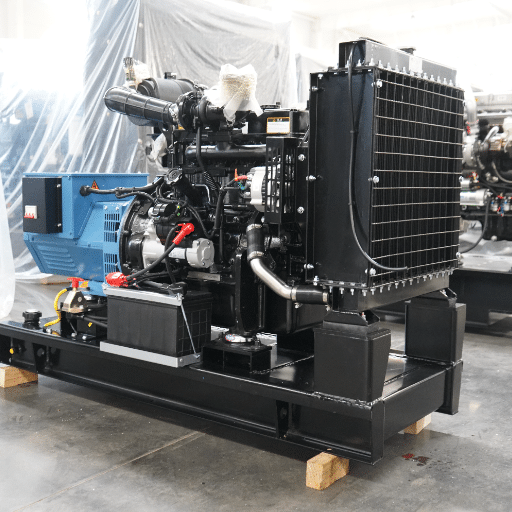



The best diesel generator for continuous power is a Prime Power (PRP) or Continuous Operating Power (COP) rated unit sized 20-25% above your calculated load, running at 70-80% capacity. Unlike standby generators built for emergency use, continuous-duty diesel engines are engineered to run 24/7 with proper maintenance every 250-500 hours.
Here’s a counterintuitive truth: the cheapest standby generator becomes the most expensive choice when you run it 24/7. We see this mistake cost industrial operators thousands in premature overhauls and unplanned downtime every year.
You already know that power interruptions halt production and damage equipment. What you might not know is that choosing the wrong power rating can quietly double your operating costs. This guide shows you exactly how to select, size, and maintain a diesel generator for continuous power. You’ll learn the ISO 8528-1 ratings that matter, how to calculate true load requirements, and which brands deliver real 20,000+ hour durability.
Key Takeaways
- Choose Prime Power (PRP) or Continuous Operating Power (COP) ratings for 24/7 operation; Emergency Standby Power (ESP) units are not designed for continuous heat cycling.
- Run at 70-80% load for optimal fuel efficiency and engine life; chronic operation below 30% load causes wet stacking and carbon buildup.
- Size with 20-25% headroom and derate 2-3% per 1,000 ft of altitude above sea level.
- Diesel engines deliver 30-50% better fuel economy and 20,000+ hour service life compared to gas alternatives.
- Plan maintenance every 250-500 operating hours and fuel storage for 500+ hour autonomous runs.
What Is a Diesel Generator for Continuous Power?

A diesel generator for continuous power is an industrial engine-alternator set rated for unlimited hours of operation under variable or constant load. The ISO 8528-1 standard defines four power ratings, but only two are suitable for true continuous duty.
ISO 8528-1 Power Ratings Explained
Emergency Standby Power (ESP) is the maximum output available for 200 hours per year during grid failures. It’s a sprint rating, not a marathon.
Prime Power (PRP) allows unlimited hours at variable load with a 10% overload capability for one hour in every 12. This is the minimum rating for continuous industrial use.
Continuous Operating Power (COP) provides 100% constant load output with no overload allowance. Think of it as a base-load power plant in a box.
How Continuous Power Differs from Standby and Prime
Standby units use lighter components and simplified cooling systems. They’re engineered for thermal shock, not sustained heat. Run one continuously and you’ll face cracked cylinder heads and turbocharger failures within months.
Prime-rated engines feature heavier crankshafts, upgraded piston cooling, and larger radiators. Continuous-rated units go further with derated engine speeds and enhanced lubrication systems.
Typical Applications: Mining, Data Centers, Telecom, Manufacturing
Mining operations in remote Chile rely on PRP-rated CAT 3516C sets running 75% load for 18,000+ hours between overhauls. Data centers in Singapore specify mtu Series 4000 with Data Center Continuous ratings for 85% average load factor.
Telecom towers across Southeast Asia use 100 kVA COP units for constant base loads with 72-hour fuel autonomy. Manufacturing plants in Nigeria run synchronized PRP sets to cover grid instability.
In March 2025, during the expansion of a copper mine in the Atacama Desert, the site manager initially selected standby-rated generator sets to save $120,000 in upfront costs. However, less than eight months later, three units required top-end overhauls costing $45,000 each. Not only were the initial savings wiped out, but unplanned downtime also resulted in $200,000 in lost production. After switching to PRP (Prime Rated Power) 3516C units, the mine achieved 14,000 hours of trouble-free operation over the following year.
How Long Can a Diesel Generator Run Continuously?
The short answer: a properly specified continuous-duty diesel generator can run indefinitely with scheduled maintenance. The limiting factor isn’t the engine; it’s your maintenance discipline and fuel supply.
Runtime by Generator Class
Portable generators: 6-12 hours before refueling and cool-down.
Standby generators: 8-24 hours per tank, maximum 200 hours annually.
Prime power generators: up to 500 hours between service intervals.
Continuous-duty generators: 500+ hours non-stop with strict monitoring.
According to GenPower USA, prime power generators regularly achieve 500 hours between services, while continuous-duty units exceed this with proper fuel monitoring and load management.
The 500-Hour Maintenance Threshold
Every 250-500 operating hours, your generator needs oil and filter changes, coolant analysis, and valve adjustments. Skipping these intervals cuts engine life by 40% or more. A Cummins QSK60 running continuous duty can exceed 30,000 hours between major overhauls when serviced on schedule.
Fuel Consumption and Tank Sizing for Extended Runs
A 500 kVA diesel generator burns approximately 100-110 liters per hour at 75% load. For 72-hour autonomy, you need 7,500 liters of usable tank capacity plus 10% reserve. Fuel polishing systems become essential for runs exceeding 500 hours to prevent microbial growth and filter clogging.
How to Size a Diesel Generator for Continuous Duty

Sizing errors are the leading cause of premature generator failure. Oversizing wastes capital and fuel. Undersizing destroys engines. Follow this five-step process to get it right.
Step 1: Calculate Your True Load Profile
List every motor, pump, compressor, and control system. Record running kW and starting kVA for each. Use a power analyzer for one week if your load varies significantly. Don’t guess.
A textile mill in Vietnam learned this the hard way in 2024. The engineering team estimated their load at 380 kW based on nameplate ratings. After installation, the 500 kVA generator struggled during Monday morning startup when all looms spun up simultaneously.
A week-long power audit revealed actual peak demand was 470 kW. They had sized the unit with zero headroom.
Step 2: Account for Motor Starting and Inrush Current
A 100 hp motor draws 5-7 times its running current during startup. Across-the-line starting can pull 600 kVA for a 100 kW motor. Soft starters and VFDs reduce this to 2-3 times, but you still need headroom.
Step 3: Apply the 20-25% Headroom Rule
Add 20-25% to your calculated maximum load. This margin covers future expansion, measurement error, and the natural efficiency sweet spot at 70-80% load. A 400 kW calculated load needs a 500 kVA prime-rated generator.
Step 4: Derate for Altitude and Temperature
Naturally aspirated engines lose 2-3% power per 1,000 ft above sea level. Turbocharged engines fare better but still derate 1-2% per 1,000 ft. Ambient temperatures above 40°C require additional 2% derating per 5°C.
Step 5: Choose Between Prime and Continuous Ratings
Select PRP when your load varies more than 30% throughout the day. Choose COP when you run a constant base load like a data center or pumping station. When in doubt, specify PRP for flexibility.
Fuel Efficiency and Total Cost of Ownership
Fuel represents 60-70% of lifetime generator operating costs. A 1% improvement in Specific Fuel Consumption saves thousands annually on continuous-duty units.
Specific Fuel Consumption at Partial Load
Most industrial diesel engines achieve peak efficiency at 75% load. At 50% load, SFC rises 8-12%. At 25% load, it climbs 20-30% and wet stacking begins. This is why right-sizing matters more than buying the most efficient engine.
5-Year TCO: Prime vs. Standby Units
Consider a 500 kVA application running 6,000 hours annually. A standby unit might cost 45,000upfrontbutrequiresa45,000upfrontbutrequiresa18,000 top-end overhaul at 10,000 hours. A prime-rated unit costs 58,000butruns20,000hoursbeforesimilarservice.Theprimeunitsaves58,000butruns20,000hoursbeforesimilarservice.Theprimeunitsaves12,000 in capitalized overhaul costs alone, plus 15% lower fuel consumption from proper loading.
When Premium Engines Pay for Themselves
The mtu 4000 series commands a 25% price premium over standard industrial engines. In continuous data center applications, its 85% load factor capability and 2% better SFC deliver payback in 3.2 years. For intermittent use, the premium never returns.
Ready to calculate your exact fuel savings? Contact Shandong Huali engineers for a custom TCO analysis →
Top Diesel Generator Brands for Continuous Operation

Not all “industrial” generators are built for continuous duty. Brand selection determines your maintenance intervals, parts availability, and ultimate engine life.
Tier 1: Caterpillar, Cummins, mtu
Caterpillar 3500 series remains the mining industry standard. The 3516C delivers 2,500 kW with 95-110 gal/hr fuel consumption and unmatched global parts support.
Cummins QSK and QSV series excel in paralleling applications. Their Masterless Load Demand logic handles complex load sharing without a master controller.
mtu Series 4000 offers Data Center Continuous ratings with 100% load acceptance and HVO fuel compatibility. It’s the premium choice for hyperscale facilities.
Tier 2: Perkins, FG Wilson, Mitsubishi
Perkins 4000 series provides solid prime power performance at 15-20% lower acquisition cost than Tier 1. FG Wilson packages offer excellent dealer support in emerging markets. Mitsubishi S-series engines deliver large displacement inertia for violent load spikes in crusher and mill applications.
Tier 3: Weichai, Yuchai, SDEC
Chinese OEMs have closed the reliability gap for continuous applications. Weichai’s 53.09% thermal efficiency record makes it compelling for fuel-sensitive mining operations. Expect 30-40% lower upfront cost with slightly higher long-term maintenance requirements.
How Shandong Huali Matches Engines to Continuous Duty Applications
Shandong Huali doesn’t push a single engine brand. Our engineers analyze your load profile, altitude, fuel quality, and maintenance capabilities before recommending Cummins, Perkins, or Weichai power. Every continuous-duty set undergoes 8-hour full-load testing in our national-standard testing center before shipment.
For a gold mine project in Ghana last year, we specified Perkins 4000 series engines over premium alternatives after analyzing local fuel sulfur content and technician availability. The decision saved the client $85,000 in capital cost while maintaining 18,000-hour overhaul intervals. Learn more about our custom diesel generator solutions →
6 Practical Ways to Maximize Uptime and Efficiency

Specification is only half the battle. Operational discipline determines whether your diesel generator for continuous power delivers 20,000 hours or 8,000 hours of service.
1. Right-Size the Unit
We covered sizing, but it bears repeating: the single biggest efficiency killer is chronic light loading. A generator running at 25% load burns 30% more fuel per kWh than the same unit at 75% load.
2. Avoid Chronic Light Loading
If your load regularly drops below 30%, install a load bank or parallel smaller units. A 1,000 kVA generator running 250 kW loads will suffer wet stacking, glazed cylinder liners, and turbocharger carbon buildup within 2,000 hours.
3. Maintain Filters, Injectors, and Oil on Schedule
Continuous operation accelerates the accumulation of contaminants. Change the oil every 250 hours in dusty environments, or every 500 hours in clean environments. Always use genuine (OEM) filter elements; inferior aftermarket filters can cause a fuel injection pump valued at $12,000 to fail.
For detailed service schedules, reference our diesel generator maintenance checklist.
4. Monitor Fuel Quality and Treat for Long Storage
Diesel degrades after 6-12 months. For 500+ hour runs, install fuel polishing systems and add biocide every 90 days. Water content above 0.05% destroys injector nozzles in under 100 hours.
5. Install Load Management and Remote Monitoring
Modern DSE controllers log load factors, fuel consumption, and alarm history. Remote monitoring catches low-load operation and coolant leaks before they cause downtime. Shandong Huali integrates DSE 8610 controllers with cloud telemetry on all continuous-duty packages.
6. Consider Paralleling or Hybrid Systems for N+1 Redundancy
Two 500 kVA PRP sets in parallel provide 1,000 kVA capacity with built-in redundancy. Run one at 75% load while the second stands ready. This approach cuts fuel consumption 18% compared to a single 1,000 kVA unit at 37% load.
FAQ
What is the difference between prime and continuous power?
Prime Power (PRP) allows unlimited hours at variable load with 10% overload capability. Continuous Operating Power (COP) provides 100% constant load with no overload allowance. PRP suits variable industrial loads; COP suits base-load applications like data centers.
Can I use a standby generator for continuous power?
No. Standby (ESP) units are rated for 200 hours annually. Continuous use causes overheating, accelerated wear, and premature failure. You’ll void the warranty and face overhaul costs within 1,000-2,000 hours.
How much fuel does a 500 kVA diesel generator use per hour at full load?
Approximately 105-115 liters per hour at 100% load, 80-90 liters at 75% load, and 55-65 liters at 50% load. Exact figures depend on engine make, altitude, and ambient temperature.
What happens if I run a diesel generator below 30% load?
Chronic light loading causes wet stacking: unburned fuel and carbon accumulate in the exhaust system. Symptoms include black smoke, oil dilution, and turbocharger seal leaks. Recovery requires sustained operation at 75%+ load or injector servicing.
How often should a continuous duty generator be serviced?
Every 250 operating hours for oil and filters in harsh environments; every 500 hours in clean, temperature-controlled installations. Annual valve adjustments and cooling system flushing are mandatory regardless of hours.
Conclusion
Selecting the right diesel generator for continuous power comes down to five decisions: specify PRP or COP rating, size for 70-80% average load, add 20-25% headroom, derate for altitude, and commit to 250-500 hour service intervals. Get these right and you’ll achieve 20,000+ hours of reliable operation with fuel costs 30-50% below gas alternatives.
The mining operator in Chile who switched from an oversized standby unit to a right-sized PRP generator cut fuel costs 22% in the first year. The data center manager in Singapore who specified mtu DCC ratings achieved 99.98% availability across 8,760 hours. These results aren’t accidents; they’re the product of correct rating selection and disciplined maintenance.
Ready to specify your continuous power solution? Request a custom quote from Shandong Huali → Our engineers will analyze your load profile, recommend the right engine and rating, and deliver a factory-tested generator set built for your exact duty cycle. Power your operations with confidence.