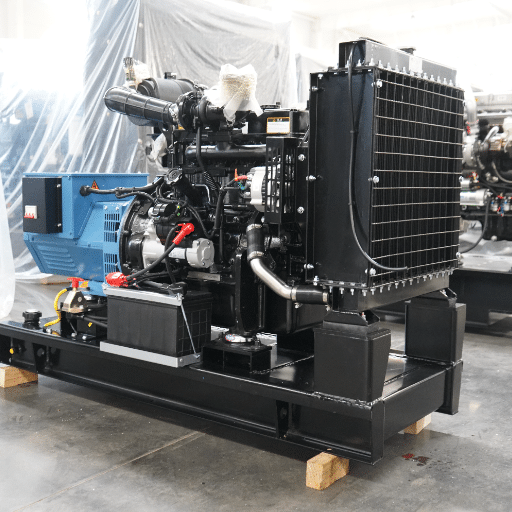


Yes, you can recover heat from a diesel generator. But only within a narrow band of temperatures the engine will tolerate, and only if the set runs enough hours to pay back the equipment. Miss either condition and generator heat recovery stops being an efficiency project and becomes an expensive one.
The pitch you have probably read goes like this. A diesel genset converts roughly a third of its fuel into electricity and sheds the rest as heat. Capture that heat and overall energy use climbs from about 35% toward 70% or higher. None of that is false.
What the pitch leaves out is that the heat isn’t sitting there waiting for you. It’s heat the engine is actively trying to get rid of, at a temperature the engine insists on controlling. Your cooling system already has opinions about how much you can take.
This article covers what a diesel genset can actually give you, what limits it, and how to tell whether your site qualifies. We build these systems into large industrial sets at Shandong Huali, so the constraints below come from engine documentation and real installations rather than from a brochure.
One clarification first, because the term is crowded. This article covers heat recovered from a genset engine: its jacket water, exhaust, and lube oil. A heat recovery steam generator (HRSG) is a different machine, a boiler component used with gas turbines and large marine plants. HVAC heat recovery is a different trade again. If you arrived looking for either of those, this is not it.
Key Takeaways
- You can recover heat from a diesel generator, but two temperature walls cap the usable amount: the thermostat that must keep jacket water hot, and the aftertreatment system that must keep exhaust hot.
- On a Tier 4 Final or Stage V set, exhaust is not waste. SCR needs roughly 250 °C and DPF regeneration needs above 350 °C, so aggressive exhaust recovery can break emissions compliance.
- Heat recovery pays on running hours. The practical threshold is about 1,000 hours a year. A standby set running 50 to 200 hours doesn’t qualify.
- Jacket water is low-grade heat at roughly 80 to 90 °C. It can heat water and spaces, but it cannot make steam or drive an absorption chiller efficiently. Exhaust can.
- Running a standby set harder to justify recovery is the wrong fix. It compresses overhaul intervals and can affect your warranty.
What Generator Heat Recovery Actually Recovers

A diesel engine produces four heat streams worth knowing about. Any serious generator waste heat recovery project starts by separating them, because they differ enormously in temperature and in how much of them you can practically use.
| Heat stream | Typical temperature | Grade | Practical recovery |
|---|---|---|---|
| Jacket water | 80 to 90 °C | Low | Good, within a strict return-temperature limit |
| Exhaust gas | 250 to 450 °C | High | Good in principle, but capped by aftertreatment and dew point |
| Lube oil | 80 to 100 °C | Low | Limited, small share of total heat |
| Charge air (after cooler) | 40 to 80 °C | Very low | Rarely worth the exchanger |
Notice the shape of that table. The two streams everyone talks about sit at opposite ends of the temperature scale, and the two nobody mentions are barely worth the pipework.
A generator’s cooling system moves all four. Our guide to the generator cooling system walks through the circuit itself.
What matters here is a narrower question: of the heat going out, how much can you take before something objects? That is a different calculation from heat rejection, which our article on generator heat rejection calculation covers.
Why the Headline Efficiency Number Is an Envelope, Not a Result
Vendors quote figures like “30% to over 80% efficiency” or “above 75% recovery.” Those describe a theoretical envelope: what a perfectly matched site could reach with a heat load that always fits the supply.
Real sites rarely match it. A plant that needs hot water in January and nothing in July collects a fraction. Treat those figures as the ceiling of a good case, not a forecast. The EPA Combined Heat and Power Partnership publishes the reciprocating-engine heat balance they are built on.
Planning a large industrial installation? We specify cooling and recovery systems against your actual site conditions, not a datasheet.
The Recoverable Band: Two Temperature Walls That Cap Generator Heat Recovery
Here is the constraint that reshapes the whole calculation.
You can’t recover all the heat a genset produces, because the engine controls the temperature of the streams you would tap. Take too much and you break something the engine depends on. There’s a floor you must not go below, and a ceiling you must not climb above.
The Floor: Your Thermostat Owns the Return Temperature
A diesel cooling system isn’t a passive heat source. It’s a temperature control system, and its thermostat exists to hold jacket water at operating temperature.
Extract too much heat in a recovery loop and the water returning to the engine arrives too cold. That causes real problems: incomplete combustion, wet stacking in the exhaust, acid condensation in the lube oil, and thermal shock across the liners.
Rodrigo manages a process plant in central Chile where the recovery loop was sized against a preheat load larger than the jacket circuit could supply. Through the winter, return temperature fell below the thermostat’s band and the engine ran cold. The first sign of trouble was acid condensation in the lube oil at the next service.
The engine documentation sets hard numbers. Caterpillar’s marine installation guidance recommends keeping the jacket water temperature differential below about 8.3 °C (15 °F) at maximum heat rejection. It also calls for retaining thermostats, so coolant returns to the engine at approximately 79 °C (175 °F). Our guide to heat exchanger cooling covers those figures in full, along with the sizing and water-quality rules for the exchanger itself.
So the recovery loop is a guest in the cooling system, not the owner of it. The engine’s operating band is a boundary condition, not a target you can negotiate.
The Ceiling: Tier 4 Final and Stage V Aftertreatment
This one is newer, and almost nobody mentions it.
On any modern emissions-certified set, the exhaust leaving your engine is not waste heat. It is the working fluid of the aftertreatment system, and that system only works when it stays hot.
- SCR (selective catalytic reduction) needs roughly 250 °C for efficient NOx reduction, with its active window starting around 150 °C.
- DPF (diesel particulate filter) passive regeneration needs exhaust above about 350 °C. Active regeneration runs at 550 to 600 °C.
- Backpressure across the combined DOC, DPF, and SCR has to stay within roughly 7 to 10 kPa. Exceed it and the engine derates.
Recover exhaust heat aggressively and you pull the exhaust temperature below the window the aftertreatment was certified against. The emissions system stops working correctly, the set throws faults, and you have compromised the thing the certification depends on.
This tension is documented in the SAE technical literature, notably paper 2015-01-1606 on waste heat recovery and aftertreatment thermal management. It is absent from the vendor marketing we have reviewed. Our guide to generator emissions standards covers what those tiers require.
Sofia Marchetti, a plant engineer in northern Italy, hit this wall directly. Her site added exhaust recovery to a Stage V set to lift overall efficiency. It worked, until the SCR stopped performing. Recovered heat had pushed exhaust temperature below the operating window, and the set began throwing faults.
The recovery loop was eventually bypassed, and the capital was stranded. The exhaust on a certified set is a compliance boundary, not an efficiency opportunity.
What Is Left Between the Walls
What remains is a band, not a harvest. On the jacket-water side you can draw down to the return-temperature limit and no further. On the exhaust side, on a certified set, you can draw heat only while the aftertreatment stays in its window.
So when a datasheet promises 70% or 80% overall energy use, read that as the share of the heat balance a perfectly matched site could capture. Your site gets what survives both walls. On a certified set the exhaust share is usually the smaller opportunity, not the larger one, and for our own installations that is the first calculation we run, before any exchanger is sized.
The Running-Hours Test: Does Your Site Qualify for Generator Heat Recovery?

The temperature band sets what you can recover. Running hours set whether it is worth recovering at all.
Recovered heat has value only when it displaces purchased fuel. That value accumulates per hour of operation, so the economics scale directly with how much the set runs.
Standby, Prime, and Continuous: Duty Rating Is Running Hours
| Duty rating | Typical annual hours | Heat recovery verdict |
|---|---|---|
| Standby (emergency) | 50 to 200 | Does not pay |
| Prime (continuous variable load) | 1,500 to 4,000+ | Worth engineering |
| Continuous (steady base load) | 6,000+ | Strongest case |
The dividing line between standby and prime is essentially a running-hours line. Once a set crosses a few hundred hours a year it has left standby duty behind, whatever the nameplate says.
The Roughly 1,000-Hour Threshold
Trade reporting on heat recovery has long put the practical break-even at roughly 1,000 annual operating hours. Below that, the value of the recovered heat rarely outweighs the added cost of the heat exchangers, controls, and storage.
That’s the whole test, and it’s unforgiving. If your genset only runs during outages, generator heat recovery won’t pay, and no equipment choice changes that.
Nurlan manages a cold-storage depot in Kazakhstan with a 400 kW standby set running about 90 hours a year. A supplier quoted a diesel generator heat recovery system sized on the set’s rated thermal output, which assumed the hours of a prime-power machine. The arithmetic looked excellent.
Installed, the system delivered a rounding error against its cost. Recovery is sized on running hours, not on rated output.
Why Running a Standby Set Harder Is the Wrong Answer
The tempting response to a failed hours test is to run the standby set more. That is the expensive direction.
A standby-rated set run at prime hours reaches overhaul intervals sooner, ages faster than its duty rating anticipates, and may put warranty coverage at risk. If a site genuinely needs thousands of running hours, the right answer is a set rated for that duty, not a recovery system bolted onto one that is not.
This is why recovery is a prime-duty feature. That conclusion disqualifies a lot of sites, and saying so plainly is more useful than selling them equipment they cannot amortise.
Matching the Grade to the Use: What Recovered Heat Can Actually Do
Temperature determines what the recovered heat can drive. Competitor pages tend to list every application against every source, which is how you end up with someone trying to make steam from 85 °C water.
| Source | Space heating | Domestic hot water | Process preheat | Absorption chilling | Steam | ORC power |
|---|---|---|---|---|---|---|
| Jacket water | Yes | Yes | Yes, low temp | Marginal | No | No |
| Exhaust | Yes | Yes | Yes | Yes | Yes | Yes |
| Lube oil | Marginal | Yes | Marginal | No | No | No |
| Charge air | Marginal | Marginal | No | No | No | No |
Jacket Water: The Low-Grade Workhorse
Jacket water is the stream most sites should look at first. It’s available whenever the engine runs, it’s thermally stable, and it suits the most common industrial loads: space heating, domestic hot water, and low-temperature process preheat.
Its ceiling is its temperature. At 80 to 90 °C, jacket water can’t generate steam and can’t efficiently drive an absorption chiller.
Exhaust: High Grade, Heavy Constraints
Exhaust carries the high-grade heat, and it is the only stream that can drive absorption chilling, steam generation, or an organic Rankine cycle (ORC) for additional electricity.
It also carries every constraint this article has described: the aftertreatment window on certified sets, the acid dew point, and backpressure limits. Exhaust heat recovery is where the biggest gains and the biggest risks live together.
Trigeneration: When the Output You Want Is Cooling
If a site needs cooling rather than heat, recovered exhaust heat can drive an absorption chiller, an arrangement called trigeneration. It works, and it is a genuine fit for sites with year-round cooling demand that coincides with generator runtime.
It’s also a project-scale decision, not a bolt-on. That’s the full cogeneration case, which our article on industrial CHP cogeneration covers in depth.
What a Generator Heat Recovery System Looks Like in Practice

The hardware is simpler than the decision-making around it.
The Loop
A recovery loop takes a branch off the cooling circuit. A plate or shell-and-tube heat exchanger transfers heat from the jacket water into a secondary loop, which carries it to the thermal load. A buffer tank absorbs the mismatch between supply and demand.
Then there is the component that tells the truth about the whole exercise: a dump radiator. It sheds recovered heat when nothing needs it. Every recovery system has one, and its presence is the honest admission that supply and demand rarely coincide neatly.
Setpoints, bypass valves, and controls keep the jacket water return temperature inside the engine’s band at all times. If the recovery load would pull it below the limit, the loop bypasses. The engine always wins.
The Thermal Demand Must Be Simultaneous
Recovered heat is worthless unless something wants it at the same moment, at the same grade, and at the same rate.
A genset at 30% load produces roughly 30% of its design heat. A heating load in July is near zero. Thermal storage can bridge short gaps and shift peaks, but it can’t manufacture a use for heat that nobody wants.
Match the load profile before sizing any exchanger. This is the step that separates a working installation from an expensive one.
Retrofitting vs Specifying New
Adding recovery to an existing set means working around an installed cooling circuit. Space, existing pipework, and the engine’s control strategy all constrain what is possible. Specifying recovery on a new set is easier, because the cooling system can be designed for it from the start.
What It Looks Like on a Real Site
At Coldfoot, Alaska, a University of Alaska study documented an 80 kW Caterpillar cogeneration system. Jacket water heat recovery saved roughly 2,200 gallons of fuel oil a year and covered about one third of the space heat needed by a maintenance shop. The study also found recovery output was relatively insensitive to load, a useful property for a heat source you can’t fully control.
Note what made it work. The generator runs continuously, and the site needs heat constantly.
Is Generator Heat Recovery Worth It? The Payback Arithmetic

You can screen a site in five inputs.
- Usable thermal output (kW), after the recoverable band is applied.
- Annual running hours.
- Value of the fuel displaced, adjusted for the efficiency of whatever currently supplies that heat.
- Installed cost of exchangers, storage, controls, and pipework.
- Maintenance cost added by the new loop.
Simple payback is the installed cost divided by the annual value of displaced fuel.
Published generator heat recovery payback figures run from under a year to well over a decade. That spread isn’t evidence of unreliable technology. It reflects the five inputs above, and the biggest driver by far is fuel price.
One techno-economic study of marine exhaust recovery found payback moving from about 20 years to under 7 as diesel price rose from 0.6to0.6to1.3 per litre. The same system, at the same site, spans a range wide enough to justify or kill the project.
That’s why a vendor quoting a single payback figure is telling you very little. Ask what fuel price it assumes and what running hours it assumes. Those two answers will tell you more than the headline number.
Ready to find out whether your site qualifies? Tell us your running hours and your thermal load, and our engineers will tell you honestly whether recovery is worth engineering. Talk to our engineering team →
Frequently Asked Questions
Can you recover heat from a diesel generator?
Yes, within limits. A diesel genset turns roughly a third of its fuel into electricity and sheds the rest as heat, and part of that is recoverable from the jacket water and the exhaust. What you cannot do is take all of it, because the engine controls the temperature of both streams.
How many hours does a generator need to run for heat recovery to pay back?
Roughly 1,000 hours a year. Below that, the fuel you displace rarely covers the exchangers, controls, storage, and pipework. A standby set running 50 to 200 hours is nowhere near it, which is why so many sites are disqualified before the engineering starts.
Why can’t you recover all of the exhaust heat?
Because on a certified set the exhaust is not waste. SCR needs roughly 250 °C to reduce NOx, and passive DPF regeneration needs above about 350 °C. Drop below those windows and the aftertreatment stops working, the set throws faults, and the efficiency gain does not survive.
Which should you recover first, jacket water or exhaust?
Jacket water, on almost every site. It is available whenever the engine runs, it is thermally stable, and it suits space heating, hot water, and low-temperature process preheat. Its limit is its own temperature, about 80 to 90 °C, which is why it cannot make steam. Exhaust carries the high-grade heat, and the constraints with it.
Does heat recovery affect a generator’s warranty?
It can. A retrofit modifies an installed cooling circuit, and a standby-rated set run at prime hours sits outside the duty it was sold for. Clear both with the engine manufacturer before committing capital. If the hours are genuinely there, the better answer is a set rated for that duty.
Conclusion
Generator heat recovery is a real efficiency gain, and it’s a narrower one than most marketing suggests. Five things decide whether it applies to you.
- The heat you can recover is bounded by two temperature walls: the thermostat that keeps jacket water hot, and the aftertreatment system that keeps exhaust hot.
- On a Tier 4 Final or Stage V set, exhaust is a compliance boundary first. Aggressive recovery can break SCR and DPF performance.
- Recovery pays on running hours. Roughly 1,000 a year is the practical threshold, and a standby set doesn’t reach it.
- Match the grade to the load. Jacket water heats water and spaces. Exhaust makes steam and drives chilling.
- Running a standby set harder is the wrong fix. Buy the right duty rating instead.
The sites that benefit are the ones already running generators as prime power, with a thermal load that exists whenever the engine runs. Mines, islands, remote camps, and process plants are the natural fits.
If that sounds like your operation, we’ll run the numbers with you before you buy anything. If it doesn’t, we’ll tell you so. Tell us your running hours and your thermal load → and we’ll tell you honestly whether generator heat recovery is worth engineering at your site.