

The right diesel generator coolant antifreeze is an ethylene glycol mix at about 50/50 with distilled water, chosen by chemistry and never by color: IAT, OAT, or HOAT to match your engine, plus a cavitation additive (SCA) when it runs wet liners. A diesel generator cooling system is a closed loop, and the fluid in that loop decides whether it protects the block or quietly shortens the engine’s life.
Most coolant advice gets the color wrong. Two jugs can be the same color and have completely different chemistry, and the costliest site mistake, mixing types, doesn’t surface until gel plugs the radiator or a wet liner pits through. Color tells you almost nothing. The failure of the coolant tells you everything.
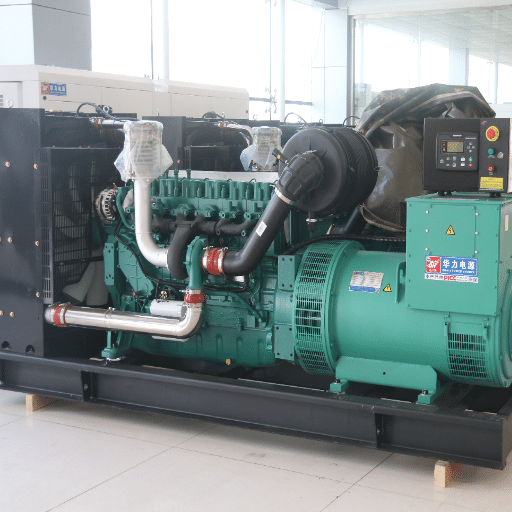
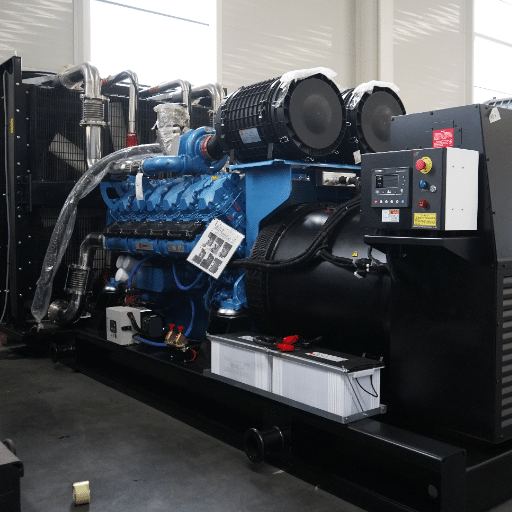
We build and test these loops at Shandong Huali on gensets from 20 kVA to 3,000 kVA with Cummins, Perkins, Weichai, and Yuchai engines, and we fill each one before it ships. This is the spec our line uses, not a car-care tip. Every build starts on our diesel generator range, where the engine, radiator, and coolant are matched before we quote.
Below you’ll get the four decisions in order: the type, the ratio, the water, and the additive wet-liner engines need. You’ll also learn why more antifreeze is not more protection.
Key Takeaways
- Diesel generator coolant is ethylene glycol antifreeze diluted with distilled water, chosen by chemistry (IAT, OAT, or HOAT), never by color.
- The standard mix is 50/50; 40% is the practical floor and anything much past 60% raises the freeze point and cuts heat transfer sharply.
- Mixing coolant types can throw a gel that clogs the radiator, so top up with the same chemistry the system already holds or flush first.
- Wet-liner diesel engines need a cavitation additive such as SCA or DCA4; plain water can pit a liner through in as little as 500 hours under severe conditions.
- Use distilled, deionized, or demineralized water. Hard water leaves scale that can cut heat transfer by 30 to 40%.
What Coolant Does a Diesel Generator Need? A Direct Answer

Most diesel generators need the same base fluid: ethylene glycol antifreeze mixed at 50/50 with distilled water, in the chemistry your engine maker specifies. If the engine has wet cylinder liners, and most modern diesels do, it also needs a cavitation additive, either built into the coolant or added as an SCA.
The table below is the whole decision at a glance. The reasoning behind each row comes next.
| Decision | The answer | Why it matters |
|---|---|---|
| Base fluid | Ethylene glycol antifreeze + water | Carries heat out of the engine and stops the coolant freezing |
| Mix ratio | 50/50 (safe band 40-60% concentrate) | Freeze protection, boil protection, and heat transfer in balance |
| Water | Distilled, deionized, or demineralized | Tap water leaves scale that insulates the block |
| Chemistry | Whatever the engine OEM specifies (IAT, OAT, or HOAT) | Different chemistries must never be mixed |
| Wet-liner engines | SCA or a fully formulated coolant rated to the engine spec | Prevents cavitation pitting through the liner |
If you take only one thing from this article, make it the chemistry rule: find out what coolant is already in the system, write it on the tank, and refill with the same type.
Diesel Generator Coolant Antifreeze Types: IAT, OAT, and HOAT

Every concentrate is mostly the same base, ethylene glycol or propylene glycol. The additive package dissolved in it is what makes one coolant different from another, and the acronyms describe that package.
| Type | Typical colors | Inhibitor chemistry | Typical life |
|---|---|---|---|
| IAT | Green, blue | Silicates and phosphates (or nitrite) | About 2-3 years or roughly 6,000 hours |
| OAT | Orange, red, dark green | Organic acids (carboxylates) | 5+ years |
| HOAT | Yellow, pink, blue | Organic acids plus a small silicate dose | Between the two, often 5+ years |
IAT is the conventional green coolant. It uses inorganic inhibitors, mainly silicates and phosphates, that coat the metal surfaces and stop corrosion. It’s cheap and effective, and it wears out fastest because those inhibitors get consumed. That’s why green coolant has the shortest service interval, roughly every 2 to 3 years or around 6,000 hours on a working set.
OAT is the extended-life chemistry. It protects with organic acids that last years longer, typically 5 years or more, and it sits behind most long-life products, often orange or red. The catch is that some OAT coolants are nitrite-free, and nitrite is the additive that blocks cavitation on wet liners. An engine maker only approves a nitrite-free coolant if its own tests show the liners stay protected, which is why the approval matters more than the label.
HOAT blends both. Hybrid coolants add a small silicate dose to the organic-acid package. They get some of OAT’s long life and some of IAT’s metal-coating behavior, and they’re common in modern heavy-duty fleets, often yellow, pink, or blue.
Color is decoration, not chemistry. Two “red” coolants can be different formulas, and same-color brands are not automatically compatible. The only reliable labels are the chemical name and the OEM approvals printed on the container. If it carries an approval code for your engine, it matches; if it only carries a color, treat it as unknown.
That point matters on a genset. Automotive antifreeze is built for small engines with pressed-in liners and short trips. A diesel generator runs a heavy-duty engine for hours at constant load, and many of those engines use wet liners, which automotive coolant never has to protect. Buy a heavy-duty coolant rated to a recognized standard, not a bottle that says it fits any car.
Why You Should Never Mix Different Coolant Colors
The never-mix rule is chemistry, not fussiness. When an IAT coolant meets an OAT coolant, the two inhibitor packages can react and drop out of solution as a gel-like sludge. That sludge packs into the thinnest passages in the system, the tubes inside the radiator core, and quietly chokes coolant flow.
The damage rarely announces itself. A few wrong jugs across a season is enough, and the first sign is usually a high-temperature trip under full load in hot weather, one of the common generator overheating causes in our service log.
So top up with the same chemistry the system already holds. If you don’t know what’s in it, or if someone already mixed brands, flush and refill with one chemistry before the problem becomes a bill. A flush is scheduled maintenance, not an emergency repair, and the full procedure belongs with the cooling system maintenance guide rather than here.
Thabo runs the standby sets at a construction camp in Zambia. A maintenance mechanic topped up one unit with bright green automotive coolant because it was the only jug in the workshop, even though the system held an orange extended-life coolant. By the next hot season the set was tripping on high coolant temperature under load, and the radiator core had to be cleaned out and the system flushed before it would carry full load again. The jug cost a few dollars. The cleaning and downtime cost far more than a proper flush would have.
The Right Diesel Generator Coolant Antifreeze Ratio
Antifreeze and water split the work. Glycol lowers the freezing point and raises the boiling point; water does the heat carrying. The ratio is the balance between those two jobs, and this table shows the standard curve for ethylene glycol mixed with water. Treat the temperatures as approximate; blends shift them by a couple of degrees.
| Antifreeze concentrate | Freeze point | Approx. boiling point (atmospheric) | Typical use |
|---|---|---|---|
| 30% (30/70 mix) | About -15 °C | About 104 °C | Too weak for cold sites; corrosion additives short-changed |
| 40% (40/60 mix) | About -25 °C | About 106 °C | Practical tropical minimum |
| 50% (50/50 mix) | About -37 °C | About 108 °C | The standard fill for most sites |
| 60% (60/40 mix) | About -52 °C | About 111 °C | Severe cold regions only |
Three things follow from that table, and each one surprises someone.
- 50/50 is the standard because it covers almost every site. It protects down to about -37 °C, and the radiator cap pressure lifts the working boiling point well past 120 °C. It’s the fill we ship on our own sets.
- More concentration is not more protection, and at the extreme it backfires. The freeze point doesn’t keep dropping as you add glycol. It bottoms out near 60 to 70% at about -50 °C, then climbs because undiluted antifreeze only freezes at about -13 °C. Water does the heat carrying, so every extra point of glycol makes the coolant worse at it; near a 70% mix it transfers roughly half the heat that plain water does. Pure concentrate is not coolant.
- 40% is the floor for a reason that has nothing to do with freezing. The corrosion inhibitors need a minimum concentration to do their job. Below about 40% you trade away more than freeze protection; you also leave the metal without enough inhibitor. The honest band is 40 to 60% concentration, with 50% as the default.
Ravi, the plant engineer at a food processor near Dubai, decided that more antifreeze meant more protection and had a set filled to about 70% concentrate. Under full load in summer the unit ran hot even with a clean radiator. A refractometer showed a freeze point near -50 °C, protection the site never needed, while the thick mix carried only about half the heat of water. Back at 50/50, the jacket temperature settled into the normal band within a day.
If the coolant was mixed by someone else, test it rather than guess. A refractometer reads the freezing point of a sample directly and is the tool to trust; a ball-style hydrometer drifts on colored or degraded coolant and is worth skipping.
The loop this fluid rides, from water pump to radiator and back, gets the full part-by-part walkthrough, with normal temperatures, in our guide to how a generator cooling system works.
Distilled Water, Not Hard Water
The water is half the coolant, and it’s the silent half. Tap water, well water, and borehole water carry dissolved minerals, mainly calcium and magnesium, that come out of solution on hot surfaces as scale. Scale is a poor conductor, so once it builds up it can cut heat transfer by 30 to 40% without a single drop of coolant being lost.
The gauge creeps up, the radiator stays clean, and nobody finds the cause because it’s a crust you can’t see from outside the block.
Hard water also works against the inhibitors themselves. Silicate-based coolants in particular can drop their silicates out of solution when the water is hard, stealing corrosion protection at the same moment scale is forming.
The rule is simple: use distilled, deionized, or demineralized water for the mix and for every top-up. All three are fine, and all three are cheap next to a cylinder head. If an emergency forces plain drinking water, treat it as temporary and flush and refill at the next service. On a wet-liner engine running extended hours, that temporary water also needs the cavitation protection covered next.
SCA Coolant and Wet-Liner Engines: The Cavitation Problem

Here is where the diesel generator coolant antifreeze choice actually protects metal, and where most coolant guides stop short.
The failure no gauge warns you about
Engines like Cummins, Perkins, Weichai, and Yuchai use wet cylinder liners: sleeves that sit in the block with engine coolant flowing against their outer face. Combustion sets up high-frequency vibration in that coolant, which forms microscopic vapor bubbles. When those bubbles collapse against the liner wall, each micro-implosion erodes a little metal. Repeat that millions of times and the liner pits, then pinholes.
Cavitation damage is invisible until it’s catastrophic. There’s no overheating warning and no leak you can see; coolant just reaches the oil or the combustion chamber. Under severe conditions with plain water, liner pitting can develop within about 500 hours of operation.
What SCA is and how much to add
The protection is a cavitation additive, sold as a supplemental coolant additive (SCA) or under names such as Fleetguard’s DCA4. It lays a protective film on the liner face and converts soft rust into hard magnetite, which resists the bubble collapse. The Luby Equipment guide to avoiding liner pitting explains the mechanism and gives the operating rules:
- Check the additive level at every service.
- Add additive whenever you add make-up water.
- Prefer a coolant that already carries the additive, so initial fill and top-ups stay in proportion.
Dosing is not a guess. Fleetguard’s DCA4 coolant additive data sheet lists the numbers we use when we precharge a system: about 0.6 units of additive per litre of system capacity (roughly 2.2 units per US gallon), or 4 to 8% of system volume of liquid additive, with a little extra if the system is filled with water alone. The healthy operating range sits near 0.4 to 0.8 units per litre, about 1.5 to 3.0 units per US gallon, and the level is checked with a coolant test strip at each service rather than by sight. If you use a fully formulated coolant already built to your engine’s specification, the precharge is usually inside it.
Which standard should you buy?
Three names cover most of the heavy-duty market, and any of them beats a color match:
- ASTM D6210 for heavy-duty coolants formulated with an SCA package.
- Caterpillar EC-1 for extended-life coolants.
- Cummins CES 14603 for coolants approved for Cummins engines, including its extended-life OAT, which needs no SCA topping.
The rule for a wet-liner engine: follow the engine maker’s specification, not the coolant vendor’s color chart. If the product carries an approval code from the engine builder, it matches; if it only claims to be universal, it may not protect the liners at all.
Daniel looks after the standby set at a network compound in northern Kenya. The set ran clean for about eighteen months on distilled-water top-ups, with no SCA added because it never threw an alarm. At a routine oil change the laboratory flagged rising potassium, the marker for coolant getting into the oil. When the head came off, one liner carried a pinhole worn through from the coolant side by cavitation. The engine never overheated, never leaked visibly, and never warned anyone. Today the additive check sits on the same service sheet as the oil change.
How Long Does Diesel Generator Coolant Last?

Coolant life is set by chemistry, not by the calendar alone. Conventional IAT green coolant should be changed on a 2 to 3-year cycle or roughly every 6,000 hours, whichever comes first, because its inhibitors get consumed. Extended-life OAT and HOAT coolants run 5 years or more when the system stays clean and the level is kept with the same coolant and the right water.
A coolant is done when it shows one of these:
- A rust-colored or sludgy appearance.
- A freeze point that has crept up on the tester.
- An additive reading that will not hold its band.
Any one of those means the chemistry is spent. Changing it is a straightforward drain, flush, and refill that belongs to the regular service schedule. The detailed procedure fits with the wider cooling system maintenance guide rather than in this article.
Frequently Asked Questions
What coolant do I use in a diesel generator?
Ethylene glycol antifreeze mixed at 50/50 with distilled water, in the chemistry your engine specifies (IAT, OAT, or HOAT), plus a cavitation additive if the engine has wet liners. The engine maker’s coolant specification overrides every bottle label.
Can I use car antifreeze in a diesel generator?
Only if the engine maker approves it. Automotive coolant is formulated for small engines without the wet-liner cavitation problem that a heavy-duty diesel faces. For a wet-liner engine, use a heavy-duty coolant rated to a recognized standard such as ASTM D6210, CAT EC-1, or the engine builder’s own spec.
Can you mix different coolant colors?
No. Green is usually an IAT chemistry and red or orange is usually OAT, and mixing the two can throw a gel that clogs the radiator. Same-color coolants can also be different chemistries, so top up with the exact type already in the system or flush and refill.
What is the best diesel generator antifreeze ratio?
50/50 is the standard answer. The safe band is 40 to 60% concentrate: below 40% you lose corrosion protection, and much above 60% the freeze point stops falling, heat transfer drops sharply, and pure concentrate actually freezes warmer than a 50/50 mix.
Can I use plain water in a diesel generator cooling system?
Only as a short emergency. Water alone freezes, provides no corrosion protection, and gives wet liners no cavitation protection, where severe conditions can pit a liner within about 500 hours. Flush and refill with proper coolant at the first opportunity.
What is SCA in diesel generator coolant?
Supplemental coolant additive. It protects wet cylinder liners from cavitation pitting, the erosion caused by vapor bubbles collapsing against the liner face. On a wet-liner engine, check the level at every service with a coolant test strip.
Conclusion
The diesel generator coolant antifreeze decision comes down to four choices, and each fits in one line:
- Type: buy to the engine maker’s chemistry spec, not to a color.
- Ratio: 50/50 with distilled water, inside the 40-60% band.
- Water: distilled, deionized, or demineralized, never hard.
- Additive: SCA or a fully formulated coolant on wet-liner engines.
Get those four right and the coolant quietly protects the block for years. Get them wrong and the bill arrives as a gel-clogged radiator, a scaled jacket, or a pinhole liner, usually at the worst possible moment and always more expensive than the correct fluid would have been.
If you’re sizing a new set or you’re not sure what your current one should carry, send us your site conditions, your engine model, and your load profile. Our engineering team will spec the coolant with the rest of the cooling system before the set ships instead of after it fails.