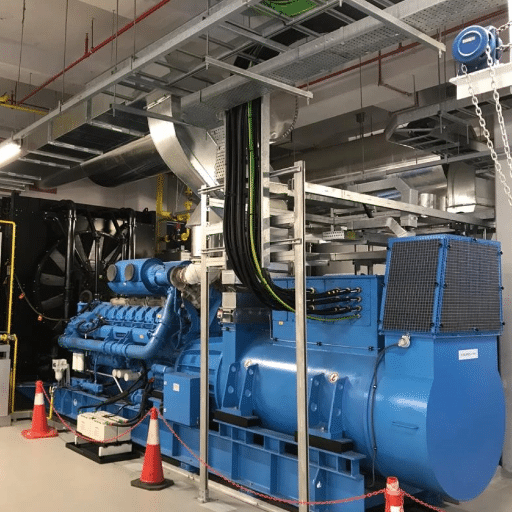


A generator set for commercial buildings is typically a standby diesel unit between 100 and 625 kVA, paired with an automatic transfer switch and sized from a real load calculation. Office towers, malls, and hotels usually land in the 400 to 625 kVA band, while smaller commercial properties often start around 80 kVA.
The cost of getting this wrong shows up fast. When a storm cut grid power to a mid-sized shopping mall in Kuala Lumpur for nine hours in March 2025, the building had no backup system. Refrigerated tenants lost inventory, the anchor supermarket closed for a full day, and two restaurants reported a combined loss above $40,000. The property manager, Anita, commissioned a 500 kVA standby generator set the following month. A similar outage that December lasted six hours, and tenants never noticed.
If you manage or develop commercial property, you already know backup power is not optional equipment anymore. This guide walks through what a generator set for commercial buildings must carry, how to size it, what the codes require, and how to choose between diesel and gas. It is written by a manufacturer that has delivered power solutions for hotels, office complexes, and retail centers across more than 100 global projects.
Key Takeaways
- Commercial building generator sets are typically 80 to 625 kVA, permanently installed, and wired into the building through an automatic transfer switch (ATS).
- Size from a load calculation that separates life-safety loads from optional loads, and never size from square meters alone.
- Diesel dominates standby duty because it accepts full load within seconds; natural gas units respond slower but suit some urban sites.
- In the US, NFPA 110 and NEC Articles 700, 701, and 702 define what must be backed up and how the system is tested; other markets have equivalent local codes.
- Standby power accounts for about two-thirds of global genset demand, and commercial buildings are a core driver of that market.
Why Commercial Buildings Need Backup Generator Sets

A commercial building without backup power is one outage away from lost revenue, safety risk, and tenant complaints. The loads at stake are not conveniences.
Critical loads a building generator must carry
- Life-safety systems: emergency lighting, fire pumps, fire alarms, and smoke control
- Vertical transport: elevators, at least one car per code requirements
- Security: CCTV, access control, and alarm systems
- Climate and refrigeration: HVAC for critical areas, cold storage for retail tenants
- Business continuity: server rooms, point-of-sale systems, and communications
Standby applications like these account for roughly 67% of global diesel genset demand, in a market Global Market Insights values at about USD 40.9 billion in 2026. Commercial buildings are a structural driver of that demand, not a niche.
What downtime actually costs
The math is straightforward. Add one day of lost tenant revenue claims, spoiled inventory, security exposure, and the reputational cost of a dark building. For most retail and hospitality properties, a single serious outage exceeds the price difference between a cheap generator and a properly specified one. That is why backup power solutions are now standard infrastructure in modern commercial developments.
Not sure what your building needs? Send us your load list and floor area and our engineers will return a free sizing recommendation.
What Size Generator Set Does a Commercial Building Need?

A commercial building generator set should be sized from a load calculation: total the connected loads, apply diversity factors, add motor starting allowances, then include a 10 to 25 percent margin. Small commercial buildings often need 80 to 200 kVA, while office towers, malls, and hotels typically require 400 to 625 kVA or more.
Step-by-step load calculation
Consider an eight-story office building as a worked example:
- List the loads: emergency lighting 15 kW, fire pump 45 kW, one elevator 30 kW, security and access control 8 kW, server room 40 kW, essential HVAC 90 kW.
- Apply diversity: not everything runs at once. A realistic demand factor brings the running total to about 190 kW.
- Add motor starting: the fire pump and elevator motors can draw two to three times their rated power at start. Sequence the starts and allow roughly 60 kW of additional headroom.
- Add margin: 15 percent for future tenants and load growth brings the target to about 290 kW, or roughly 360 kVA at a 0.8 power factor.
The building specifies a 400 kVA standby unit. Good standby generator sizing always ends with a worked number like this, never a guess. For a deeper method, see our step-by-step generator sizing guide.
Typical size bands by building type
| Building type | Typical genset size | Notes |
|---|---|---|
| Small office or retail (under 2,000 m²) | 80 to 200 kVA | Life-safety plus essential systems |
| Mid-rise office or hotel | 250 to 500 kVA | Elevators, HVAC, IT loads |
| Shopping mall or office tower | 400 to 625 kVA | Multiple risers, large HVAC |
| Large complex or campus | 1,000 to 2,000 kVA | Often multiple paralleled units |
For large complexes and campuses, see our commercial and industrial generator sets from 1,001 kW and up.
Life-safety loads vs. optional loads
Codes usually require life-safety loads on their own circuit with the fastest transfer. Business loads like full HVAC and server rooms are your choice. Splitting them lets you buy one right-sized generator instead of one oversized unit, or stage two units for redundancy.
A property manager in Jakarta learned why this separation matters. He sized his building’s genset from nameplate totals without diversity factors and ended up with a 625 kVA unit for a building that never drew more than 300 kVA. The oversized engine ran at light load for years, wet-stacked, and needed an early top overhaul. A correct load calculation would have saved him about $35,000 upfront and cut his maintenance costs.
Diesel vs. Natural Gas for Commercial Buildings
When choosing a generator for commercial buildings, both fuels work for standby duty, but they behave differently when the grid fails.
Diesel starts fast and accepts full load within about ten seconds, which is why it dominates hospitals, data centers, and commercial standby applications. On-site fuel storage gives you runtime independence from the gas network, and modern engines meet strict emission standards. The trade-offs are fuel maintenance and delivery logistics.
Natural gas connects to the utility pipeline, so there is no fuel tank to manage and emissions are lower. The weaknesses are slower load acceptance and total dependence on the gas grid staying live during the same event that killed the power. As Foster Fuels explains, that response gap is the main reason diesel remains the default for critical standby loads.
Battery storage is emerging as a complement, especially for bridging short outages and reducing generator runtime in urban areas. For whole-building backup measured in hours or days, though, a generator set for commercial buildings remains the proven foundation, with batteries layered in where the economics make sense. For a fuller fuel-by-fuel breakdown, see our diesel vs. gas generator comparison.
Code and Compliance Essentials for Commercial Building Generator Sets

Any generator set for commercial buildings must meet local codes. Codes vary by country, but the logic is the same everywhere: life-safety systems must have reliable emergency power, and the system must be tested on a schedule. Always confirm details with your local authority having jurisdiction.
NFPA 110 and the NEC, simplified
In the US market, three NEC articles matter. Article 700 covers emergency systems that are legally required for life safety, like exit lighting and fire pumps. Article 701 covers legally required standby systems. Article 702 covers optional standby systems, which is where most business-continuity loads sit.
NFPA 110 then classifies the emergency power supply system itself. Level 1 systems protect human life and carry the strictest requirements. Level 2 systems serve less critical loads with more flexibility. As Curtis Power Solutions outlines, the standard also governs installation environment, fuel supply, and acceptance testing.
Installation requirements that surprise buyers
- Location and ventilation: generators need combustion air, cooling airflow, and exhaust routing. Basement installs often require engineered ducting.
- Fuel storage: day tanks plus bulk storage must meet local fire codes, and diesel needs periodic polishing or rotation.
- Noise limits: urban jurisdictions commonly impose property-line dBA limits, which pushes many projects toward silent enclosures.
- Testing obligations: most codes require regular exercising under load, with records. A generator that is never tested is a liability, not an asset.
Our generator maintenance checklist gives your facility team a ready framework for those ongoing obligations.
Installation Realities in Urban Commercial Buildings
A generator set for commercial buildings rarely gets the luxury of a convenient empty lot. Placement is an engineering decision with real trade-offs.
Placement options
- Ground-level enclosure: easiest for installation, fuel delivery, and service access. The default choice when space allows.
- Rooftop: saves ground space and eases noise at street level, but requires structural verification and crane logistics.
- Basement or indoor room: protected and discreet, but demands engineered ventilation, exhaust, and fuel piping. Usually the most expensive option.
Noise control
A standard open genset is far too loud next to offices, hotel rooms, or apartments. Silent enclosures with double-wall steel and acoustic lining typically achieve 72 to 75 dBA at 7 meters, and super-silent builds go lower. Always request documented noise data measured per ISO 3744, not marketing claims.
A boutique hotel in Dubai faced exactly this problem in 2025. Its first generator, installed in a service alley without acoustic treatment, triggered guest complaints every time it ran its weekly exercise. The replacement was a super-silent 350 kVA unit in a double-wall enclosure. Exercise cycles now run at 6 a.m. without a single complaint on record.
Fuel autonomy planning
Decide how many hours the building must run without refueling. Common targets are 8 to 24 hours for offices and retail, and 48 to 72 hours for hospitality or mixed-use sites with life-safety obligations. Size the tank to the target, then confirm refueling access for extended events.
Cost Framework and Choosing a Supplier

Budget for the system, not the unit. A complete commercial building backup power solution includes the generator set, ATS, installation, fuel system, commissioning, and ongoing maintenance. The generator itself is often only 50 to 60 percent of the project total.
The most expensive mistakes are consistent across projects: undersizing and stalling on motor starts, oversizing and destroying the engine at light load, skipping the load study to save a week, and buying from a supplier with no after-sales network. Each one costs more than doing it right.
When you evaluate suppliers, demand factory load-bank test reports, named engine and alternator brands, clear warranty terms, and local spare parts support. Shandong Huali supports commercial building projects from load assessment through commissioning, with silent and containerized configurations across a 5 kW to 3,000 kW range. You can review our commercial diesel generator range to see typical configurations.
Frequently Asked Questions
What size generator set does a commercial building need?
Most commercial buildings need between 80 and 625 kVA. The exact size comes from a load calculation: total connected loads, adjusted for diversity, motor starting currents, and a 10 to 25 percent growth margin. Square-meter rules of thumb are a starting point only.
Is diesel or natural gas better for commercial buildings?
Diesel is the default for standby duty because it accepts full load within seconds and stores fuel on site. Natural gas suits sites with reliable pipelines and less critical transfer times, and it avoids fuel storage. Buildings with life-safety loads usually choose diesel.
Where should a commercial building generator be installed?
Ground-level outdoor enclosures are preferred when space allows. Rooftops save ground space but need structural checks. Indoor or basement rooms work but require engineered ventilation and exhaust. Local fire and noise codes often decide the final location.
How long can a commercial generator run continuously?
Runtime depends on fuel capacity, not the engine. With a properly sized tank, standby units routinely cover 8 to 72 hours of autonomy, and diesel engines can run for days with refueling. Plan tank size around your building’s target autonomy.
Does my building legally require a backup generator?
Many jurisdictions require emergency power for life-safety loads in buildings above certain heights or occupancies, including fire pumps, emergency lighting, and elevators. Requirements vary by country and building class, so confirm with your local authority or a licensed electrical engineer.
Conclusion
Selecting a generator set for commercial buildings is a structured decision, not a guess. Keep the essentials in view:
- Size from a load calculation with diversity, motor starting, and growth margin, not from rules of thumb
- Separate life-safety loads from optional loads to right-size the system and meet code
- Choose diesel for fast, independent standby response; consider gas or batteries where they genuinely fit
- Plan placement, noise, fuel autonomy, and code testing obligations before you buy
- Buy from a supplier that proves quality with test reports and supports you after commissioning
Buildings that plan backup power properly stop noticing outages. Tenants stay open, safety systems stay live, and the investment pays for itself the first time the grid fails.
Ready to specify backup power for your building? Request a free load assessment from our engineering team, and we will return a sizing recommendation and quotation built around your property.