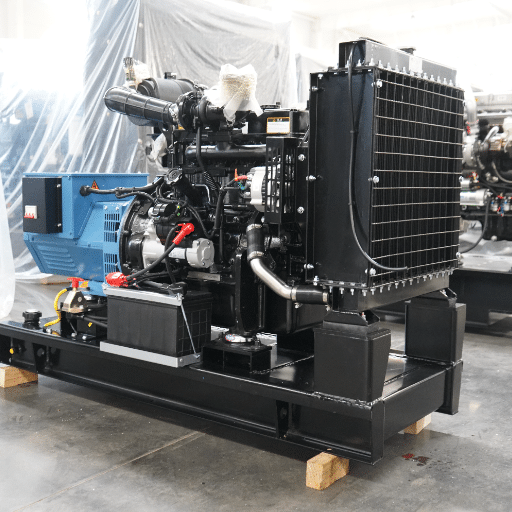


A three-phase diesel generator produces three alternating voltages offset by 120 degrees, and delivers about 1.73 times the power of a single-phase machine at the same current. That is the standard definition, and it is where most guides stop.
Here is what they leave out. The three-phase output changes what your site can run, how much current your switchgear must carry, and what happens when the load is uneven. Get those wrong and a correctly sized set still disappoints you.
Most pages on this subject describe the machine. This one describes the consequences. We build three-phase sets at Shandong Huali, from small industrial units to 3,000 kW machines, so the constraints below come from engine and alternator documentation rather than a brochure.
One clarification, because the term is crowded. This article covers three-phase output from a diesel generating set. Wiring and reconnection of the alternator itself, grounding and bonding, and cable sizing to code belong to our generator electrical connection guide. Here we stay on the output side.
Key Takeaways
- A three phase diesel generator delivers about 1.73 times the power of a single-phase set at the same current, which is why large loads are three-phase by default.
- Running single-phase loads from one phase to neutral gives you roughly a third of the set’s three-phase kVA, because you are loading one winding set. This is the most common sizing mistake in three-phase projects.
- Motor starting, not running load, usually sizes the set. Starting kVA comes from the motor’s locked rotor current, and it can exceed the running load by a wide margin.
- Uneven loading across the phases heats the alternator and forces derating. NEMA MG-1 sets the motor-side limit at 1% voltage unbalance, and derating rises steeply above it.
- On a three-phase four-wire system the neutral carries only the imbalance, so a balanced site has almost no neutral current and an unbalanced one can overload it.
Not sure whether your site needs three-phase? Send us your load list and we will tell you straight. Talk to our engineering team →
What a Three-Phase Diesel Generator Actually Is

Three separate windings sit in the alternator stator, spaced 120 electrical degrees apart. Each produces a sine wave, and the three waves peak in turn rather than together.
That spacing is the whole design. A single-phase machine has one waveform, so its output rises to a peak and falls to zero a hundred times a second. A three-phase machine always has one winding near its peak, so the power delivered to the load stays nearly constant. Motors run smoother, transformers work better, and the conductors carry more useful power for the same heating.
The alternator draws its power from the diesel engine. The governor holds speed and the voltage regulator holds voltage, keeping the three waves at the right frequency and amplitude as the load changes.
Three Windings, Four Wires, 120 Degrees
A three-phase supply reaches you on three or four conductors. The three line conductors carry the phases. The fourth, when present, is the neutral, connected to the star point where the three windings meet.
The neutral is what lets you take single-phase power from a three-phase supply. Any one line conductor paired with the neutral gives you a normal single-phase circuit at a lower voltage. That is how a three-phase distribution board feeds lighting and socket circuits alongside three-phase machines.
Not every three-phase set has a neutral brought out. A three-wire supply suits balanced three-phase loads only; if you need single-phase circuits as well, you need the fourth wire.
Why √3 Appears Everywhere in Three-Phase Work
The square root of three, about 1.732, is the ratio between line voltage and phase voltage on a star-connected system. It is not a fudge factor. It falls out of the geometry of three waves 120 degrees apart.
Multiply phase voltage by 1.732 to get line voltage, and divide to go the other way. That same number reappears in the current calculation and in motor starting kVA, and you will meet it twice more in this article.
Which Output Your Site Needs: The Decision That Comes First
Before sizing anything, settle which output you need. Two tests decide it, and neither is about budget. A 3 phase diesel generator is only worth its cost if something on your list needs it.
The Nameplate Test
Walk your load list and read the nameplates. Any load marked three-phase, or carrying a voltage like 400V, 415V or 480V, needs a three-phase supply. If nothing on your list is three-phase, a three-phase set buys you capability you will not use.
The loads that require all three phases are almost all motors: pumps, compressors, conveyors, machine tool spindles, chillers, lifts and large fans. Above roughly a kilowatt, motors are usually three-phase because it is cheaper and more efficient to build them that way.
Lighting, socket circuits, IT equipment, and smaller air conditioning are single-phase and always will be. They run perfectly well from one phase and neutral of a three-phase supply.
The Building Supply Test
If your building already has a three-phase service, a three-phase set is the natural match. Standby and prime power generators are usually specified to mirror the supply they support, because the transfer switch and distribution board are already built around it.
If the building is single-phase throughout, a three-phase set is possible but rarely sensible at small ratings. Three-phase machines below about 20 kVA carry a size and cost penalty for capability you would not use.
Our diesel generator range spans both, and the honest answer for a small site is often to stay single-phase.
The Trap: Running Single-Phase Loads from a Three-Phase Set
This is the most expensive misunderstanding in three-phase projects, and most guides skip past it.
A three-phase alternator’s rating assumes all three phases are loaded evenly. Tap one phase and neutral to feed single-phase loads, and you are using one winding set. The other two sit idle. The set cannot give you its nameplate rating through one winding, no matter what the plate says.
In practice, single-phase loads taken from one phase to neutral can draw roughly a third of the set’s three-phase kVA. Buy a 100 kVA set expecting 100 kVA of single-phase power and you will be disappointed.
One Phase to Neutral, and What It Costs You
| How you connect it | What you can draw | Why |
|---|---|---|
| One phase to neutral | Roughly a third of the three-phase kVA | One winding set is loaded and the alternator is unbalanced |
| Two phases, line to line | More than one phase, still uneven | Two windings loaded, the third idle |
| All three phases, balanced | The full rated kVA | The design case the nameplate describes |
| Reconnected for single phase | The manufacturer’s single-phase rating | A 12-lead set is reconfigured rather than tapped |
Notice the fourth row. Alternators built with twelve leads brought out can be reconnected for single-phase duty, using a manufacturer-approved diagram. A set ordered that way will outperform a set simply tapped at one phase.
The figure is set by the manufacturer, so treat the nameplate as the starting point and ask for the single-phase rating explicitly. If your project runs mostly single-phase loads, that conversation should happen before you order.
Why Uneven Single-Phase Draw Derates the Alternator
Unequal current in the three windings does more than waste capacity. It produces a rotating field that turns against the main field, called negative-sequence current, and that current heats the alternator’s rotor and stator without producing useful output.
The alternator is rated for a temperature rise. Negative-sequence current spends that margin without doing work, so the set must be derated. A badly unbalanced three-phase set can overheat at what looks like a comfortable total load.
Mei found this on a job in Fujian. Her team specified a 400 kVA three-phase set for a workshop with one three-phase machine and a large single-phase lighting and socket load. The lighting load went onto one phase and neutral. At what the panel showed as 45% total load, the alternator ran hotter than the three-phase machine alone had ever made it, and the voltage on the loaded phase sagged under switching. The fix was to spread the single-phase circuits across all three phases, which cost a day of rework and no new equipment.
Three Phase Generator Voltage, Frequency, and Nameplate Data
Three-phase sets are quoted by line voltage, which is the higher of the two numbers on the plate. Understanding which figure is which prevents a whole category of mismatch.
400V Line, 230V Phase, and the √3 Between Them
On a 400V three-phase supply, the voltage between any two line conductors is 400V. The voltage between one line conductor and neutral is 230V.
Check it with the constant: 230 multiplied by 1.732 gives 398, which rounds to 400. That is the whole relationship.
| Phase voltage (line to neutral) | Line voltage (phase to phase) | Where you meet it |
|---|---|---|
| 230V | 400V | Europe, Africa, the Middle East, much of Asia, 50 Hz |
| 240V | 415V | UK, Australia, parts of Asia, 50 Hz |
| 220V | 380V | Older installations and some Asian markets, 50 Hz |
| 277V | 480V | North American industrial, 60 Hz |
| 120V | 208V | North American commercial, 60 Hz |
The 50 Hz and 60 Hz Voltage Pairings
Voltage and frequency travel together. North America runs 60 Hz, which is why its industrial voltages are 480V and 208V rather than 400V. Most of the rest of the world runs 50 Hz at 400V or 415V.
A set ordered for one market will not suit the other without changes to both the engine speed and the alternator. If equipment is moving between regions, settle the voltage and frequency question before anything else.
The behaviour of frequency on loads, and what happens when a motor meets the wrong one, belongs to our 50 Hz vs 60 Hz generator guide. Here it is enough to know they are specified as a pair.
Why 400V Equipment Tolerates 380V to 415V
The nominal figures are labels, not tolerances. Equipment rated at 400V is built to run within a band around it, and that band covers 380V through 415V comfortably.
If your site measures 390V while the plate says 400V, that is usually a normal supply rather than a fault. Investigate when the reading falls outside the accepted band, not when it differs from nominal.
How Much Current a Three Phase Generator Delivers

The kVA figure tells you the size of the machine. The amps figure tells you what the switchgear, cables and protection have to carry. They are different numbers and you need both.
kW to kVA at Power Factor
A generator carries two ratings. The engine limits the kW it can produce. The alternator limits the kVA. The bridge between them is power factor.
At the conventional 0.8 power factor, a set rated 100 kVA delivers 80 kW. If your load runs at a lower power factor, the same alternator gives you less useful power. The concept, and why the two ratings exist, is covered in our kVA vs kW generator guide.
kVA to Amps with the √3 Factor
Current in a three-phase circuit is calculated with the same constant that linked voltage:
Amps = (kVA × 1000) ÷ (1.732 × line voltage)
At 400V, that works out to about 1.44 amps per kVA. At 480V it is about 1.20 amps per kVA. Higher voltage means fewer amps for the same power, which is why transmission uses high voltages.
| Rating | Amps at 400V | Amps at 480V |
|---|---|---|
| 100 kVA | 144 A | 120 A |
| 250 kVA | 361 A | 301 A |
| 400 kVA | 577 A | 481 A |
| 630 kVA | 909 A | 758 A |
| 1,000 kVA | 1,443 A | 1,203 A |
A Worked Example
Take a 250 kVA set at 400V. Divide 250,000 by 692, which is 1.732 multiplied by 400. The answer is 361 amps.
That is the current the set can deliver per phase at its rated kVA. The main breaker, the busbar, and the cable from the set all have to carry it. Sizing the conductors that carry this current to code is a separate exercise, and a site-specific one.
Sizing a set against a real load list? Send us the list and the site voltage, and our engineers will work with you to determine the current and rating. Talk to our engineering team →
Three-Phase Generator Sizing When Motors Are Involved
Here is where most projects go wrong. They add up the running load, apply a margin, and order. Then the set trips on the first motor start.
Motors draw a large current surge when they start, before they reach running speed. That surge, not the running load, sets the required size.
Why Starting Load, Not Running Load, Sizes the Set
A motor at rest has no back-EMF to oppose the supply, so it looks almost like a short circuit. Current at the instant of starting can be six to eight times the full-load figure with a direct-on-line starter, and the power factor during that surge is low, often between 0.2 and 0.5.
The generator sees that surge as a kVA demand and a voltage dip. Too small a set and the dip is deep enough to stall the motor or drop other equipment offline.
Reading the NEMA Code Letter, or Working from LRA
Motor nameplates carry a NEMA code letter that gives the starting kVA per horsepower. The letters run from A to V, and the multiplying factors rise steeply: a code F motor takes about 5.3 kVA per horsepower to start, a code G about 6.0, and a code K about 8.5.
If the plate shows locked rotor amps rather than a code letter, the starting kVA directly comes out of the current. Caterpillar publishes the formula in its engine and generator sizing guide:
Starting kVA = (voltage × locked rotor amps × 1.732) ÷ 1000
There is the constant again. It is the same 1.732, doing the same job.
One Big Motor Against Several Small Ones
The counterintuitive part deserves its own heading. Several small motors can demand more starting power than one large motor of the same total horsepower.
Caterpillar’s published worked example makes the point. A single 200 hp motor starting at code G needs about 1,200 kVA, which at a lagging power factor of 0.25 comes to roughly 300 kW. Ten 20 hp motors add up to the same 200 hp and the same 1,200 kVA, but the smaller motors have a higher starting power factor of about 0.46. The result is about 552 kW, which is 84% more starting power than the single large motor.
Kwame ran into this at a water treatment site in Ghana. The load list showed six 15 kW pump motors, and the running total suggested a 200 kVA set would be comfortable. Starting was a different matter. Two pumps starting together tripped the set repeatedly. The answer was a soft starter on the two largest pumps rather than a larger generator, because the starting demand was the problem and the running load was never close to the limit.
The Four Starting Methods and What Each Saves
Reducing starting kVA lets you keep a smaller set. Four methods do it, and each has a catch.
- Direct-on-line is the simple case and the benchmark. Full voltage, full inrush, maximum starting torque.
- Star-delta starts the motor on a reduced-voltage star connection, then switches to delta to run. It cuts starting kVA to roughly a third, but it also cuts starting torque by the same proportion, so it suits loads that start unloaded.
- Soft starters ramp the voltage up electronically. They reduce the surge smoothly, and some designs produce a second inrush at the changeover from start to run.
- Variable frequency drives (VFDs) control speed and torque precisely, and start the motor gently. They also put harmonics back onto the generator, and a set feeding a drive may need additional capacity for that reason.
Cummins documents the reducing factors in its application manual. The engineering trade is always the same: less starting current bought with less starting torque, or with added equipment cost.
Load Balancing a Three Phase Diesel Generator

A three-phase set wants three roughly equal loads. Real sites rarely present one, because single-phase circuits have to go somewhere.
The goal is not perfection. It is keeping the phases close enough that no winding carries a disproportionate share.
What Imbalance Physically Is
Imbalance is unequal current in the three line conductors. It can come from unequal voltages or unequal loads, and on a generator it is nearly always the loads.
When the currents differ, the currents no longer cancel in the neutral and a negative-sequence component appears in the alternator. That component heats the rotor and stator without producing useful output, exactly as it does when you tap a single phase heavily.
The visible symptoms are a hot alternator at moderate total load, voltage that sags or rises as loads switch, and current readings that differ noticeably between phases.
The NEMA Limit and Why Derating Matters
The recognised figure for the motor side comes from NEMA MG-1, the standard covering motors and generators. It holds that polyphase motors should operate at rated load only where voltage unbalance does not exceed 1%. Above that threshold, the motor must be derated and its published performance is no longer guaranteed.
The reason the limit is so tight is amplification. Current unbalance is roughly six to ten times the voltage unbalance. A 1% voltage difference can produce a 6 to 10% current difference in the motor windings, and one winding then runs hotter than the others.
Derating worsens quickly as unbalance climbs. NEMA’s published curve falls steadily across the range, and by around 5% unbalance a motor is limited to roughly three quarters of its nameplate output, with operation beyond that not recommended. The unbalance also has a cost beyond derating: the added heating shortens insulation life.
Because the alternator is subject to the same physics, the practical advice for the generator side is to keep unbalance as low as the distribution board allows, and to treat any persistent imbalance as a fault to correct rather than a condition to accept.
Distributing Single-Phase Loads on a Real Board
Balancing is a distribution board exercise, and it is done once, at design or at commissioning.
- Count the single-phase circuits and their ratings before allocating them.
- Spread the largest ones across different phases first.
- Avoid putting all the lighting on one phase and all the sockets on another, which is a common default.
- Re-check after any significant addition, because the balance achieved at commissioning drifts as loads change.
- Where a genuinely large single-phase load exists, consider whether it belongs on the three-phase set at all.
Measuring Imbalance with a Clamp Meter
A clamp meter and a few minutes tell you where you stand. Measure the current in each line conductor under normal load, then compare.
The standard calculation expresses imbalance as the maximum deviation from the average, divided by the average. If the three phases read 100 A, 110 A and 120 A, the average is 110 A, the maximum deviation is 10 A, and the current imbalance is about 9%.
Measure under representative load with normal equipment running. A reading taken at light load tells you little, because imbalance usually grows with the load. For the alternator’s thermal side, our guide to generator alternator specifications covers insulation class and temperature rise.
If the figure is high, correct it at the board before buying a larger set. Imbalance is a distribution problem, and a bigger alternator is an expensive way to tolerate one.
Three-Phase Faults That Damage Equipment

Two conditions are specific to three-phase supplies, and both destroy equipment rather than merely stopping it. Neither gets much attention in dealer content, and both are worth understanding before they happen.
Lost Phase, or Single Phasing: Why the Motor Keeps Running and Then Burns
If one line conductor is lost, through a blown fuse, a failed contactor pole, a broken cable or a loose terminal, something counterintuitive happens. The three-phase motor does not stop.
It keeps running on the remaining two phases, drawing a distorted current, with the lost phase’s current continuing through the motor windings as a single-phase circuit. The motor runs slower, noisier and hotter. It will often keep going until the winding insulation fails.
The damage is a burnt motor, and it happens over minutes to hours rather than instantly. The asymmetry is what makes it dangerous: a single-phase motor losing its supply simply stops.
Recognition is straightforward if you are looking. Measure phase-to-phase and phase-to-neutral at the motor terminals. If one reading is absent or wildly different, you have found it. A motor that has suddenly become noisy or hot under unchanged load is a suspect.
Phase Rotation and Which Way the Motor Turns
Phase rotation describes the order in which the three phases reach their peaks. Conventionally it is labelled A, B, C, and a motor connected to an ABC supply turns one way. Swap any two line conductors and the order becomes C, B, A. The motor turns the other way.
For many loads, direction does not matter. For a pump, a compressor, or a screw conveyor, it matters a great deal. Running a pump backwards can damage the impeller and the seal, and a gearbox driving the wrong way may be destroyed before anyone notices.
Rotation is checked with a phase sequence meter, or simply by bumping the motor and observing its direction before connecting the load. Every reconnection, every cable replacement, and every new installation is an opportunity to reverse it.
What Protects Against Both
Phase failure relays and voltage monitoring relays watch for these conditions directly. They detect a lost phase, an unacceptable voltage unbalance, and in some designs a reversed sequence, and they trip before the motor is damaged.
A relay costs a small fraction of the motor it protects. On any site where motors matter, it is among the cheapest protection available.
The annunciation and setpoints for protection devices sit in the controller rather than the generating set, and our generator control panel functions guide covers how those are configured and displayed.
Sipho watched this play out at a bottling plant in South Africa. One line conductor to a conveyor motor was lost at a damaged terminal block. The conveyor kept running, badly, drawing about 180% of its normal current on the remaining two phases. It ran that way for most of a shift before the winding failed. The motor was a write-off, and a phase failure relay would have tripped the circuit in seconds.
What Changes If You Are Converting Rather Than Buying
Sometimes the question is how to run one three-phase machine on a single-phase supply. That is a different decision from buying a generator.
A phase converter manufactures a third phase. Rotary types use an idling motor-generator; static types use capacitors and electronics. Both have limits. A static converter provides no true third phase at start, so it will not start a hard load and it derates the motor. A rotary converter starts better but is itself a machine with bearings, losses and maintenance. Converter output also carries voltage unbalance that motors tolerate and sensitive equipment does not.
The choice comes down to scale. For one machine on an otherwise sound supply, a converter is usually cheaper. A generator earns its cost when the three-phase load is large, when several machines must run, when the site also needs standby power, or when the work is mobile. It also gives you what a converter cannot: a supply independent of the grid.
Specifying a Three Phase Set: What to Put in the Enquiry
Most quotation problems trace back to an enquiry that left something out. Seven lines prevent nearly all of them.
- Voltage and frequency, stated as a pair.
- Phase, and whether a neutral is required.
- kVA and kW at a stated power factor, not one figure alone.
- The load list, with motor ratings and starting methods identified.
- Duty rating, matching the hours it will actually run.
- The largest single load and its starting demand, since it often governs the size.
- Site conditions, including altitude and ambient temperature, which affect output.
Send those and the sizing conversation is short. Leave them out and the quotation becomes a guess, usually resolved by oversizing.
The formal specification fields are covered in our generator set specification guide. For the plate on the machine once it arrives, the numbers will match what you asked for if the enquiry was complete.
Frequently Asked Questions
Can a three-phase generator run single-phase equipment?
Yes, and it does so routinely. Connect the single-phase load between one line conductor and the neutral. The limit is capacity rather than compatibility: a load taken from one phase to neutral can draw roughly a third of the set’s three-phase kVA rating, because you are loading one winding set rather than all three. Spread single-phase loads across all three phases to use more of the set.
Can a single-phase generator be converted to three-phase?
Usually not. Conversion needs an alternator with twelve leads brought out, which can be reconnected for a different output configuration. Most single-phase machines are not built that way, and the voltage regulator may not behave correctly after reconnection. If you need three-phase output, specify it when you order rather than planning to convert later.
What size generator do I need for a three-phase motor?
Start from the motor’s starting demand, not its running rating. Take the locked rotor amps if the plate gives them, or the NEMA code letter if it does not, and calculate the starting kVA. Then add the running load of everything else and compare against the set’s starting capability. As a rule of thumb the starting demand can be several times the running load, and it is what sizes the set.
Conclusion
A three-phase diesel generator is not a bigger single-phase machine. It is a different machine with different rules, and five of them decide whether your project works.
- The output is about 1.73 times a single-phase set at the same current, and it delivers power more steadily.
- Single-phase loads taken from one phase cost you capacity, roughly a third of the three-phase rating, because one winding set is doing the work.
- Motor starting usually sizes the set, not the running load, and several small motors can demand more than one large one.
- Unbalance derates you. NEMA MG-1 sets the motor-side limit at 1% voltage unbalance, and current unbalance amplifies it six to ten times.
- Lost phase destroys motors while leaving them running. Protection is cheap and the alternative is a burnt winding.
The pattern to remember is that three-phase equipment rewards balance and punishes assumption. Most of the problems in this article were designed in before the set was ever ordered.
If you are specifying a three-phase set, or trying to work out why the one you have is not behaving, tell us the load list and the site voltage. Talk to our engineering team → and we will work out whether the problem is the set, the load, or the way the load is distributed.
If your set is already installed and you want the underlying ratings and standards defined, ISO 8528-1 sets out how generating set ratings and performance are classified.