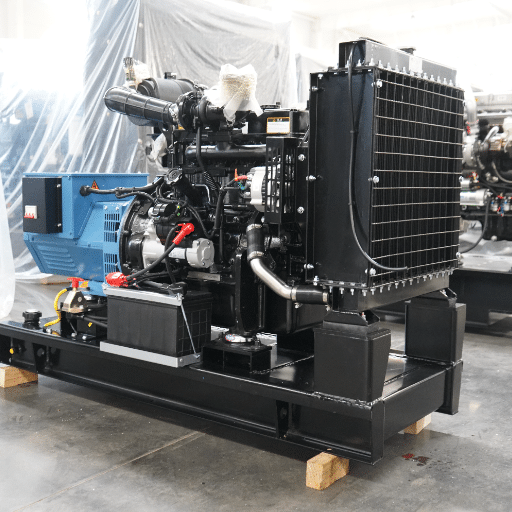


A generator coolant temperature alarm is not one device. It is at least two: an analog sender that reads temperature and can drift, and a switch that trips at a fixed point and cannot. Which one fired decides whether you spend the afternoon on the engine or on the wiring.
Most operators never make that distinction. The alarm says high coolant temperature, so the engine must be hot. Usually it is. But an alarm is a claim made by an instrument, and instruments fail in ways engines do not.
This article covers that layer: the devices that measure, the logic that decides, and the cases where the alarm is wrong. We build these systems into large industrial sets at Shandong Huali. For the reasons an engine genuinely overheats, our guide to generator overheating causes covers that ground in ranked order.
Key Takeaways
- A coolant temperature circuit usually holds two separate devices: an analog sender that drives the reading, and a switch that trips the alarm. A sender can drift and lie; a switch cannot.
- High coolant temperature has three possible actions, not one: a warning that lets the set run on, an electrical trip that sheds load first, and an immediate shutdown.
- A low coolant level fault is a different device again, mounted in the radiator. A controller delay exists so slosh and momentary drops do not stop the set.
- NFPA 110 requires a low water temperature alarm on Level 1 and Level 2 systems, and it monitors the block heater. It is the one coolant alarm that fires when the engine is cold.
- Alarms lie for four reasons: drift, open circuit, short circuit, and air at the probe. An infrared reading separates the instrument from the engine.
What Sits Behind a Generator Coolant Temperature Alarm: Switch, Sender, or Both

Start with the device, because the device determines what the alarm can tell you.
A temperature sender is analog. Inside is typically an NTC thermistor, a resistor whose resistance falls as temperature rises. The controller reads that resistance and converts it into a number. Because the output is continuous, the sender can report any temperature, including a wrong one.
A temperature switch is discrete. A bimetal disc snaps at a set temperature, closing or opening a contact. There’s no middle ground and no reading. It has tripped or it hasn’t.
That difference is the whole article in miniature. A sender that drifts by 10°C produces a plausible-looking number that is simply untrue. A switch that drifts doesn’t exist. It works, or it fails completely.
| Property | Sender | Switch | Combined unit |
|---|---|---|---|
| Output | Analog, variable resistance | On/off trip point | Both, on separate outputs |
| Typical device | NTC thermistor | Bimetal snap disc | Sender plus fault-limit switch |
| What it feeds | Gauge reading and controller display | Warning lamp, buzzer, shutdown relay | Reading plus protection |
| Wiring | Often one wire, grounded through the block | Two wires | Two or more |
| Failure mode | Drifts, then reports a plausible wrong number | Sticks open or closed, no middle ground | Either, depending on the output |
| How to check it | Compare against an infrared reading | Test the trip point directly | Test each output separately |
Older sets often used both devices side by side: a sender for the gauge, a separate switch for the overheat lamp. Modern controllers frequently combine them into one body with two outputs, so a single part number can produce both a reading and a hard trip. Enovation Controls publishes a sender and fault-limit switch in one housing built for exactly that two-stage role.
So when a coolant alarm fires, ask which device raised it. If the reading moved progressively and sits at a believable number, suspect the sender. If the alarm appeared instantly at a fixed point, that is a switch doing its job.
Specifying protection for a new set? We configure controllers against engine documentation and site conditions rather than a template. Talk to our engineering team →
High Coolant Temperature Is Three Actions, Not One

Most operators describe the outcome as “it shuts down.” Controllers do not work that way, and the difference decides how much margin you have.
On DSE-class controllers and their equivalents, a coolant temperature threshold can be configured to trigger one of three actions:
- Pre-alarm. The alarm annunciates and the set keeps running. It clears when temperature falls back below the setting.
- Electrical trip. The controller opens the load switch first, then runs a cooling timer before stopping the engine. The set sheds load and cools unloaded rather than stopping hot.
- Shutdown. The engine stops immediately. No cooling timer, no staged transfer.
Same sensor, same overshoot, three different physical events. An electrical trip is gentler than a shutdown, because the turbocharger and liners are not left holding residual heat under load. A pre-alarm is not a fault at all yet; it is notice that you have entered the band worth watching.
Thresholds Are Configured, Not Universal
The setpoints are values in the controller’s configuration file, editable through the manufacturer’s software or, on some modules, from the panel. A coolant temperature alarm threshold is not a fixed property of a generator.
Which is why we do not print a universal ladder here. Published OEM values differ, sometimes by 10°C or more between engine families, and the correct figures for your set are in its engine documentation. Our generator overheating causes guide covers where the warning and shutdown bands typically fall.
What matters at this layer is the relationship between the numbers. A warning set too close to a trip produces nuisance alarms on hot days. A trip set too close to normal running temperature produces shutdowns on ordinary load steps.
The tempting response to a nuisance alarm is to switch the protection off. That converts an annoying generator into an unprotected one. Find out why the alarm fires, then adjust the threshold or its delay.
The Low Coolant Level Shutdown
A low coolant level alarm is a different device from everything above, and it fails differently.
The level probe mounts in the radiator, typically the upper tank or near the filler neck, with its tip submerged in coolant. The controller looks for the probe’s signal voltage to pull low when liquid surrounds a clean tip. When the level drops and the tip is exposed, that path breaks, the voltage goes high, and the fault registers.
Note what the probe measures. It isn’t reading temperature at all, which is why a low coolant level fault can appear on a set nowhere near hot. It’s often the first sign of a slow leak.
The Same Lamp, Two Different Faults
On some common panel designs the coolant lamp is not dedicated to one fault. A steady light means high coolant temperature; a flashing light means low coolant level. Same lamp, same colour, two different problems with two different responses. Confirm which indication you are looking at before diagnosing either. Our generator control panel functions guide covers the rest of the annunciation set.
The Delay That Stops Slosh From Tripping the Set
A probe in a radiator has a problem: coolant moves. Load changes and vibration shift liquid around, and a probe tip can be briefly exposed without anything being wrong.
Controllers handle this with a delay. The engine control module on units such as the Wacker Neuson mobile generator range runs a roughly 10-second timer before acting on a low coolant signal, to prevent nuisance shutdowns. If the level recovers inside that window, nothing happens.
A fault that logs and clears repeatedly is usually a marginal level or an intermittent connection rather than real coolant loss.
“The Radiator Is Full, but It Says Low Coolant”
This is the most common version of the question, and the answer is usually air.
After a top-up or a drain, air can remain trapped in the system. If that air collects at the probe, the tip sits in vapour instead of liquid. The probe behaves exactly as designed and reports no coolant, because where it is standing, there is none.
The fix is proper bleeding: fill slowly, open the bleed point at the thermostat housing or the highest point in the system, and keep filling until coolant runs out with no bubbles. The same symptom also appears when the probe is dirty, since a fouled tip can fail to conduct even when submerged. Cleaning it comes before condemning it.
The Alarm That Fires When Nothing Is Running

Some generator coolant temperature alarms fire when the engine is cold, stopped, and in no danger of overheating at all. It isn’t a fault in the alarm. It’s a different alarm doing what it was installed to do.
NFPA 110 and the Low Water Temperature Alarm
NFPA 110, the standard covering emergency and standby power systems, lists low water temperature as a safety indication, which is why installations following it carry a low water temperature alarm (often labelled a low coolant temperature alarm).
Its purpose is not to protect the engine from heat. It monitors the block heater. On a standby set, a failed heater is invisible until the moment you need the generator, at which point a cold engine is slow to start and slow to accept load. The alarm setpoint typically sits around 20°F (11°C) below the manufacturer’s regulated temperature, so a heater losing ground raises an alarm well before it costs you a transfer.
The requirement scales with climate. NFPA 110 calls for coolant heaters on Level 1 systems unless the generator room ambient never falls below 70°F (21°C). Where ambient can reach 40°F (4°C), the heater must hold the block at not less than 90°F (32°C). Below 32°F (0°C) ambient, battery heaters are required too.
Why This Alarm Is Worth Taking Seriously
A low water temperature alarm is easy to dismiss. Nothing is hot and the set may not even be running. Operators log it and move on.
That’s the mistake. The alarm is the only notice you get that preheat has failed, and the consequence is deferred, not avoided. The next outage is when you find out.
Halvard maintains a district heating plant in Norway where a low water temperature alarm appeared on a stopped set in February. Nothing looked wrong. The engine was simply cold, as an idle engine is. The block heater had failed silently, and the alarm was the only evidence. It surfaced at the next outage as a start far slower than the site’s transfer window allowed.
Treat it as a preheat fault, not a false alarm. Our guide to the generator block heater covers sizing, setpoints, and the preheat bands in full.
When a Generator Coolant Temperature Alarm Is Wrong

Coolant alarms fail for four reasons. Knowing which one you have is most of the diagnosis.
| Failure | What the controller sees | What it usually is |
|---|---|---|
| Drift | A plausible reading, wrong by several degrees | An aged sensor; compare it against an infrared reading |
| Open circuit | Signal out of range, or an alarm on a disconnected sensor | Broken wire, loose connector, failed sensor |
| Short circuit | Reading pinned at one extreme and never moving | Chafed loom, crushed cable, moisture in a connector |
| Air at the probe | A reading that follows the steam, not the coolant | Trapped air after a drain and refill |
Drift: The Plausible Lie
A drifting sender produces a reading that looks reasonable and is wrong. It’s the hardest failure to spot: nothing about the number announces itself as false.
Tomasz, a maintenance lead at a plant in Poland, spent two days chasing a high coolant alarm on a 500 kW standby set. Coolant, thermostat, and cap all came out and were replaced. None of it helped. The sender had drifted. The switch, the device that would actually have stopped the engine, had never been touched and was fine.
The defence is a second opinion. An infrared thermometer aimed at the thermostat housing or coolant outlet gives you an independent temperature. If the panel and the infrared reading disagree by more than a few degrees, you have a sender problem. Not an engine problem.
Open and Short: Signals Outside the Range
A disconnected sender, a broken wire, or a failed connector produces a signal outside the range the controller expects for any real temperature. Many modules alarm on a disconnected sensor rather than displaying zero, because a missing signal is itself a fault that should not pass silently. On J1939-equipped engines this typically surfaces as a signal fault family distinguishing erratic signal, voltage above normal, and voltage below normal.
The opposite failure, a short, drives the reading to one extreme and holds it there. A reading pinned at maximum with a cold engine is a circuit fault. So is a reading that never moves at all while the set runs, since real coolant temperature responds to load.
Before replacing a sensor, check the circuit around it. Loose or corroded connectors, chafed loom, and control wires routed alongside power cables all produce erratic readings that look like sensor faults. The ground path deserves particular attention, because a sender that grounds through the engine block depends on that connection being sound. Published diagnostic guidance notes that replaced coolant sensors frequently turn out to have been wiring faults.
Air at the Probe
Air causes false readings at the coolant temperature sensor just as it does at the level probe. A sensor sitting in steam reads the temperature of the steam, not the coolant, and the coolant may be considerably cooler. The alarm can be entirely correct about what the sensor is touching while being completely wrong about the engine. If a high temperature alarm appeared shortly after a drain and refill, suspect air before you suspect the engine.
One Test That Separates Them
For a single decisive check, disconnect the sender and substitute a fixed resistor matching a known temperature. The controller should display that temperature. If it does, the controller, wiring, and configuration are sound and the sender is your suspect. If it does not, the fault is downstream of the sensor. This splits the system in one step, with no tooling beyond a resistor of known value.
Frequently Asked Questions
What is the difference between a coolant temperature sender and a coolant temperature switch?
A sender is analog and reports an actual temperature, usually through an NTC thermistor whose resistance falls as heat rises. A switch is discrete: a bimetal disc snaps at a fixed temperature and makes or breaks a contact. The practical difference is failure. A sender can drift and report a plausible wrong number. A switch cannot drift; it works or fails completely. Many modern sets carry both in one housing.
Why does my generator alarm on low coolant when the radiator is full?
Usually air trapped in the cooling system after a top-up, collecting at the probe so the tip sits in vapour instead of liquid. Bleed the system at its highest point and refill slowly; our generator cooling system maintenance guide covers the full procedure. If it is genuinely full and correctly bled, check the probe: a fouled tip can fail to conduct even when submerged, and a probe reading high resistance at any level has failed.
Can a bad coolant sensor cause a false high temperature alarm?
Yes, and it is expensive to misdiagnose, because it sends you into the cooling system after a problem that is not there. A drifted sender reports a plausible but wrong temperature. Compare the panel reading against an infrared thermometer at the coolant outlet; a disagreement of more than a few degrees points at the sender.
Why does my generator show a low coolant temperature alarm when the engine is cold?
Because that alarm is not about overheating. It monitors the block heater on a standby set and fires when coolant falls too far below the manufacturer’s regulated temperature. NFPA 110 lists low water temperature as a safety indication for that reason. Treat it as a preheat fault: a failed heater stays invisible until the moment you need the set.
Can I keep running with the coolant temperature alarm on?
It depends which action the controller took. A pre-alarm is designed to let the set run while you investigate, and it clears itself when temperature falls back. If the controller tripped the load switch or stopped the engine, the protection has done its job and the cause needs finding before you restart. Never disable protection to keep a set running.
How do I reset a high coolant temperature alarm?
A pre-alarm clears on its own when temperature returns below the setting, so there is nothing to reset. A trip or shutdown latches and must be cleared at the controller, and the sequence varies by module, so check its manual. Clear it only after the cause is addressed. Resetting a latched shutdown without finding out why it happened is how the same fault returns under load.
Conclusion
A generator coolant temperature alarm is a claim made by an instrument, and instruments fail in ways engines do not. Four things are worth taking away.
- Two devices, two meanings. A sender reads and can drift; a switch trips and cannot. Ask which one fired before you start diagnosing.
- Three possible actions. A warning, an electrical trip, or a shutdown. Same threshold, very different consequences for the engine.
- Low coolant level is a different device. It measures level, not temperature, and a delay keeps slosh from stopping the set.
- A cold-engine alarm is not a false alarm. It monitors the block heater, and it is the only warning you get before an outage finds the failure for you.
The pattern to remember is that a coolant alarm can be right about the sensor and wrong about the engine. Separating those two possibilities early turns a week of unnecessary work into an afternoon. Our generator cooling system pillar covers the circuit end to end.
If you are specifying protection for a new set, or trying to make sense of an alarm that keeps coming back, tell us the fault and the controller you are running. Talk to our engineering team → and we will help you work out whether to look at the engine or the instrument.