

Choose a data center natural gas generator by its operating duty and the loads it must accept, then confirm its output at your site. A standby proposal, a prime-power plant and a generator paired with battery storage answer different questions.
If you’re comparing bids with the same nominal kW, check what each bid assumes. One may cover outages only; another may support planned daily generation. This guide explains how to compare those duties, prepare a load schedule and assess battery support without confusing spare capacity with uninterrupted supply.
Key takeaways
- Match the named generator rating to the planned operating schedule.
- Size running capacity and test load-step behavior as separate decisions.
- Define battery power, usable energy and reserve alongside UPS continuity.
- Verify gas supply dependencies, permissions and coordinated acceptance tests.
Choose data center natural gas generator duty first
Start a data center natural gas generator specification with the operating role. State whether the plant covers grid failures, supplies planned daily energy or shares power with other sources. Then ask the manufacturer to identify the rating and its application conditions. Caterpillar’s generator rating explanation distinguishes ratings by operating conditions; the largest nameplate number alone doesn’t establish suitability.
| Intended role | Describe in the inquiry | Evidence to request |
|---|---|---|
| Standby backup | Outage duty, expected load and restoration sequence | Applicable standby rating and load-acceptance data |
| Prime supply | Planned operating hours and changing demand | Prime-duty approval and load-profile conditions |
| Continuous supply | Sustained operating load and service plan | Applicable continuous rating and maintenance basis |
| Grid-parallel or hybrid operation | Dispatch, import/export and islanding intentions | Utility permissions, protection study and controls scope |
Standby service includes a continuity handoff
For a backup data center natural gas generator, describe the gap between loss of grid power and stable engine supply. An uninterruptible power supply (UPS) keeps the protected load supplied while the generating system starts and takes load.
Ask what each quoted time means. Does it end when the engine starts, when sources synchronize or when the set accepts load? Those are different events.
The Caterpillar standby gas white paper discusses application-specific load acceptance. Use it to frame questions, rather than importing its historical costs or assuming every gas engine has the same response.
Preparing an equipment inquiry? Contact us with the intended duty, load schedule and site conditions. Identify unresolved design inputs so a quotation can state its assumptions.
Prime power needs its own operating basis
Illustrative scenario: a developer receives a standby quotation, then considers daily behind-the-meter generation. For that data center natural gas generator, request a new duty assessment, operating-hour profile and permit basis. The original price and kW rating don’t establish that the data center natural gas generator can perform the new role.
Prime power is a real procurement direction, but announcements need careful reading. In its June 16, 2026 Circe Energy announcement, Cummins described a Texas data-center prime-power agreement. Deliveries were scheduled for 2026 through 2030, with phased energization planned from 2027. Those dates describe a plan, not verified operation.
For a broader explanation of duty terminology, use our standby versus prime power comparison. Keep the manufacturer’s rating sheet for the data center natural gas generator with the proposal.

Size a data center natural gas generator from the load sequence
A data center natural gas generator must cover the required steady load and the specified load changes. Don’t approve capacity from IT demand alone. Include the cooling, pumps, controls and other equipment that will actually connect to the generator bus.
Build a load schedule with a clear measurement boundary
Record where you measure each load. Does that figure already include losses? The Green Grid defines PUE as total facility energy divided by ICT equipment energy.
PUE helps describe energy use. It doesn’t tell you how the plant will handle a sudden load step. If you use PUE to scale an IT load, don’t add the same cooling demand and power losses again.
| Load input | What the buyer should provide | Why it changes selection |
|---|---|---|
| IT and UPS input | Running kW, kVA, power factor and operating mode | Defines demand seen by the source |
| Cooling and auxiliaries | Equipment list, simultaneous demand and starts | Identifies coincident running and starting loads |
| Recovery sequence | Transfer order, UPS recharge and staged restart | Defines the load applied after an outage |
| Site conditions | Temperature, altitude and installation constraints | Enables model-specific output assessment |
| Expansion stages | Loads and dates for each capacity phase | Separates today’s requirement from future provision |
For the data center natural gas generator, state voltage and frequency as well as kW. Ask the supplier to show the proposed output at the declared site conditions. A standard ambient rating does not answer a site-specific capacity question. Our natural gas generator sizing guide provides further load-list preparation.
Treat load steps as a separate acceptance question
What happens when cooling restarts while the UPS begins recharging? Request a sequence showing the initial load, each added block and the time between blocks. Include allowable voltage and frequency changes and recovery times agreed with the equipment designers.
Cummins’ transient-performance overview explains why load characteristics and how loads are applied matter. Ask for the proposed data center natural gas generator’s simulation and test basis. A steady-state total doesn’t establish acceptable transient behavior.
Keep data center natural gas generator growth allowances explicit. Identify reserved switchgear capacity, future machines and the loads that exist at each stage. Avoid multiplying several generic margins without explaining what each covers. Caterpillar’s genset sizing resource is a useful starting point; final selection still needs application validation.
Check unit count without overstating redundancy
Illustrative calculation: assume required demand is 14 MW and each identical unit supplies 2 MW at site conditions. Seven units meet that demand. Adding one equal spare gives eight units and 16 MW installed capacity. If one unit is unavailable, the remaining seven provide the assumed 14 MW.
This calculation assumes the other equipment and power paths remain available. It doesn’t test a bus fault, loss of fuel or isolation for service. It doesn’t prove Tier certification.
Uptime Institute’s certification definitions distinguish concurrent maintainability and fault tolerance. These concern the whole system. Have the project designer review its layout and failure paths; don’t assign a Tier from N+1 notation.

Integrate BESS around AI load swings and UPS continuity
When pairing a data center natural gas generator with a battery energy storage system (BESS), define each job. What supplies energy? The generator does, under its approved duty.
What supports a sudden load change? The battery may do that, within its power and reserve limits. The UPS and power distribution must meet the site’s need for supply without a break.
Ask how these parts work together. Buying them doesn’t prove that the whole system meets the design needs.
Specify power, energy and minimum reserve
Start with a load profile over time. How large is the change? How fast does it occur, and how long does it last?
Ask the battery designer for charge and discharge power in MW and usable energy in MWh. State the allowed state-of-charge range for that event. Nominal energy alone doesn’t tell you the available response power.
The data center natural gas generator study should include battery recharge as a load. Specify whether recharge is delayed or limited after an outage and who controls that limit. Ask how battery degradation, temperature and equipment availability affect the usable reserve; don’t assume a new battery’s nominal capacity remains available for every purpose.
Illustrative scenario: a battery has already discharged for planned dispatch when an AI load swing occurs. The review question is whether the remaining reserve can support the required event. Ask the designer to document the minimum allowed state of charge and what happens when that threshold is reached. This is a design question, not a claim of a successful installation.
Make the controls handoff visible
Request a written control sequence. Include the generator controller, UPS, power conversion system (PCS) and energy management system (EMS). Use a responsibility table to expose gaps before the interfaces are fixed.
| Control question | Required answer in the design |
|---|---|
| Who sets the power command? | Name the device and the limit it follows |
| Who protects battery reserve? | Name the reserve rule and override conditions |
| Who starts load shedding? | State the trigger and order of loads |
| What if a control link fails? | Describe the fallback state and alarms |
| What if one asset is out of service? | Show which loads and modes remain supported |
For a data center natural gas generator operating in parallel with the grid, add islanding, reconnection and export restrictions to the study. Confirm protection responsibilities and utility approval. For broader facility context, see our data-center generator guide.
Before selecting a hybrid package, request a coordinated study of the generator, UPS, PCS and EMS. Ask it to cover the least available battery reserve, recharge demand and a credible unavailable-asset condition. Compare the study assumptions with the equipment actually quoted.
What the dated announcements establish
On August 18, 2026, Cummins announced a BESS selection for a US data-center project, citing AI-driven load variation, oscillations and ride-through needs. Separately, Caterpillar announced on January 28, 2026 an AIP/Boyd CAT alliance involving an initial 2 GW gas-generator order paired with BESS. Its announced delivery window was September 2026 through August 2027.
These examples explain why battery coordination belongs in the buying discussion. They don’t verify commissioning, delivery progress, savings or Huali integration capabilities. A data center natural gas generator proposal still needs its own system evidence.
For a manufacturer discussion of storage and controls, watch Cummins’ Smarter systems for a changing grid, published September 14, 2026. Its integration discussion is background, not approval of a project design.
Check gas supply, emissions and installation constraints
Pipeline access is a starting point for a data center natural gas generator, not a guarantee of indefinite runtime. Ask the gas supplier to confirm contracted capacity, fuel quality and minimum dynamic pressure at the equipment inlet. Include simultaneous demand from the rest of the site and other connected generating units.
Two connections also need a dependency review. Do they share an upstream regulator, pipeline or electrically powered support system? Identify the credible outage conditions and the evidence supporting the proposed fuel arrangement. Any alternate-fuel or storage proposal needs its own feasibility assessment, permissions and logistics plan.
Compare fuel options with the same project inputs
| Decision | Gas proposal evidence | Diesel alternative evidence |
|---|---|---|
| Fuel resilience | Supply agreement, dynamic pressure and upstream dependencies | Usable inventory, replenishment route and delivery constraints |
| Operating permission | Intended duty and applicable emissions assessment | Intended duty and applicable emissions assessment |
| Site fit | Gas train, ventilation, exhaust and service access | Storage, containment, ventilation, exhaust and service access |
| Lifecycle cost | Fuel-use data and tariff assumptions for the duty | Fuel-use data and delivered-fuel assumptions for the duty |
Use our gas versus diesel comparison for further questions. Choose from documented site conditions rather than a universal fuel winner.
For a US project, start with the EPA stationary-engine rule overview. It doesn’t grant permission to install an engine. Ask the relevant authority and project specialists which rules apply to the engine, duty and location. Other countries need their own review.
Complete the data center natural gas generator site review with acoustic limits, exhaust routing, ventilation, fire requirements and maintenance access. The natural gas generator installation guide can help prepare questions, while the project engineer defines the actual design.

Validate commissioning, maintenance and lifecycle assumptions
A successful no-load start proves less than the full operating sequence required from a data center natural gas generator. Before ordering, agree what must be demonstrated, which instruments will record it and who accepts the result. Use the same data center natural gas generator load assumptions in the quotation, design study and test plan.
Ask for evidence of the coordinated sequence
Request test procedures for startup, transfer, staged load acceptance and UPS recharge. Where BESS is included, specify the reserve condition and dispatch mode used during the test. Include the agreed failure cases, such as a generating unit unavailable or loss of a control communication link.
Record the initial conditions, measured voltage/frequency behavior, recovery and deviations from acceptance limits. A report should let the reviewer compare results with agreed criteria, not just confirm that equipment ran. Cummins’ data-center application resources discuss integration testing as part of a system approach; the actual contract must define your deliverables.
Base service and cost on the operating profile
For the data center natural gas generator maintenance plan, request the actual OEM schedule, applicable fuel-quality requirements and service scope. Keep running hours, starts, alarms and work records. Don’t substitute a generic annual interval for the model’s instructions. Use our natural gas generator maintenance guide to organize the discussion, then reconcile it with those instructions.
Compare costs over the same study period and at the same load and running hours. Include equipment, site work, fuel, tariffs and routine service. State when an overhaul is assumed and which outage limits affect operation. For a hybrid proposal, add battery replacement assumptions and recharge energy. The commercial gas generator cost guide offers a cost-planning checklist; request project quotations rather than treating general figures as a budget.
If heat recovery is proposed, commission a separate feasibility study of the usable heat demand and equipment arrangement. Our industrial CHP cogeneration guide is optional further reading. Don’t credit heat savings in the financial case before establishing a use for that heat.
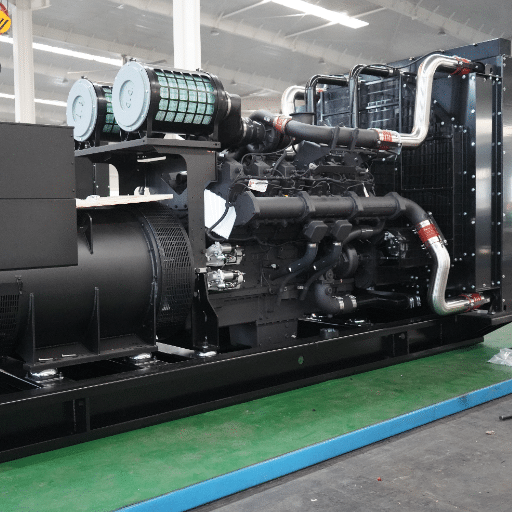
Resolve common data center natural gas generator questions
Can a standby-rated set be used for prime duty?
Only where the manufacturer documents an applicable rating and approves the proposed duty, and the project has the required operating permissions. State expected hours and demand rather than asking whether a standby unit can simply run longer. A data center natural gas generator needs an operating basis matched to the application.
Does N+1 prove Tier III?
No. It describes a capacity arrangement under stated assumptions. It doesn’t demonstrate concurrent maintainability across distribution, controls and supporting systems. In the earlier illustrative example, eight units satisfy the assumed spare-count arithmetic; the calculation does not certify the facility.
Can BESS replace the UPS?
Don’t assume equivalence. Ask the designers to demonstrate the required interruption tolerance, transfer behavior, protection and available reserve. A battery selected for energy dispatch may have a different duty from the UPS. Judge the complete continuity design, including behavior when an asset is unavailable.
Does pipeline gas mean unlimited runtime?
No. Continued supply depends on the contracted service, upstream network, dynamic pressure, fuel quality and credible failure conditions. The data center natural gas generator also remains subject to its duty rating, maintenance needs and operating permissions.
What information should buyers send first?
Send location, voltage, frequency, duty, operating hours, load sequence and expansion phases. Add gas data, UPS recharge settings and the required continuity outcome. If battery storage is proposed, state its intended job and reserve requirement. Flag unknowns so the parties can assign responsibility for resolving them.

Prepare your project inquiry
A data center natural gas generator selection starts with duty and load behavior, then connects fuel resilience, continuity and validation. Keep these decisions linked: a change from outage backup to daily generation should trigger a review of ratings, permissions, service and costs.
Before comparing final bids, prepare one inquiry pack:
- Duty: outage backup, daily prime supply or another defined role.
- Load: running demand, load steps, UPS recharge and growth phases.
- Site: location, voltage, frequency and local conditions.
- Fuel: gas quality, dynamic pressure and supply dependencies.
- Proof: required studies, test limits and acceptance records.
Assign the UPS/BESS study, utility interface and permit work to named parties. Ask each bidder to list exclusions and unknowns against this same pack.
Contact us to discuss your project requirements with this project information. Include the intended duty, voltage/frequency, load sequence, gas data and documentation needed for review. A clear inquiry helps make the proposed data center natural gas generator and its design boundaries easier to compare.